Affirm's AI approves shoppers FICO can't see, yet no one can explains its rules yet.
Affirm's transformer underwriter went live 17 September, approving thin-file and no-FICO shoppers at checkout. If its "comparable risk" claim holds, it monetizes borrowers a 1989 score marks invisible; if not, the losses land on Affirm's own book while its bank-charter application waits on the FDIC.
 Vincent Jiang · 3 min read
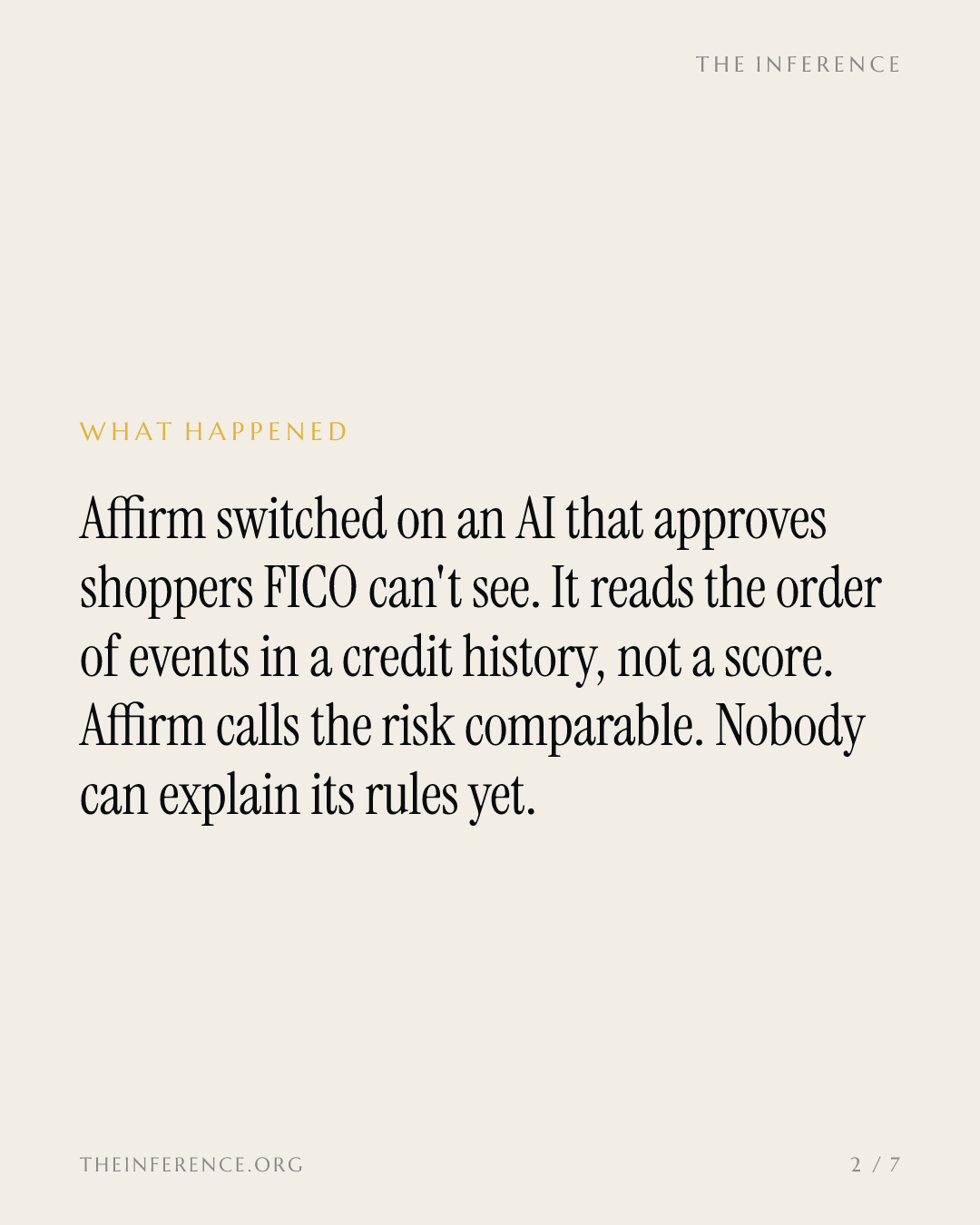
On 17 September, Affirm switched on a new brain at U.S. checkout: a transformer model, built on 14 years of transaction-level data, that reads the order and timing of events in a credit history instead of the summary a three-digit score captures 14. Its first job is approving shoppers the old system would have declined, thin files and no-FICO borrowers included 1.
A wider funnel, at what the company calls comparable risk
Affirm says the model produced 3.4% more completed purchases than a control group, at comparable risk, with the extra loans performing better than a similar expansion under earlier models 14. The result is company-reported and unaudited, and the loss metrics and borrower mix behind it are unpublished 2.
Investors priced it anyway. The stock rose 5.5% premarket on announcement day 29, and Mizuho analyst Dan Dolev has floated over $10 in GAAP earnings per share by 2030, roughly double consensus and above management's own $3-to-$4 target, in a scenario that puts the stock above $200 7.
The rulebook is a patchwork
The approval layer went live before any public rulebook could explain it. The CFPB said on 6 May 2025 it would not prioritize enforcement of its 2024 rule treating BNPL lenders like card issuers, and is contemplating rescinding it 5. Affirm furnishes repayment data to all three national bureaus; Klarna and Afterpay do not report routine on-time payments 3. Same payment record, two different credit futures, decided by which checkout button you tapped.
Senators Warren, Blumenthal, Duckworth and Hirono demanded bureau answers by 18 May; none has been released publicly 3. FICO says a yearlong study with Affirm found its new model moved most scores fewer than 10 points, but it covered only the one lender furnishing data voluntarily 3. The same firm, whose 1989 score is used by 90% of top U.S. lenders 8, ships BNPL-inclusive models to lenders this fall 3.
The losses would land at home
The machine is being asked to widen a funnel that already runs hot. Revenue has grown at least 29% year over year for ten straight quarters 6, and fiscal fourth-quarter GMV rose 36% to $14.1 billion on 53 million transactions, up 41%, at an average order value that fell 4% 12.
Revenue has grown at least 29% year over year for ten straight quarters
Data
| Quarterly revenue | |
|---|---|
| Q1 '24 | $0.58B |
| Q2 '24 | $0.66B |
| Q3 '24 | $0.7B |
| Q4 '24 | $0.87B |
| Q1 '25 | $0.78B |
| Q2 '25 | $0.88B |
| Q3 '25 | $0.93B |
| Q4 '25 | $1.12B |
| Q1 '26 | $1.04B |
| Q2 '26 | $1.17B |
Levchin's own guardrail for the machine: "a human decides what's worth looking at, what's not worth looking at" 4. If the risk math breaks, losses land on Affirm's own book while its Nevada industrial-bank application, filed 23 January, waits on the FDIC 2, and card delinquencies sit at a 15-year high 3.
The borrower-side loss lands either way. About 15% of U.S. adults used BNPL in the past year, Federal Reserve data shows, and usage skews toward borrowers with limited credit access 3. A Klarna shopper's flawless pay-in-four record never reaches the bureaus, so it cannot help at a mortgage or card desk; the first explanation of the new rules arrives as a denial letter or a higher rate 3.
If Affirm's math holds instead, it compounds on borrowers a 1989 score marks invisible 2. The first full credit cycle, the bureaus' answers and FICO's fall rollout will say which 3.
How this brief was made
01Gathered & sourced298 channels · 2,008 articles▾
Agents swept 298 channels and ingested 2,008 articles, then de-duplicated and ranked them for signal.
02Verified & cross-validated9 claims · 17 data feeds▾
Every one of 9 load-bearing claims was checked against primary sources, with 17 live data feeds reconciling the figures and charts.
- 1PYMNTS, "EXCLUSIVE: Affirm Rebuilds Underwriting to Approve Borrowers a Credit Score Can't See," 17 September 2026
- 2Startup Fortune, "Affirm's AI Now Approves Shoppers Banks Would Reject for Lacking a Score," September 2026
- 3247 Daily Info, "Buy Now, Pay Later Loans Are Quietly Reshaping Your Credit Score And Senators Say No One Can Explain the Rules," 17 September 2026
- 4Stocktwits via TradingView, "AFRM Stock Rises Overnight: Affirm CEO Says AI Won't Put Human Underwriters 'Out Of Business'," September 2026
- 5Consumer Financial Protection Bureau, "CFPB Announcement Regarding Enforcement Actions Related to Buy Now, Pay Later Loans," 6 May 2025
- 6Sharadar quarterly fundamentals, from Affirm's SEC filings, retrieved 23 September 2026
- 7Yahoo Finance (Investing.com), "Could Affirm be a $200 stock?," 17 September 2026
- 8FICO, "FICO Score" (company site), retrieved 23 September 2026
- 9CoinCentral, "Affirm (AFRM) Stock Jumps 5% After Launching AI Model for Loan Approvals," 17 September 2026
03Reviewed & edited2 human editors▾
2 editors read the draft against the evidence, tuned the framing, and signed off before it shipped.
Become a contributor
Reporting on the business of AI and want it read? We take pitches from outside contributors who bring primary sources and a number worth arguing about.
Deepdive
AI-generated from this story and its cited sources. Not investment advice.