AlphaSense's agents burn 54 trillion tokens a year; Cerebras posted 14.2% gross margins
The market-intelligence platform's agents now do 99% of its research and burn 54 trillion tokens a year, served in part by Cerebras hardware, the supplier it named in a joint post. Cerebras reports a 14% gross margin and just hit an all-time low days before earnings.
 Vincent Jiang · 3 min read
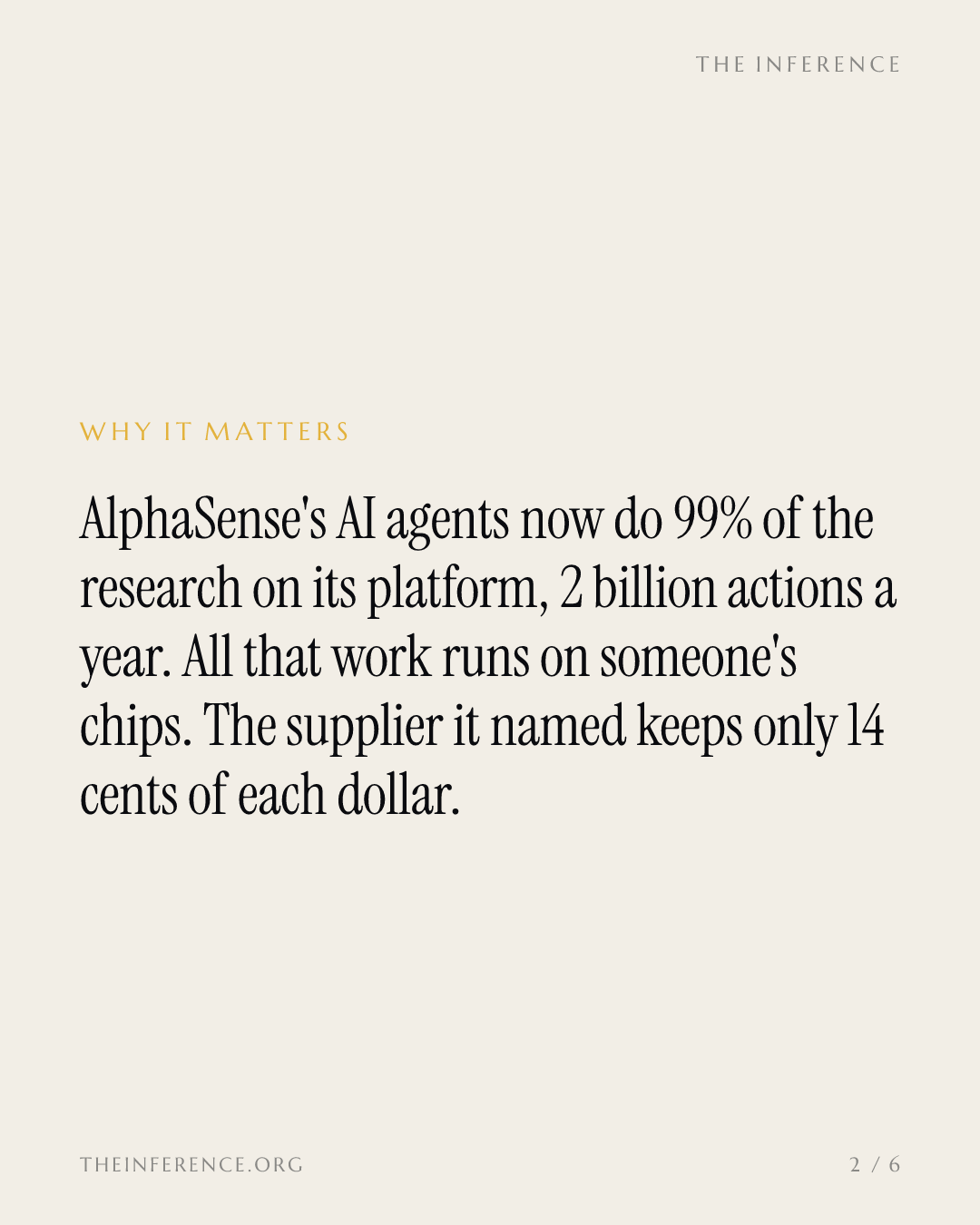
On October 6 AlphaSense~$4B — AlphaSense, private, latest valuation ~$4B, a private market-intelligence platform, put out numbers no human had asked for: its AI agents now perform 99% of all research activity on the platform, roughly 2 billion agent actions a year against 20 million human ones, and token consumption has reached an annualized run rate of 54 trillion, five times the level of early 2026 16. The company sells subscriptions to banks, and banks keep buying: more than 10,000 investment-banking users were added in the third quarter, segment ARR grew 75% year over year, and 18 of the world's 20 largest investment banks now use the platform 12. Read those two lines together and the tension is visible: the company sells seats to people, 10,000 more of them in a single quarter, while its own disclosure says agents, not people, do almost all the work, and every one of those agent actions consumes tokens someone must serve 16.
Every token is an inference call someone must serve
On September 30 AlphaSense and Cerebras Systems−11.13% — Cerebras Systems, down 11.13 percent today (CBRS) published a joint post naming the supplier: Cerebras hardware runs the same model 8.5 times faster, cuts the p90 time to first token by 88% from 19.5 seconds to 2.3 seconds, and lets the platform review three times as much evidence at no added latency 7. That is a real customer, at real scale, in a workload category (fast agentic inference) that Cerebras has built its pitch around. The joint post does not say what share of the 54-trillion-token volume Cerebras carries, only that it runs the agentic research.
The market priced the opposite
The listed supplier looks like it is losing money on the era it enables. Cerebras reported a 14.2% GAAP gross margin for the June quarter, down from 31.1% a year earlier, against roughly 75% claimed for Nvidia−1.59% — Nvidia, down 1.59 percent today 94. Its core gross margin, which excludes some costs, fell to 40.6%, and management guided the September quarter to 38-40%, calling it the trough 8. On October 16 the stock fell 10.5% to a new all-time low, more than 30% below its $185 IPO price and 67% below its May peak of $386 5.
The inference supplier earns a 14% gross margin against about 75% at Nvidia
- Gross margin (%)
- Estimate
Data
| Gross margin (%) | |
|---|---|
| Cerebras GAAP, Q2 2026 | 14.2 |
| Cerebras core (co. measure) | 40.6 |
| Nvidia, Q2 2026 (estimate) | 75 |
What the two disclosures allow, together
The arithmetic nobody has done: one enterprise customer's agentic workload, at 54 trillion tokens annualized and 2 billion agent actions, is precisely the demand a 14% gross-margin inference vendor needs but has not yet converted into profit 169. Size the customer against the supplier and the ceiling is low: AlphaSense's whole business, above $700 million of ARR by one tracker's estimate, a private figure 2, sits against a supplier with $25.4 billion of remaining performance obligations at June 30, much of it the OpenAI$1.18T — OpenAI, private, latest valuation $1.18T agreement, which recognized $56.8 million of revenue that quarter, though OpenAI could buy compute elsewhere 9. Even the entire AlphaSense workload on Cerebras hardware would be a few percent of near-term revenue at most, so the token run rate is a demand signal, not a revenue driver.
The verdict, and the dated test
The bear case says a 14% gross margin means inference demand does not pay, and investors have cut Cerebras accordingly 45. The bull case says the margin is a trough artifact: the company rented back systems to meet demand, and expects recovery as owned capacity replaces them 8. Neither camp has touched the AlphaSense token figures. The September-quarter earnings print, days away, reports the guided margin and settles whether the trough was as billed 8. Adoption evidence and margin doubt are both on the record; the print prices one of them.
Deepdive
AI-generated from this story and its cited sources. Not investment advice.