Ambience's KLAS validation put $37,500 a year on each ER doctor; $6.69 billion Abridge sells minutes
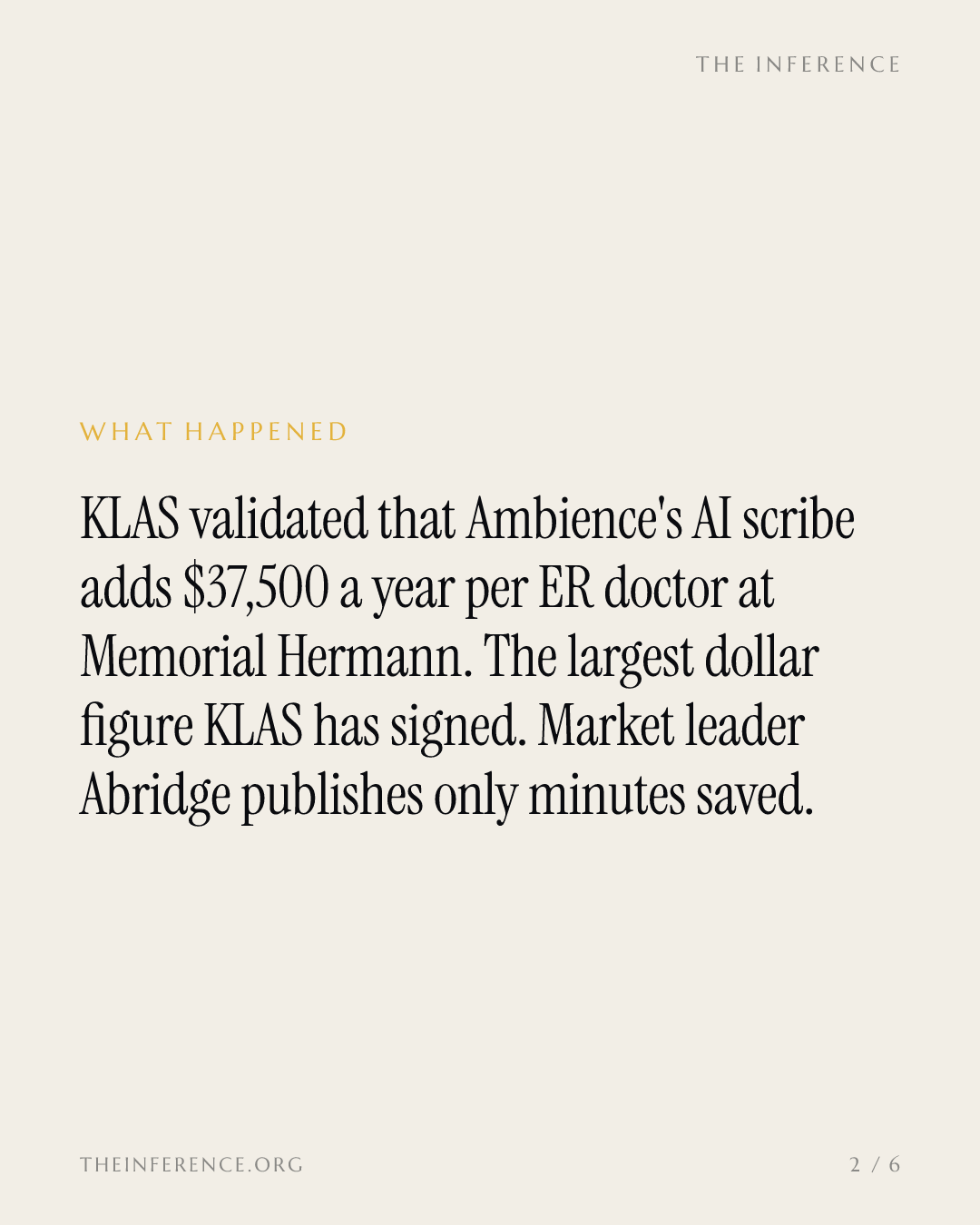
A KLAS validation published November 3 puts about $37,500 of extra annual productivity on each emergency physician at Memorial Hermann, the Houston-based health system, the largest per-provider dollar figure KLAS has validated to date. Abridge, marked at $6.69 billion, has published minutes saved per clinician-day and no validated dollars.
 Vincent Jiang · 3 min read

KLAS Research, the vendor-rating firm health systems hire to check technology claims, published a validation on November 3 built from interviews with Memorial Hermann Health System, the Houston-based health system whose clinicians were the ones measured, alongside clinician surveys, operational data and independent billing data 1.
The measured result for Ambience Healthcare~$1.25B — Ambience Healthcare, private, latest valuation ~$1.25B, the San Francisco AI documentation company founded in 2020: about $37,500 of additional annual productivity per emergency department physician, a 1.3% rise in work RVUs per encounter, and 1.7 more patient visits per physician in a 10-hour emergency shift against non-users 1. Physicians scored it a Net Promoter Score of 78, on 40 survey responses 1. The 15-month pilot of about 100 emergency physicians has grown into a deployment for more than 560 clinicians across ambulatory care and emergency medicine 1.
The receipt is the product
Ambience does not sell seats or tokens. Its partnership model, the Ambience Standard, puts contract fees at risk against each health system's own outcome targets 2, which makes a validated dollar figure the sales asset: a buyer can see the pool the fee is carved from.
This is not the first receipt in the market. KLAS had already validated dollar gains for Suki's ambient documentation at three health systems, finding a $1,004 monthly net gain per provider at McLeod Health, $2,629 counting coding uplift 3. Ambience's figure works out to about $3,125 a month, the larger of the two, and it is the largest per-provider dollar figure KLAS has validated to date 3.
The largest per-provider receipt KLAS has validated is Ambience's
Ambience's validated $37,500 tops Suki's coding-uplift figure of about $31,500 a year
Data
| Value | |
|---|---|
| Ambience: Memorial Hermann ED | $37,500/yr |
| Ambience: Onvida (company est.) | $24,000/yr |
| Suki: McLeod, coding uplift ($2,629/mo ×12) | $31,548/yr |
| Suki: McLeod net gain ($1,004/mo ×12) | $12,048/yr |
Part of the $37,500 is money the system may have left behind
The headline splits, and the split is the question a buyer needs answered. If the 1.3% gain in work RVUs, the Medicare units that measure physician work and set payment, reflects documentation capturing care it previously missed, that part becomes billings for the health system and, where physician pay is productivity-weighted, for the physician group.
The 1.7 extra visits per shift is different money, the same doctor seeing more patients, capacity a hospital can fill 1. The report measures the pilot period only, and the satisfaction score carries 40 responses 1. How the $37,500 splits between captured billing and added throughput, and who keeps each part, the validation does not say 1.
The $6.69 billion leader sells minutes, not dollars
Abridge$6.69B — Abridge, private, latest valuation $6.69B, the Pittsburgh company that leads this market, has the distribution: more than 300 health systems live, over 100 million clinical conversations a year, NVIDIA−3.10% — NVIDIA, down 3.10 percent today co-developing its foundation model and Eli Lilly+0.62% — Eli Lilly, up 0.62 percent today as a strategic investor 4. Its published evidence is minutes saved per clinician-day, and it has released no validated dollar figure.
Independent trials put its note-time saving at 22 minutes a clinician-day, and a Veterans Health Administration evaluation scored human note takers above 11 AI scribes in all five standardized cases 5. Its latest private mark is $6.69 billion, about five times Ambience's $1.25 billion 56. The vendor carrying five times the valuation has carried no comparable dollar receipt.
The market prices the scribe without a dollar receipt at five times the one with it
Abridge carries $6.69 billion against Ambience's $1.25 billion, with no dollar receipt
Data
| Valuation | |
|---|---|
| Abridge | $6.69B |
| Hippocratic AI | $1.65B |
| Ambience | $1.25B |
The VA ceiling is where receipts turn into revenue
The Department of Veterans Affairs structured its ambient scribe contract as a $775.72 million five-year ceiling shared across vendors, with Abridge and Knowtex as prime awardees; Knowtex reports live deployment in 310 VA clinics and 79 hospitals 78.
A VHA-funded study found AI-generated notes scored lower on quality than human-written ones, and the agency has not reconciled that with the rollout 7. Three things decide the next two years: the value of the first task orders under that ceiling, whether Ambience's number holds past a 100-physician pilot, and whether Abridge ever publishes a dollar figure 7. Vendors that prove a number take the revenue; the rest sell features.
Get Health by email, free
AI in medicine, pharma and biotech. In our daily email, every weekday.