Arm Can See $2 Billion of Demand for Its First Chip. It Commits to Half.
Rene Haas raised his confidence in the AGI CPU for the third time since March, and the stock jumped 8.57% on Thursday. The number that would settle it — shipped silicon — doesn't arrive until early 2027.
 Richard TangSeptember 18, 2026 · 4 min read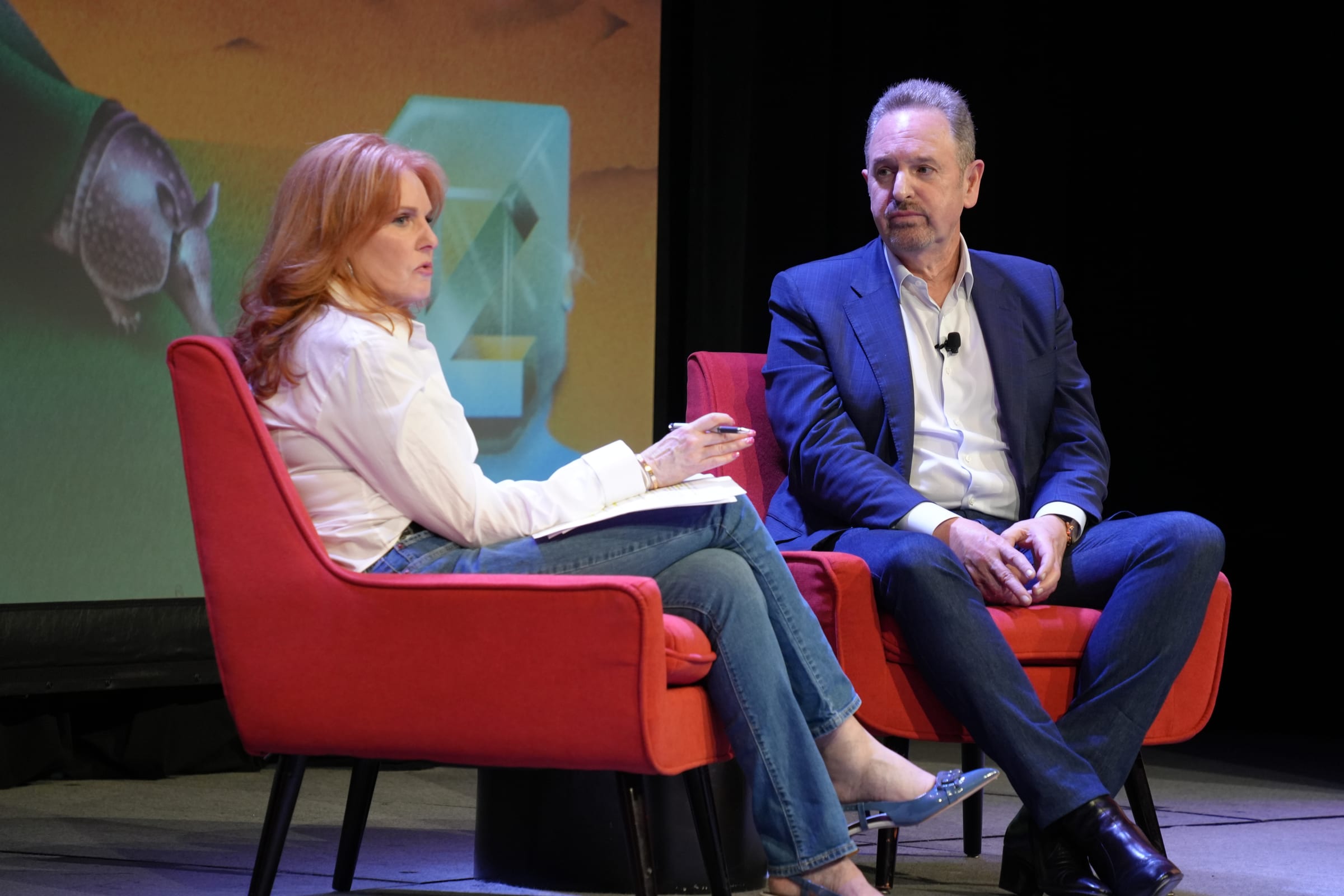
Wednesday night on CNBC's "Mad Money," Rene Haas was asked about the $2 billion of demand Arm says it can see for the AGI CPU, the company's first complete chip of its own. "We're feeling really good about it," he said, and then went further than before: "I'm more confident today than I was on that July earnings." 1 The stock rose 8.57% on Thursday, to about $265, after closing at $244 the day before 852 — still roughly 45% below its June high of $452 1.
What did not change this week is the number that matters: Arm's official revenue outlook for the chip is still $1 billion. It was $1 billion at the March launch, when Arm first outlined the opportunity. In May, management disclosed $2 billion of demand visibility and kept the outlook — the stock fell 10%. In July, it said demand "now exceeds $2 billion" and that capacity for the first $1 billion was secured; the stock rose more than 7% the next session. 13 September was the third repetition of the same disclosure: more confidence, same commitment.
Data
| AGI CPU demand vs commitment | |
|---|---|
| Launch figure (March) | $1B |
| Demand visibility (May) | $2B |
| Demand visibility (July) | $2B |
| Committed outlook (held) | $1B |
I read the sequence as a supply negotiation conducted in public — my interpretation, not a company statement. The gate Arm keeps describing is manufacturing: TSMC wafers, substrates, memory, test equipment, the list Haas gave on the July call and again this week, when he called demand "off the charts" and supply the constraint 36. CFO Jason Child expects the chain to stay tight through calendar 2027, loosening only as wafer and memory capacity, on current industry estimates, grows 70–100% into 2028 and 2029 3. Guiding $1 billion against $2 billion of visible demand is the honest arithmetic of a foundry-allocation problem, not a demand problem.
The royalty machine funding the bet
The reason a chief executive's adjective can move a quarter-trillion-dollar stock 5 is the business underneath it. In the quarter ended 30 June, Arm's revenue was $1.29 billion, up 22%. Royalties reached $715 million, up 22%, with data-center royalties more than doubling again; licensing hit a record $574 million; free cash flow was $665 million 3. Neoverse server cores passed 1.5 billion cumulative shipments — the last 500 million took nine months, the first billion took six years 3.
- Royalties$715M55.4%
- Licensing: other customers$381M29.6%
- Licensing: SoftBank$193M15%
Data
| Slice | Value | Share |
|---|---|---|
| Royalties | $715M | 55.4% |
| Licensing: other customers | $381M | 29.6% |
| Licensing: SoftBank | $193M | 15% |
That machine is now funding something new. For 35 years Arm licensed designs and let its partners carry the manufacturing risk 7; the AGI CPU moves the wafers, substrates and memory onto Arm's own ledger. One slice of the pie deserves a second look: $193 million of the $574 million licensing line came from SoftBank, which owns 86.4% of Arm 37. The controlling shareholder is also the largest named licensing customer — disclosed and legal, but worth weighing when you judge the quality of that revenue.
Selling against your own payers
The royalty line is paid by companies that build their own Arm-based server chips: Nvidia's Vera is in production, Google's Axion hosts its newest TPUs, AWS plans tens of millions of Graviton5 cores, Microsoft expanded Cobalt, Qualcomm is entering with Dragonfly. IDC, cited on the call, says spending on Arm-based accelerated servers has now passed x86 3. The AGI CPU sells into the same market. A Bank of America analyst put the tension to Haas directly on the July call — if Nvidia, Amazon and Google co-design their own CPUs with proprietary accelerators, doesn't Arm's CPU-only chip get squeezed? Haas answered with coexistence paths like Nvidia's NVLink Fusion 3. The launch customers suggest a complementary lane so far: Cerebras, OpenAI, Meta, Cloudflare and Oracle — companies that want Arm servers without designing their own 3.
The economics also invert. The licensing model ran at a 41% non-GAAP operating margin last quarter; first-generation chip gross margin is guided to the high-30s to low-40s percent, reaching 50% only after Arm brings in-house work an ASIC partner does today 3. And the strain with licensees is already in court: Qualcomm, Arm's largest licensee, goes to trial in the fourth quarter 5. None of this is fatal. But at 127 times forward earnings in mid-August 5, after a July in which the stock fell 34% when AI sentiment wobbled 4, the market is paying for a smooth landing.
When the adjectives run out
First shipments begin in the fiscal quarter ending March 2027 34. Child has promised a detailed revenue and margin picture at Q3 results, before shipping starts, and a separate silicon line once it passes 10% of revenue — expected in fiscal 2028 3. Against that timeline, the $2 billion pipeline (roughly 40% of Arm's $4.92 billion fiscal-2026 revenue 7) and the company's $15 billion 2031 CPU forecast 4 are statements of demand, not bookings.
What moves the needle most now is capacity secured and converted: every wafer Arm locks up between now and the new year turns directly into revenue. Haas's three-step confidence sequence is soft evidence that it is happening. The hard evidence arrives early next year, on one new line of the income statement. Trade the adjective if you like; I'd wait for the silicon.
How this brief was made
01Gathered & sourced283 channels · 1,561 articles▾
Agents swept 283 channels and ingested 1,561 articles, then de-duplicated and ranked them for signal.
02Verified & cross-validated8 claims · 35 data feeds▾
Every one of 8 load-bearing claims was checked against primary sources, with 35 live data feeds reconciling the figures and charts.
- 1CNBC, "Arm CEO says he's more confident its new AI chip can meet a loftier $2B revenue goal," 16 September 2026
- 2Yahoo Finance (TIKR), "Arm CEO Expresses Confidence in Data Center CPU Revenue Demand," 17 September 2026
- 3Arm (ARM) Q1 FY2027 earnings call transcript, call held 29 July 2026, published by Motley Fool Transcribing via Yahoo Finance on 7 August 2026
- 4The Motley Fool, "Why Arm Holdings Stock Lost 34% in July," 3 August 2026
- 524/7 Wall St., "ARM Stock: The $2 Billion AI Signal Investors Shouldn't Ignore," 18 August 2026
- 6Crypto Briefing, "Arm CEO Rene Haas cites strong demand amid chip supply constraints," 17 September 2026
- 7Wikipedia, "Arm Holdings" (financials as of 31 March 2026; parent SoftBank Group 86.4%, citing FY2026 Form 20-F), accessed 18 September 2026
- 8Yahoo Finance (Quartz), "Arm CEO Rene Haas more confident on $2 billion AI chip revenue target," 17 September 2026
03Reviewed & edited2 human editors▾
2 editors read the draft against the evidence, tuned the framing, and signed off before it shipped.
Become a contributor
Reporting on the business of AI and want it read? We take pitches from outside contributors who bring primary sources and a number worth arguing about.
Deepdive
AI-generated from this story and its cited sources. Not investment advice.