Deals

Bending Spoons Hunts Fallen Unicorns. Most of Its Growth Is Bought.

Bending Spoons' revenue grew 126% in Q2 2026. Organic growth was 3%. Miro is the next test of that acquisition model.

Vincent JiangVincent Jiangtwo-minute read
Share
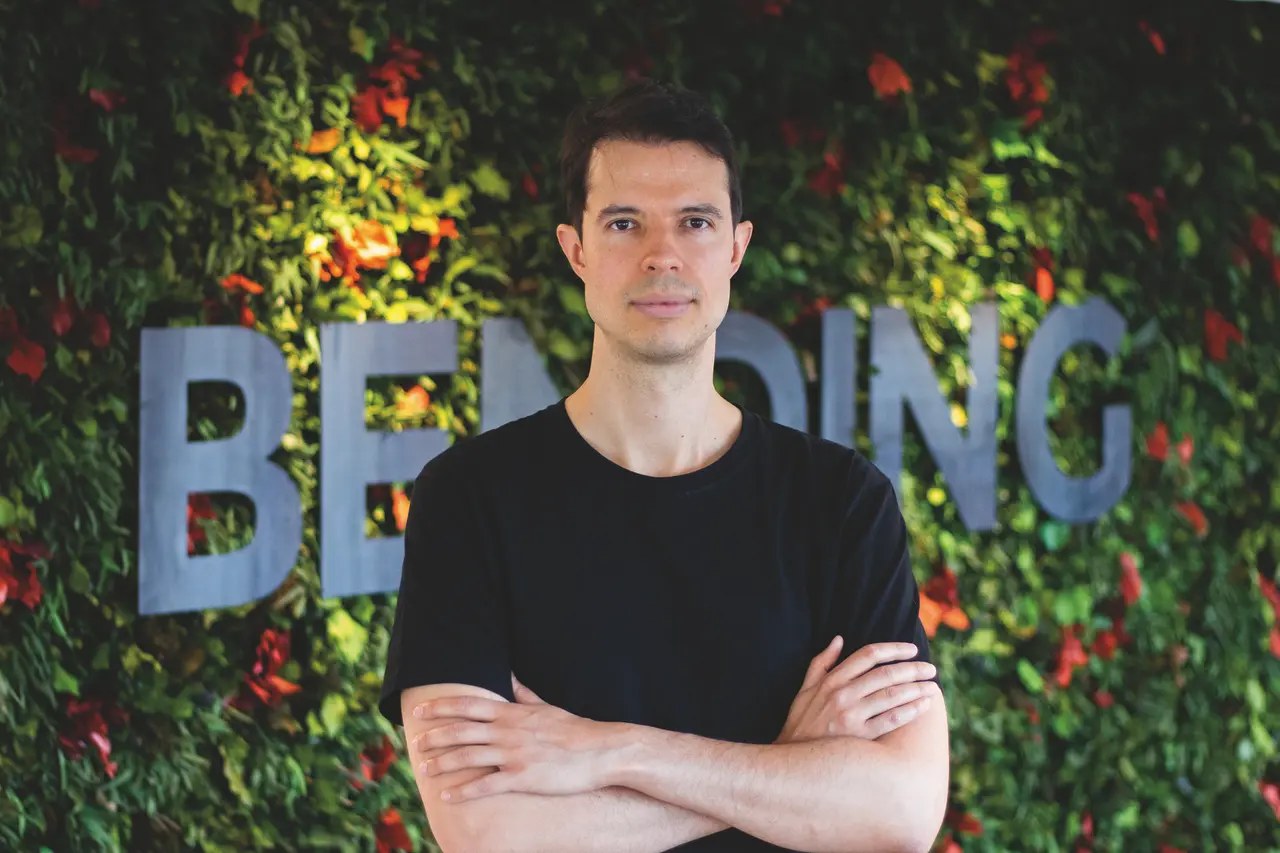
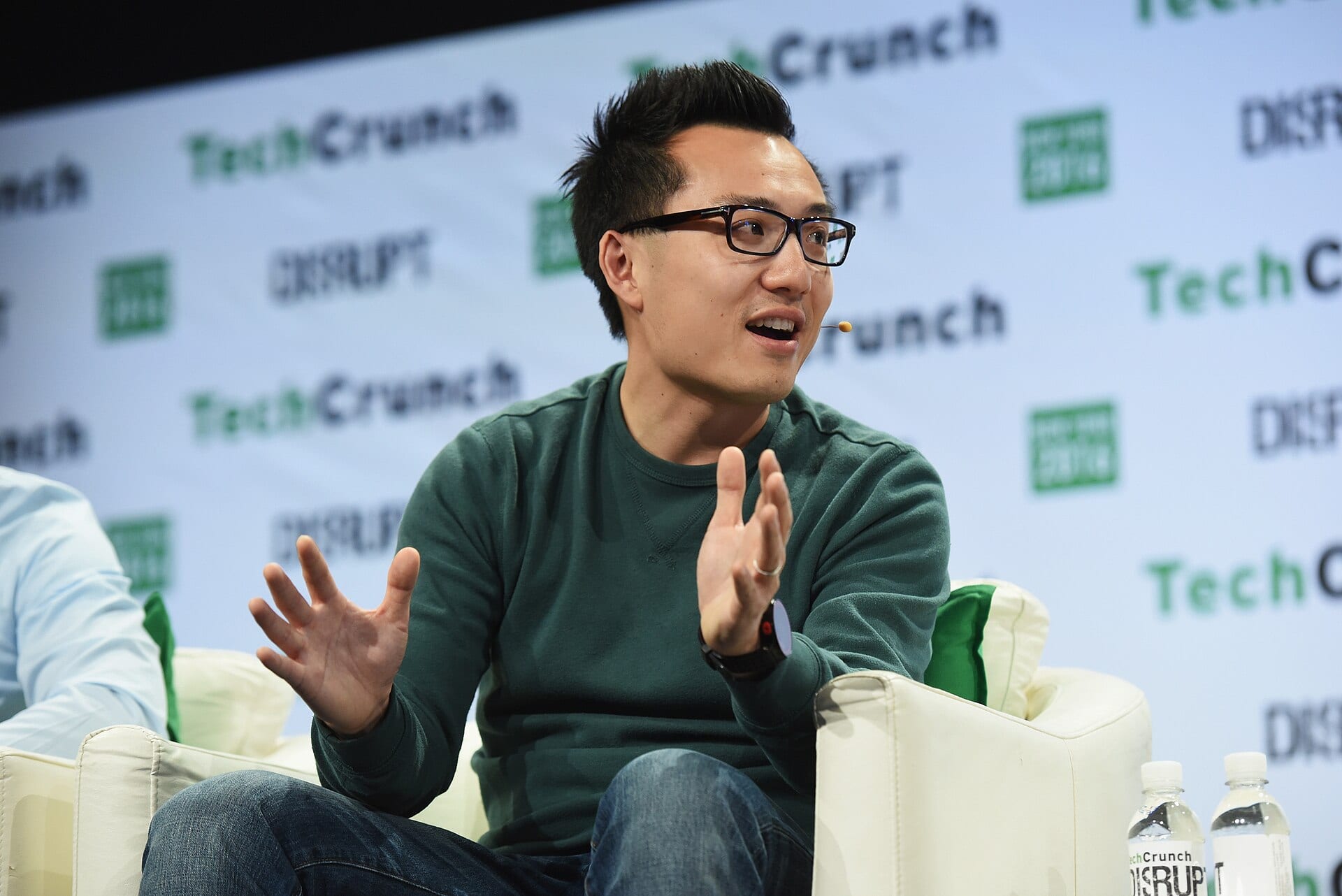
Bending Spoons cofounder and chief executive Luca Ferrari
Luca Ferrari, cofounder and chief executive of Bending Spoons. The photograph's capture date was not specified. (Credit: Blending Spoons, as the credit is spelled on the source page, via News.at, updated August 21, 2026. Rights clearance pending.)

From $17.5 billion to the exit

Andrey Khusid's Miro$1.79B — Miro, private, latest valuation $1.79B reached a $17.5 billion valuation in January 2022.1

The September 10 agreement with Bending Spoons−1.38% — Bending Spoons, down 1.38 percent today implies an equity value of about $1.79 billion, nearly 90% lower.1,2

Buying a place in the workflow

Luca Ferrari's company announced the Airtable$1.285B — Airtable, private, latest valuation $1.285B deal in August and completed it September 4. Miro would follow a purchase that already put another workplace tool under the same owner.3,4

Miro reports around $600 million in annual recurring revenue, nearly 90% from business and enterprise customers. Those teams have work embedded in the product, giving the next owner relationships it would otherwise have to build.2

The cost of a new owner

Ferrari says he prioritizes predictable businesses that his team can substantially improve.5

That transformation can hurt. Bending Spoons planned to cut 75% of WeTransfer's staff in September 2024.6 Evernote's$200M — Evernote, private, latest valuation $200M 2025 revenue growth came from higher spending per subscriber, partly offset by fewer subscribers.10

These precedents give Miro's workers and customers reason to examine the integration plan closely, and to read the cost story management tells about them carefully.

The growth behind the headlines

Bending Spoons reported $704 million in second-quarter 2026 revenue, up 126% from a year earlier. Organic revenue growth was 3%.7,8

The organic measure compares the same businesses across matched periods, including estimated revenue before acquisition. It is a better test of growth within the portfolio than the total's leap after adding businesses.7
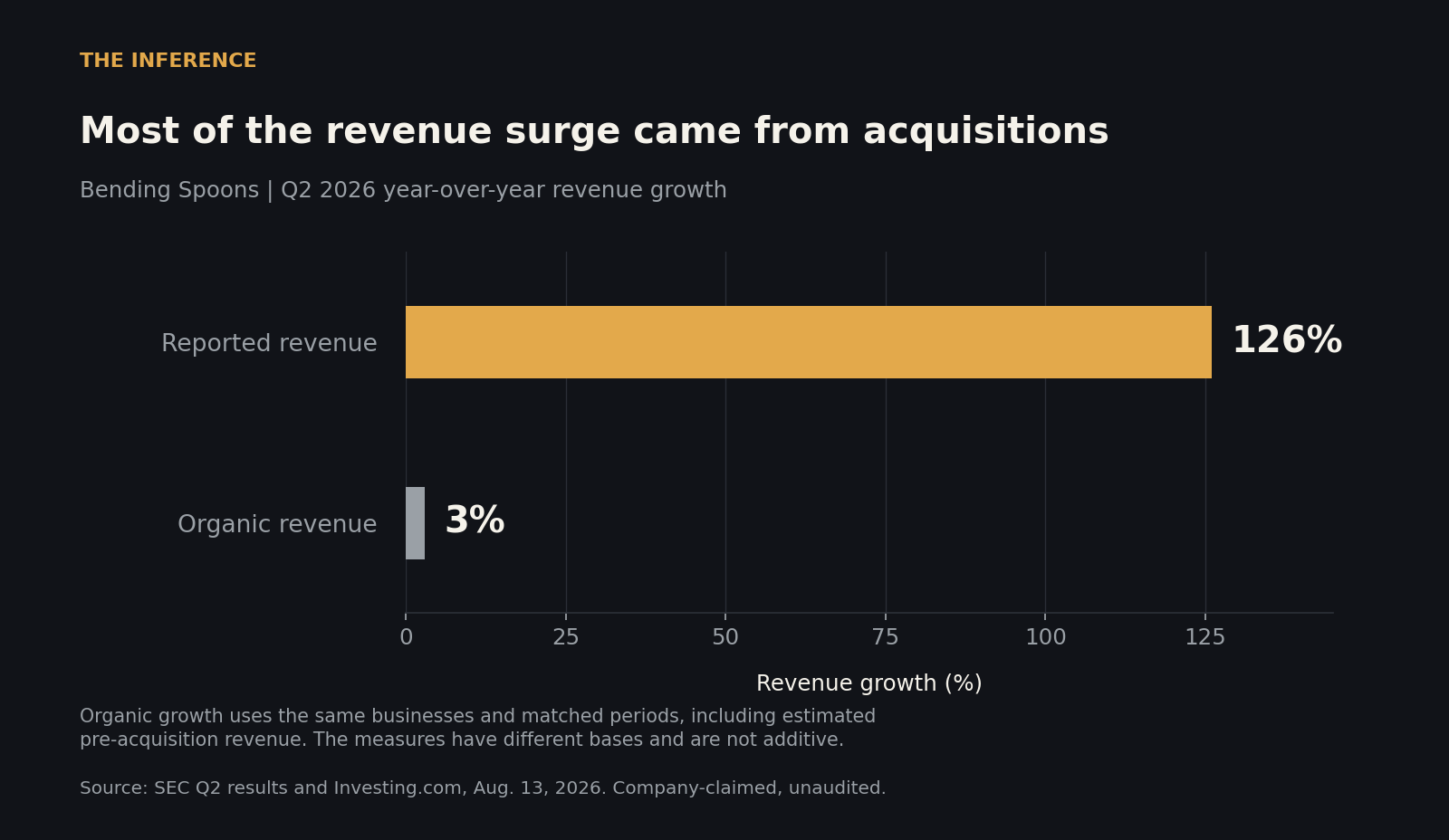
Bar chart of Bending Spoons' Q2 2026 year-over-year revenue growth: 126% reported against 3% organic. Company-claimed, unaudited.
Organic growth uses the same businesses and matched periods, including estimated pre-acquisition revenue. The two measures have different bases and are not additive. Company-claimed and unaudited; reported August 13, 2026.

Acquisitions account for most of the expansion. That makes access to new deals and the ability to integrate them central to the growth story.7,8

Rebuilding can be real

Ferrari cited more than 70 product improvements across AOL$1.4B — AOL, private, latest valuation $1.4B, Eventbrite$500M — Eventbrite, private, latest valuation $500M and Vimeo$1.38B — Vimeo, private, latest valuation $1.38B in the second quarter. Bending Spoons also reported $240 million in operating income.7,9

Better engineering and tighter costs can sustain useful software. The unresolved question is how much customers benefit alongside the owner.

Watch the first renewal

Miro's deal is expected to close in the fourth quarter, pending approvals. Watch subsequent pricing, customer retention, product reliability and organic growth.2

The next renewal will test whether Bending Spoons bought customer loyalty or merely the cost of leaving.

Get Deals by email, free

The acquisitions, rounds and contracts that move AI money. In our daily email, every weekday.
Loading BSP

Reader comments

0 comments

    Deals

    AMD closed Taalas at $2.9 billion, with $1.4 billion riding on undisclosed milestones

    AMD's completion release named no price; the quarterly filing that carries the terms makes up to $1.4 billion of the $2.9 billion contingent on conditions the company has not disclosed. It is the second AI acquisition in a fortnight, about $11.1 billion combined, by a stock trading above 100 times trailing earnings.

    Deals

    Cognizant won Network Rail's seven-year data center contract 28% under the buyer's own estimate

    The seven-year data-center award hands Cognizant volume in a weak market, but the buyer's own tender estimate shows a large UK public-sector deal clearing about 28% below budget, and the award notice offers no explanation.

    Deals

    Anthropic IPO nears $500 billion in orders before Nasdaq debut

    Anthropic closed its order books on Tuesday with roughly $400 billion of institutional interest and nearly $100 billion of retail interest, about seven times the shares on offer, and is guiding pricing above its $70–$78 range ahead of Thursday's Nasdaq debut under ANT. The final price lands after the US close tonight, and the money it moves reaches from IPO allocators to the chip and cloud suppliers holding guaranteed Anthropic contracts.

    Deals

    Tarheel Investors, a KKR-controlled 10% holder, took $604 million in cash from Integer's $5.7 billion buyout

    The November 17 Form 4 shows one firm on both sides of the take-private: KKR-managed funds paid $127 a share for the medical-device maker while a KKR-controlled 10% holder took cash instead of rolling into the deal. For KKR & Co. shareholders, it is the working end of the capital turn out of USI and into Strategic Holdings.

    Deals

    DOJ takes DoorDash's $17 billion Instacart deal while Sequoia partners sit on both boards

    The Justice Department took the merger on November 16, and it is the same agency probing venture board interlocks at Andreessen Horowitz. For holders of DoorDash and Instacart, the risk runs through Section 8 arithmetic nobody had run and a $1.25 billion break fee.

    Deals

    Axon switches its $1.2 billion Skydio deal to 90% cash

    Skydio's sellers will be paid in dollars after Axon's shares slid 21% in a month, and the roughly $360 million of extra cash lands on a quarter that must already rescue a cut free cash flow target. The financing risk now sits with Axon's shareholders.

    Subscribe to TheInference for free