Calpers cut its Magnificent Seven stake 26% while BlackRock's Fink counts on index buyers who cannot leave
Calpers is selling its listed AI concentration and buying private stakes instead, while Larry Fink's $10 trillion buildout plan counts on index investors who cannot reallocate. The disagreement over the funding wrapper decides who absorbs the loss if the AI trade de-rates.
 Vincent Jiangthree-minute read

The quietest shareholder in the Magnificent Seven just sold a quarter of it
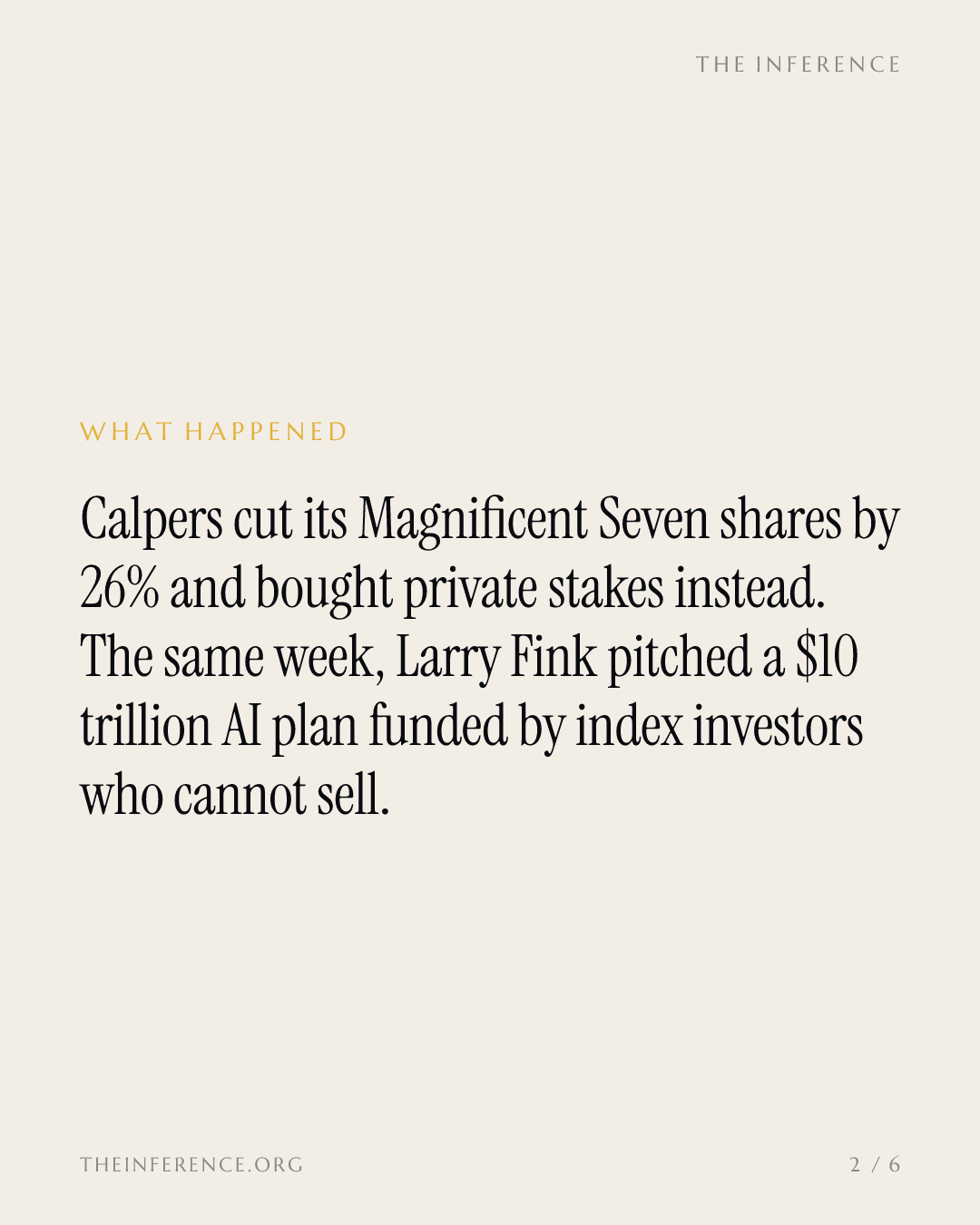
Calpers, the largest public pension fund in the United States, cut the combined number of shares it directly held in the Magnificent Seven, the seven mega-cap technology names that led the American bull market, by 26% in the first half of 2026, according to Financial Times calculations from regulatory filings 1. The same week, the fund's deputy chief investment officer, Anton Orlich, told the FT that California's $637.1 billion pension has swapped concentrated exposure to seven listed companies for stakes in several hundred private ones 1.
His reason is a price, not a panic
Orlich's argument is simple: valuations are higher in public markets, where a few names dominate, and private companies are priced more attractively, which could insulate the fund in an eventual public downturn 1. The timing matters. Tech stocks bore the brunt of this week's selling as investors questioned whether AI spending will pay off, with Microsoft−2.58% — Microsoft, down 2.58 percent today, Amazon−1.65% — Amazon, down 1.65 percent today and Alphabet+2.23% — Alphabet, up 2.23 percent today reporting next week 1. The fund earned a 14.8% preliminary return for the year to June 30, helped by both public and private equity 1.
The index money dwarfing Calpers is 35 times its size
- Estimate
Data
| Value | |
|---|---|
| Calpers assets (Jun 30, 2026) | $0.64T |
| US indexed funds (Aug 2026) | $22.4T |
| Fink's 10-yr AI infra estimate (estimate) | $10T |
The index investor who cannot leave
Days later, Larry Fink, chief executive of BlackRock+0.62% — BlackRock, up 0.62 percent today, the world's largest asset manager, repeated his estimate that AI infrastructure could require $10 trillion over ten years, funded in part through ordinary Americans' retirement accounts 2. Those accounts hold $22.40 trillion in indexed funds, and the top 15 stocks are a record 46.7% of the S&P 500's market value 2.
A pension board can vote to reallocate, and Calpers did: it can sell its listed shares and buy private stakes instead. An index fund holder owns the S&P 500 as it is weighted, so the same concentration Calpers is selling sits permanently inside the retirement accounts that Fink counts on.
What a thinner marginal buyer means for retirement accounts
The mechanism is a price-setter swap. At the margin, the listed AI trade's steady institutional hands are now reducing, so incremental buying comes from passive money that buys an index because it exists, not because it prices the stocks. When prices fall, passive funds do not sell; they simply carry the loss.
That means a drawdown in the top 15 names transmits straight into $22.40 trillion of retirement savings at the index weight 2. Confirmation of the thesis would be other large pensions following Calpers out of the mega-cap names; a rebuke would be the Microsoft, Amazon and Alphabet earnings next week justifying the spending and pulling active money back in 1. Fink's $10 trillion ask now faces its first test as a pitch to a buyer who cannot say no 1.
Get Economy by email, free
How AI moves rates, banks, payments and the wider economy. In our daily email, every weekday.