Celestica cut its buyback 45% and its free cash outlook after selling $3.45 billion of stock at $310
The 8-K filed October 30 authorizes repurchases of about 2.5% of the float, funded in part by debt, at a company that raised $3.45 billion of equity in August. The document says more about where the cash is going than about the share price.
 Richard Tang · 3 min read
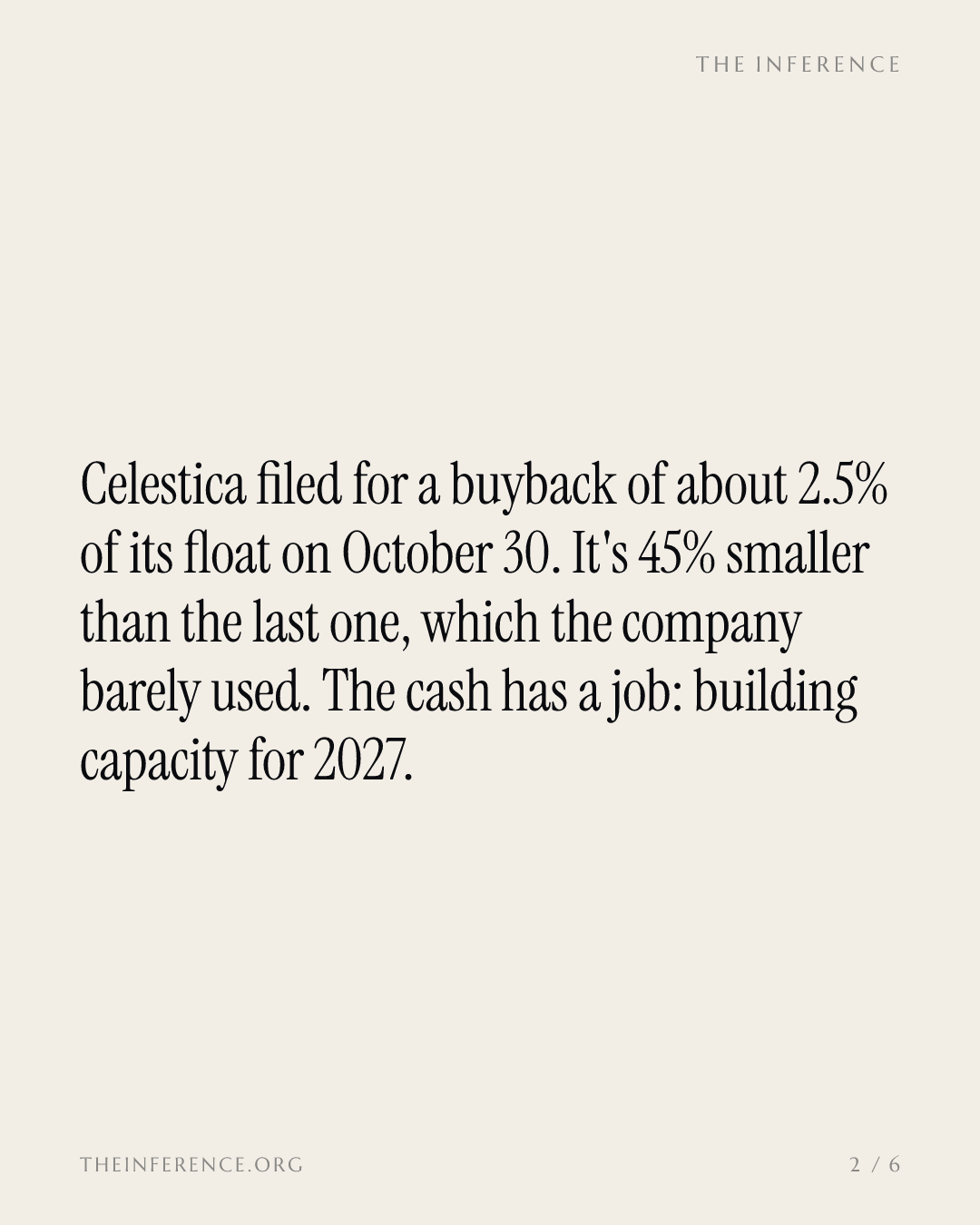
Celestica−5.55% — Celestica, down 5.55 percent today filed the paperwork for a share buyback on October 30, the same day its stock fell 6.1% to close at $265.53 1. The Toronto Stock Exchange accepted a normal course issuer bid, the Canadian label for an open-market repurchase program, covering up to 3,132,127 shares, about 2.5% of the public float, running from November 3, 2026, to November 2, 2027 2. Two details in the same filing should stop anyone tempted to read it as a board pounding the table for its own stock.
The board barely used the last bid
The bid expiring November 2 authorized up to 5,722,527 shares 2. Celestica bought 205,184 through October 20, about 4% of the permission 2. It paid a weighted average of $271.75 a share 2, and the stock now trades below that price. The new authorization is 45% smaller 2. The release's language is standard boilerplate: the purchases "constitute a desirable use of its funds" 2. The behavior behind the language is a company that repurchases the way some people go to the gym, occasionally and without conviction.
The new buyback is smaller than the one Celestica barely used
Data
| Value | |
|---|---|
| Prior bid authorization | 5.72M |
| New bid authorization | 3.13M |
| Repurchased under prior bid | 0.21M |
The growth plan is spending the cash
Funding language deserves attention at a company that just sold equity. The release says purchases will come from existing cash, draws on the credit facility or other debt 2. Celestica ended September with $4.0 billion of cash 3, most of it from the August offering that raised $3.45 billion gross at $310 a share 4 and knocked the stock from $474 to $244 5.
The same press release cut the 2026 free cash flow outlook to $460 million, from $600 million, to fund working capital for the 2027 ramp 3, alongside $1.5 to $2 billion of planned capital spending next year 3. Selling equity at $310 in August and authorizing a shrunken buyback in November is coherent: the cash has a job, building capacity, and the bid is what is left over 33.
The 2027 capital spending plan is more than eight times what Celestica spent last year
- Capital spending
- Estimate
Data
| Capital spending | |
|---|---|
| FY2020 | $51M |
| FY2021 | $49.6M |
| FY2022 | $108.9M |
| FY2023 | $122.4M |
| FY2024 | $168M |
| FY2025 | $201.2M |
| 2027 plan (estimate) | $1,750M ($1,500–2,000M) |
What the bid tells you, and what it does not
Insiders sold $254 million of stock over the past year 1; purchases came to $2 million 1. At 13.4 times forward earnings, the market is pricing doubt about the whole AI buildout, and hyperscalers are feeding it: Alphabet spent $51.4 billion on capital expenditures in its latest quarter, leaving negative free cash flow, and Meta−1.65% — Meta, down 1.65 percent today plans to raise $95 billion for its own 6. Management still says supply, not demand, limits growth, which Scotiabank's analyst read as support for a multiyear expansion 6.
Take that seriously and the small buyback stops being a red flag: a manufacturer facing supply constraints should buy capacity, not its own shares. What the bid does rule out is the bull case that leans on it. A board that believed $265 was cheap against its own $40 billion revenue guide for 2027 3 had a year to prove it at scale and chose not to. Underwrite Celestica on whether hyperscaler demand converts to revenue, and treat the repurchase as housekeeping. A company that sells stock at $310 and buys it back in fractions of a percent is telling you where its conviction sits: in the factory, not the float 3.
Get Data Center by email, free
Who is building AI's data centers, and who is paying for them. In our daily email, every weekday.