ChinaTalk says Mercor sold AI training environments to Alibaba a day after a $20 billion valuation
The China-policy newsletter sizes US vendors' China sales of AI training data at roughly $500 million, and its Mercor finding landed one day after the company's $750 million Series D priced it at $20 billion. China is about 2 percent of Mercor's quarterly revenue; the naming reaches the enterprise customers the round was raised to win.
 Vincent Jiangthree-minute read
A $500 million market nobody had priced
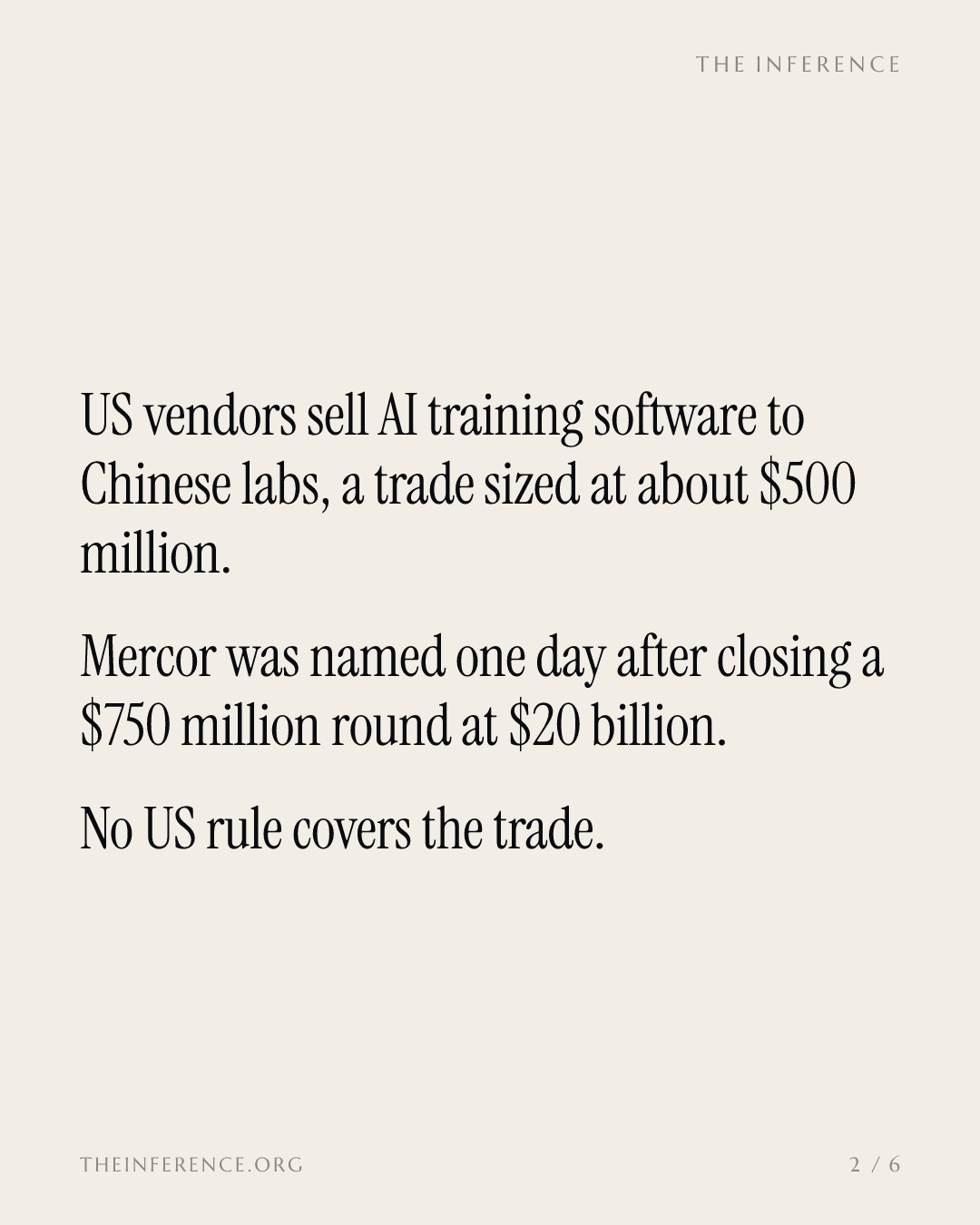
On November 11, ChinaTalk, a China-policy newsletter, published an investigation by Aqib Zakaria and Quinn Ennis into US vendors selling training data and reinforcement-learning environments to Chinese AI labs, a market it sizes at roughly $500 million 1. It names at least nine companies 1. An RL environment is a simulated workplace where a model attempts a task, fixing a bug in real code, and is scored until it improves 2.
The report says Alibaba−0.74% — Alibaba, down 0.74 percent today, the Chinese internet group, bought software-engineering environments from Mercor~$2B — Mercor, private, latest valuation ~$2B, a marketplace that pays a network of more than five million human experts to train and evaluate AI models 56. Surge AI$1B — Surge AI, private, latest valuation $1B supplied Tencent, Z.ai and Moonshot AI, whose Kimi K3 model is rated a match for US systems at programming; Turing sold to Tencent and Alibaba 12.
The same vendors supply OpenAI$1.18T — OpenAI, private, latest valuation $1.18T and Anthropic$350B — Anthropic, private, latest valuation $350B, and where a frontier lab's confidentiality blocks a resale, they offer to rebuild the set with the same experts 2. AfterQuery is the extreme case: about $100 million in annual recurring revenue, roughly half from Chinese customers, per Forbes, a figure ChinaTalk could not independently verify 6.
One day too late for the round
The report landed one day after Mercor closed a $750 million Series D at a $20 billion valuation, with Nvidia−3.21% — Nvidia, down 3.21 percent today, Salesforce−0.26% — Salesforce, down 0.26 percent today and Zoom+1.64% — Zoom, up 1.64 percent today among the named buyers, double its $10 billion mark of October 2025 45. (The Inference profiled the round on November 11 45.)
The direct cash at risk is small: Forbes put Chinese buyers at about 2 percent of Mercor's second-quarter 2026 revenue 6. The commercial exposure is larger. Mercor raised the money to expand evaluation and post-training services for enterprises 47, and rivals Scale, micro1 and Fleet publicly refuse business with Chinese customers 6.
Neither Mercor's round announcement 7 nor chief executive Brendan Foody's CNBC interview that morning 8 addressed the China sales; CNBC billed the interview around the scandal then surrounding Nvidia's chief, Jensen Huang, who has since resigned after The New York Times reported on October 29 that he appeared to be the target of a Chinese spy plot 9.
Mercor's new mark is 40 times the whole China data market
A $500 million China market now has a $20 billion company named in it
- Estimate
Data
| Value | |
|---|---|
| US-to-China data market (est.) (estimate) | $0.5B |
| Mercor Series D | $0.75B |
| Mercor valuation | $20B |
Export controls cover chips, not training software
The sales break no US rule 6. RL environments mostly fall under EAR99, the export classification that needs no license unless the buyer is sanctioned, as the Chinese lab Zhipu is 6. Washington restricts the advanced chips China cannot buy and leaves the training software ungoverned 6. ChinaTalk asks the Commerce Department's Bureau of Industry and Security to treat coding and biology environments as dual-use goods, products with both civilian and military applications, and to restrict their export 16.
The report carries its own counterweight: the sales are not proof of wrongdoing, Chinese labs remain months behind their US rivals, and US frontier labs are pulling their most sensitive environments in-house, the very revenue outside vendors sell 16. Two readings decide the next quarter: whether Mercor states a China policy before enterprise customers ask, and whether the Bureau of Industry and Security begins a rulemaking.
Get Policy & Labor by email, free
The rules governments write for AI, and what AI does to jobs. In our daily email, every weekday.



Reader comments
0 comments