Cloudflare is buying the whole stack AI agents build on, and the stock trades at 49.5 times sales
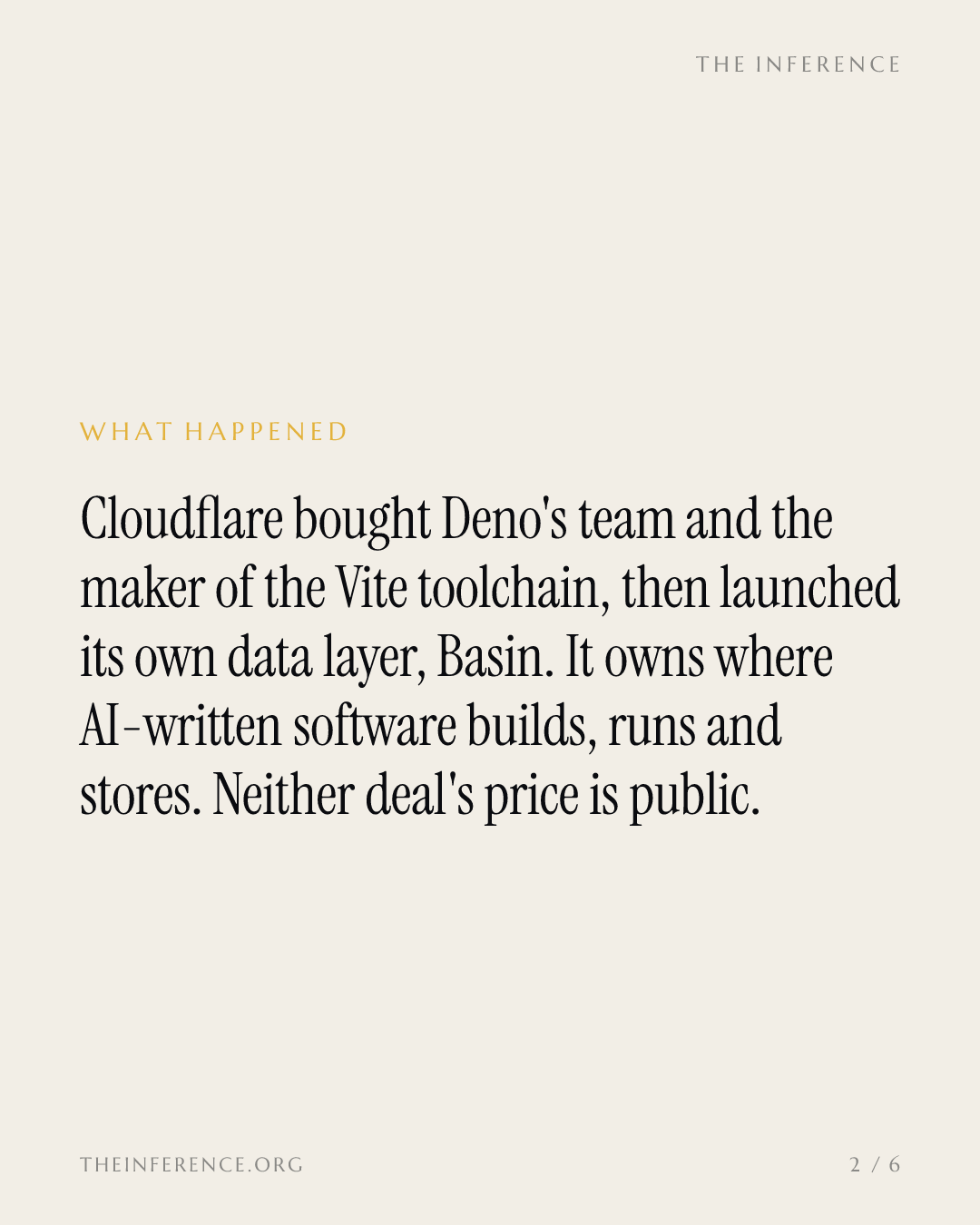
Cloudflare has bought Deno's runtime team and the maker of the Vite toolchain, and launched its own Basin data layer beside them, a bet that agents will write, run and store software on its network. Neither acquisition's price is public, and management has guided growth down to 31%.
 Richard Tang · 3 min read
Cloudflare−6.31% — Cloudflare, down 6.31 percent today now owns the three places a piece of agent-written software lands: the toolchain that builds it, the runtime that runs it, and the database that stores what it produces. That is a deliberate claim on where AI coding agents build, and the market is being asked to pay for it before the revenue line exists.
One owner for the toolchain, the runtime and the data layer
On October 9 Cloudflare said the Deno team is joining, merging celld, Deno's open-source implementation of the Workers model, into workerd, the open-source Workers runtime 1. Ryan Dahl, who created Node.js, and Deno co-founder Bert Belder will lead the self-hosting effort; the Deno runtime and Deno Deploy, a hosting service that competed with Workers, are being wound down 2. The price was not disclosed, and Deno had raised $26 million 2.
They follow VoidZero, the company of Vite creator Evan You, which joined Cloudflare in June 3. Its Vite+ 1.0, one command that manages the JavaScript runtime, package manager, test runner and bundler together, shipped on September 28 3. The release is approaching two million weekly downloads 4.
Basin, which Cloudflare built itself, reached general availability on October 1: a serverless analytics platform that stores data in the open Apache Iceberg format on the company's R2 storage, with no transfer fees 56. Its documentation carries agent-setup pages and llms.txt files written for machine readers 5.
The escape hatch will be maintained by the gatekeeper
Kenton Varda, Workers' principal engineer, rejects the lock-in charge: workerd is the production code, open source, and "being open source and giving people an escape hatch is good business" 1. He concedes workerd's Durable Objects, the small individually addressable servers with their own SQLite databases that make the model powerful, never scaled past a single instance 1.
In effect, the one hosted service running the Workers model off Cloudflare's network is gone, and the escape route will now be built by the network's own employees. workerd is free to run anywhere; Cloudflare earns only when code runs on its network. An escape hatch therefore costs the company nothing it could have billed, and the team that maintains it is now on its payroll.
The market pays first, the revenue arrives later
Management called AI "the killer application for Cloudflare Workers" back in February 2025 7. Growth reaccelerated to 36% in the second quarter of 2026 7, and management guided the next quarter back down to 31% 7. Existing customers spend at a net retention rate of 120% 7.
Cloudflare's revenue growth has reaccelerated as it assembled the agent stack
- Revenue growth (year over year)
- Estimate
Data
| Revenue growth (year over year) | |
|---|---|
| Q3 '24 | 28.2% |
| Q4 '24 | 26.9% |
| Q1 '25 | 26.5% |
| Q2 '25 | 27.8% |
| Q3 '25 | 30.7% |
| Q4 '25 | 33.6% |
| Q1 '26 | 33.5% |
| Q2 '26 | 35.9% |
| Q3 '26 (estimate) | 31% |
The market is paying up front. The stock has returned 76.4% this year 7. It trades at 49.5 times sales 7. The company still runs an operating loss equal to 8.1% of revenue over the last twelve months 7.
Cloudflare does not report revenue by product 7, so the downloads show developers adopting the tools while no filing yet shows them as income. The chain from agent-written code to billed usage is real, and Cloudflare now owns most of it; the one link nobody has demonstrated is the last one, and the third-quarter report lands after the close on November 5 9.
Deepdive
AI-generated from this story and its cited sources. Not investment advice.