Corning doubled AI fiber sales and collected $639 million of customer deposits; the stock fell 14.1% anyway
Corning doubled Gen AI fiber sales, signed multibillion-dollar supply deals and took customer deposits to fund capacity, yet the stock dropped 14.1% in a month. The market is repricing the multiple, not the business, and the bet hinges on a 2028 architecture shift that is still a forecast.
 Richard Tang · 3 min read
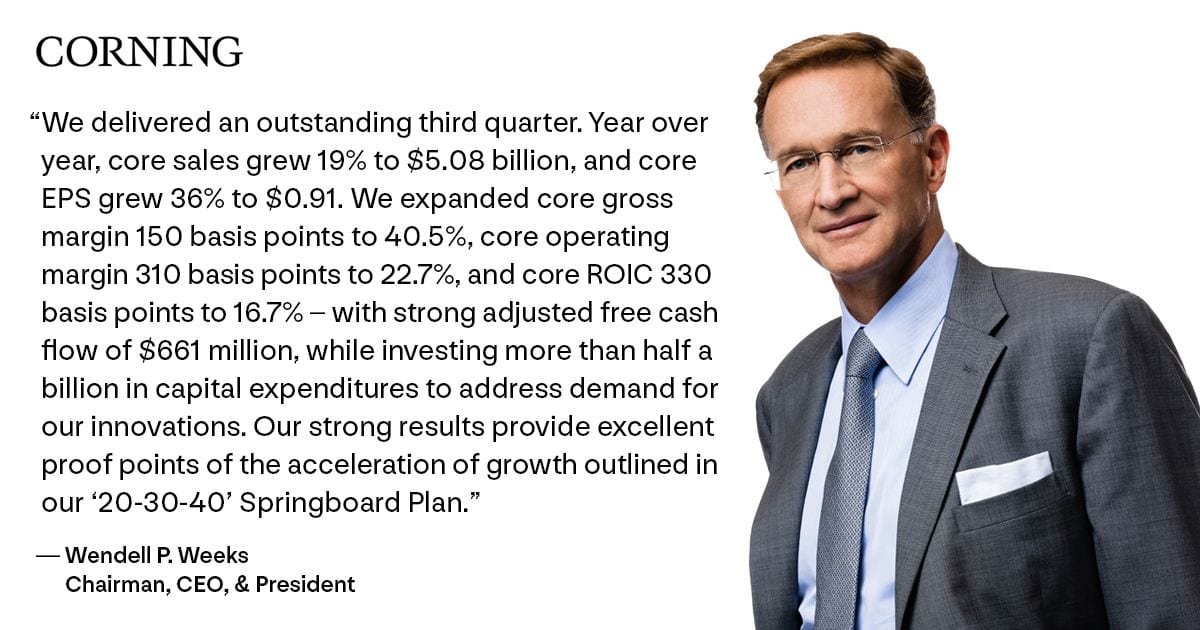
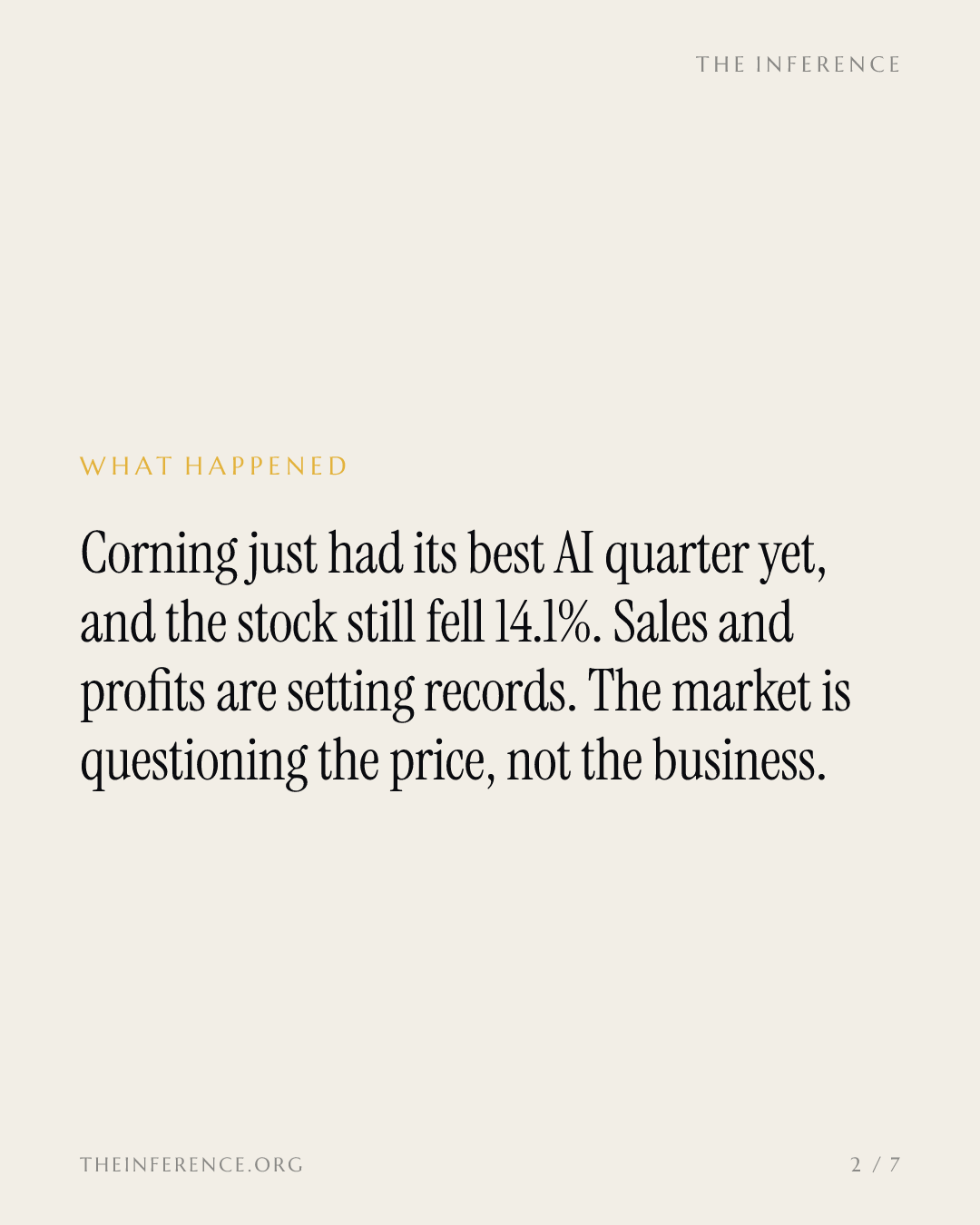
Corning−4.09% — Corning, down 4.09 percent today just reported its best AI quarter yet, and the market answered by knocking 14.1% off the stock in a month 12. The business is not the problem: core sales rose 19% to $5.08 billion, Optical Communications jumped 44%, and Gen AI product sales doubled, growing faster than GPU shipments themselves 12. What the market is repricing is the premium, and the gap between those two is the decision this week.
Customers are funding the buildout, not just buying from it
The strongest signal in the quarter is who is paying for the growth. Corning signed four long-term, multibillion-dollar supply agreements, including with Verizon+2.70% — Verizon, up 2.70 percent today and AT&T+2.53% — AT&T, up 2.53 percent today, and collected $639 million in customer deposits through nine months; management says most growth capex is funded through these agreements, not the balance sheet 13. The deposits say customers expect this buildout to run for years.
And the money is already reaching the bottom line: Optical Communications net income rose 80% year over year to $532 million, the segment's record quarter 3. The forward stakes are set by guidance: fourth-quarter core sales of $5.2 to $5.3 billion and core EPS of $0.96 to $1.00, both growing about 36% 13.
Double-digit revenue growth for nine straight quarters
- Revenue
- Net income
Data
| Revenue | Net income | |
|---|---|---|
| Q3 '24 | $3.39B | -$0.12B |
| Q4 '24 | $3.5B | $0.31B |
| Q1 '25 | $3.45B | $0.16B |
| Q2 '25 | $3.86B | $0.47B |
| Q3 '25 | $4.1B | $0.43B |
| Q4 '25 | $4.22B | $0.54B |
| Q1 '26 | $4.14B | $0.37B |
| Q2 '26 | $4.51B | $0.56B |
| Q3 '26 | $4.86B | $0.68B |
Corning still trades at nearly double its own five-year earnings multiple
Data
| Value | |
|---|---|
| GLW forward | 31.5 |
| Sub-industry | 29.9 |
| S&P 500 | 19.3 |
| 5-yr median | 17.6 |
The premium, and what stands behind it
So why the selloff? The stock still trades at 31.5 times forward earnings against a 17.6 times five-year median, and Zacks pairs its Strong Buy rank with a Value Score of D 2.
The bears also have real blemishes. Solar posted a $7 million net loss on $436 million of sales because its new wafer and module plants are ramping slower than planned, so productivity and profit improvement slip toward 2027 23. Glass Innovations, which sells cover glass for TVs, phones and notebooks, saw sales fall 3% because weak memory-chip pricing is cutting demand for consumer devices 23. And the big catalyst, a copper-to-optical shift inside AI server racks that could lift fiber per GPU from about 16 to roughly 160 starting around 2028, is management's estimate, not a signed order book 34.
The 2028 densification bet is the whole premium
The chain is worth stating plainly. AI data centers are hitting a networking bottleneck, and copper inside the rack is the next constraint: copper works well at short distances but runs into bandwidth, distance and power limits as clusters scale 4. Whoever supplies the optical replacement captures a roughly tenfold densification of demand 4. That is why customers are prepaying: they need Corning's capacity secured before their own data centers are built.
The open question is whether the 2028 transition lands on schedule. The premium is justified only if it does. What to watch: Corning converting the density forecast into signed orders and disclosed commitments, the way its carrier deals converted the scale-out opportunity into deposits. If those orders come, the current multiple looks like the entry point bulls claim. If they slip, the shareholder, not the customer, carries the cost of waiting.
Get Data Center by email, free
Who is building AI's data centers, and who is paying for them. In our daily email, every weekday.