Crusoe’s $3.9 Billion Round Is a Bet on AI’s Unfinished Work
Chase Lochmiller has billions of dollars behind him and gigawatts of construction ahead.
 Vincent JiangSeptember 17, 2026 · 7 min read
On September 17, his company, Crusoe, announced the initial closing of an anticipated $3.9 billion financing at a $30.9 billion post-money valuation. The money backs an expansion across power, data centers and cloud computing. The amount already closed was not disclosed. Crusoe’s announcement 1.
Put that alongside Atoms, Positron and Temporal, and a pattern emerges. Investors are financing the work required to make AI useful: supplying electricity, serving models economically, automating physical operations and keeping software running after something breaks.
Owning a scarce part of that process can create a durable business. But each bottleneck comes with an expensive obligation to deliver. A large funding round buys the opportunity to prove the economics; it cannot prove them itself.
The biggest checks cover very different businesses
This review covers major private technology financings announced or completed from July 1 through September 17, plus the smaller Positron and Temporal rounds. Figures below are company-reported; the table preserves commitments, partial closes and combined rounds. It is a broad survey, not an exhaustive global ranking. Dollar amounts are U.S. dollars; euros remain in their original currency.
| Company | Announcement | Financing | Stated valuation |
|---|---|---|---|
| Databricks 2 | Aug. 13 | $5B, closed | $190B |
| Crusoe 1 | Sept. 17 | $3.9B anticipated; initial close | $30.9B post-money |
| Mistral AI 3 | Sept. 8 | €3B Series D | Over €21B post-money |
| The Boring Company 4 | Sept. 9 | $3B Series D | $23B |
| Cognition 5 | Sept. 8 | Over $2B Series E | $48B |
| Firmus 6 | Aug. 7 | $2B equity committed | Over $10.5B post-money |
| Helsing 7 | July 13 | $1.8B Series E | $18B |
| Atoms 8 | July 22 | $1.7B equity | Undisclosed |
| Fireworks AI 9 | July 15 | $1.505B Series D | $17.5B |
| Hadrian 10 | Aug. 6 | $1.37B equity | $7.87B |
| Quantum Systems 11 | July 2 | $1.2B Series D signed | About $8B post-money |
| Ant International (Ant Group affiliate) 12 | July 21 | About $1.2B Series A | Undisclosed |
| River AI 13 | Aug. 11 | $1.1B across Seed and Series A | Undisclosed |
| SambaNova 14 | July 8 | $1B financing; first close | $11B post-money |
| Commonwealth Fusion Systems 15 | July 30 | $1B equity | Undisclosed |
| Base Power 16 | Aug. 3 | $1B Series D | $13B post-money |
| Valar Atomics 17 | Aug. 4 | $1B equity | Undisclosed |
| Positron 18 | Sept. 10 | $375M plus up to $500M | $5B headline post-money |
| Temporal 19 | Sept. 14 | $550M Series E | $12.55B |
Other large announcements have different structures: Motive 20 secured over $1.3 billion of growth financing, Keyfactor 21 announced an investment above $1 billion with no disclosed primary/secondary split, and Joulent 22 agreed a $1.75 billion strategic investment, with a final investment decision expected by year-end. Valar separately closed a $200 million credit facility. These amounts should not be added together as fresh equity already received.
Crunchbase’s September 3 report counted $42 billion of global startup funding in August. Five of that month’s seven billion-dollar recipients had raised their previous round less than a year earlier. That is evidence of investors returning quickly to selected companies, rather than a measure of how easily the typical founder can raise. Crunchbase’s funding data 23.
Software remains central to the funding boom. Databricks is expanding its data and AI products; Cognition is selling software-engineering agents; Fireworks is building infrastructure for customized models. Meanwhile, Helsing, Hadrian and the energy companies must turn capital into physical output. The common investment question is how much customers will pay for completed work after the full cost of delivery.
Crusoe: the asset is the ability to deliver capacity
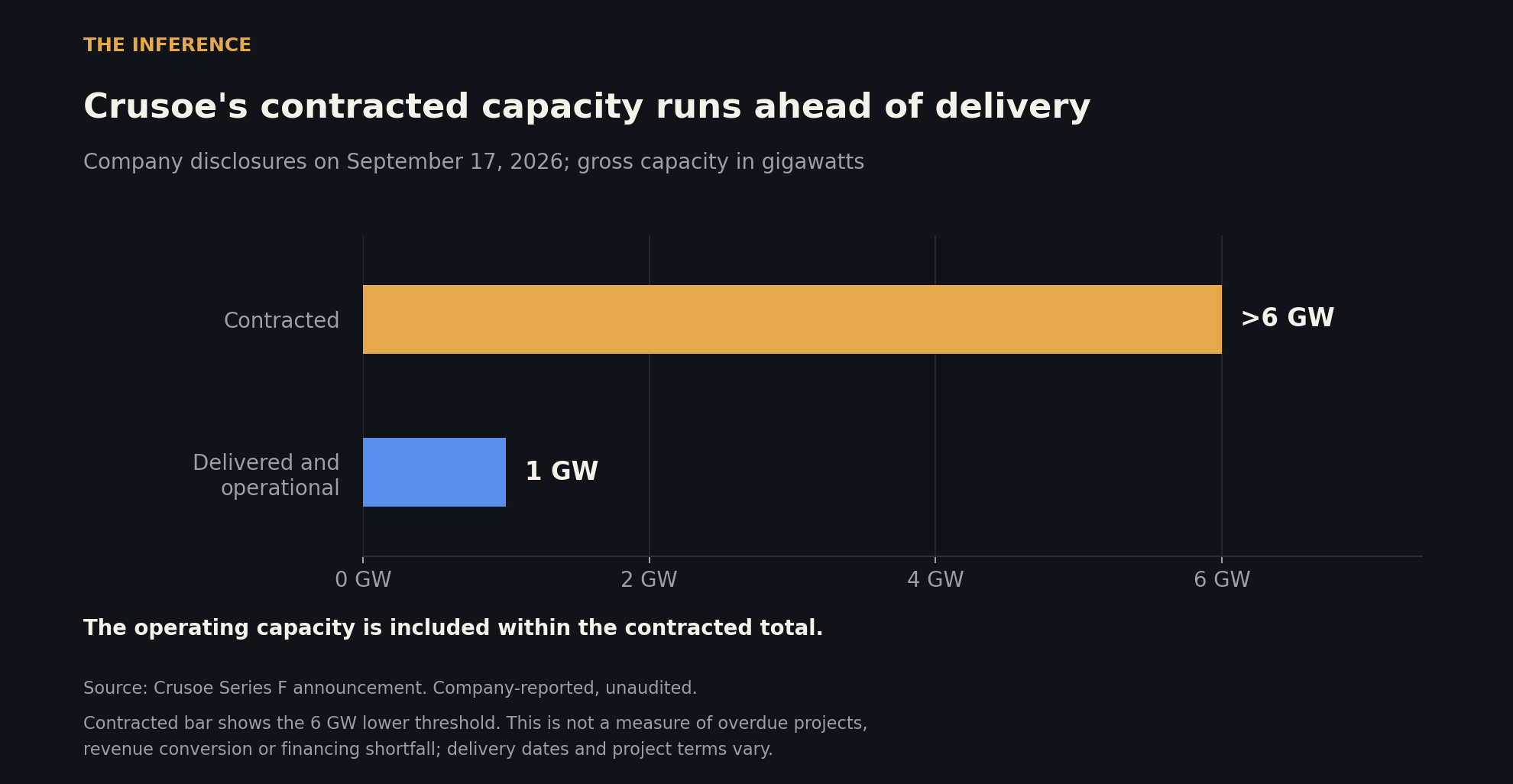
Crusoe reports more than 6 gigawatts of gross contracted capacity across data centers and cloud, including about 1 gigawatt delivered and operational. It also reports more than $140 billion of total contracted value. These are company disclosures: contracts span time, and their value is neither annual revenue nor profit. September 17 operating figures 1.
Lochmiller’s strategy brings power sourcing, construction and cloud operations under one company. That can reduce handoffs between suppliers whose schedules otherwise collide. It also concentrates the execution burden: electricity, buildings, equipment and customers must arrive in a financially workable sequence.
The important return is cash earned after construction, financing, operations and replacement equipment. Owning more of the chain helps only if it improves that return. Vertical integration can remove a supplier’s margin and inherit the supplier’s problems in the same transaction.
Atoms: industrial automation must survive the maintenance bill
Travis Kalanick’s Atoms announced a $1.7 billion equity investment on July 22, led by a16z. His letter says existing businesses were combined into one equity structure; it separately lists debt partners without disclosing an amount. This is the industrial company spanning food, mining and transport, distinct from the similarly named AI app builder. Kalanick’s letter 8, a16z’s announcement 24.
The attraction is a customer with an existing operating budget. A restaurant or mine already pays to produce and move things. Automation can win spending by lowering the cost of a completed job.
However, the calculation has to include hardware, installation, maintenance, downtime and human supervision. A robot that reduces staffing expense but creates frequent service interruptions may transfer costs rather than eliminate them. Shared software across industries is attractive; shared complexity across industries is expensive.
The announcement provides no consolidated profitability or unit-economics figures. The test is repeat deployments where customers achieve a measurable payback after the full operating bill. The size of the industries supplies an addressable market, not that evidence.
Positron: investors are funding a product transition
Positron’s September 10 headline announced $875 million at a $5 billion post-money valuation. The release breaks that into a $375 million Series C and a Series C-1 of up to $500 million. Treating the whole headline as cash already received would erase an important qualification. Financing announcement 18.
The company targets the cost of inference, the computing required to run trained AI models. Its design aims to reduce reliance on scarce high-bandwidth memory. That is an economically meaningful hypothesis: accessible memory could improve the cost of serving suitable workloads. Investor QIA’s explanation 25.
But the new Asimov chip is scheduled to enter production in the second half of 2027. Current Atlas deployments do not independently validate the economics of that future chip. The funding has to bridge design, fabrication, software integration and manufacturing. Company’s product timetable 18.
The eventual comparison must use customer workloads, including migration effort, reliability and utilization. Winning a narrow performance test is useful. Winning the customer’s total-cost calculation is what creates a business.
Temporal: reliability can earn a premium, but so can the valuation
Temporal’s September 14 round raised $550 million at a $12.55 billion valuation. It reports an annualized revenue run rate above $250 million and more than 4,300 paying customers. These are unaudited company figures, and a run rate is not a completed year of revenue. Temporal’s announcement 19.
Its software preserves the progress of an application so work can recover after a failure. That becomes valuable when an AI workflow calls several services, waits for approval and needs to resume later. Once a customer relies on it for important processes, replacing it can require substantial engineering work.
Reliability also has a boundary. Preserving a workflow does not make the AI’s judgment correct; developers remain responsible for application failures and business logic. Temporal’s documentation 26.
Dividing the valuation by the disclosed $250 million run-rate threshold gives about 50 times. The actual quotient is lower because revenue exceeds that threshold; this is not a precise revenue multiple. Investors still need sustained growth and attractive margins to justify the price. Durable customer value and an attractive entry price are separate questions.
The strongest case for the boom is operating demand
There is a fair bullish argument here. Construction capacity, computing efficiency, industrial productivity and software reliability solve identifiable customer problems. These companies can develop advantages through delivered projects, deployment experience and integration into important workflows. Large upfront funding may be necessary to reach the scale where those advantages appear.
The remaining question is who keeps the savings. Competition can pass cheaper inference or more productive machinery straight through to customers. That would be a technological success without guaranteeing attractive returns to every investor.
For Lochmiller, watch capacity become operational and generate cash. For Atoms, watch customer payback after maintenance. For Positron, watch production silicon and paid deployments. For Temporal, watch customer expansion alongside the cost of serving it.
The next useful announcement will show what the money finished.
How this brief was made
01Gathered & sourced267 channels · 2,205 articles▾
Agents swept 267 channels and ingested 2,205 articles, then de-duplicated and ranked them for signal.
02Verified & cross-validated26 claims · 31 data feeds▾
Every one of 26 load-bearing claims was checked against primary sources, with 31 live data feeds reconciling the figures and charts.
- 1Crusoe | 2026-09-17 | Company-claimed, unaudited. Source
- 2Databricks | 2026-08-13 | Company-claimed, unaudited. Primary announcement
- 3Mistral AI | 2026-09-08 | Company-claimed, unaudited. Primary announcement
- 4The Boring Company | 2026-09-09 | Company-claimed, unaudited. Primary announcement
- 5Cognition | 2026-09-08 | Company-claimed, unaudited. Primary announcement
- 6Firmus | 2026-08-07 | Company-claimed, unaudited. Primary announcement
- 7Helsing | 2026-07-13 | Company-claimed, unaudited. Primary announcement
- 8Atoms | 2026-07-22, dated through participating investor announcement | Company-claimed, unaudited. Source
- 9Fireworks AI | 2026-07-15 | Company-claimed, unaudited. Primary announcement
- 10Hadrian | 2026-08-06 | Company-claimed, unaudited. Primary announcement
- 11Quantum Systems | 2026-07-02 | Company-claimed, unaudited. Primary announcement
- 12Ant International | 2026-07-21 | Company-claimed, unaudited. Primary announcement
- 13River AI | 2026-08-11 | Company-claimed, unaudited. Primary announcement
- 14SambaNova | 2026-07-08 | Company-claimed, unaudited. Primary announcement
- 15Commonwealth Fusion Systems | 2026-07-30 | Company-claimed, unaudited. Primary announcement
- 16Base Power | 2026-08-03 | Company-claimed, unaudited. Primary announcement
- 17Valar Atomics | 2026-08-04 | Company-claimed, unaudited. Primary announcement
- 18Positron | 2026-09-10 | Company-claimed, unaudited. Source
- 19Temporal | 2026-09-14 | Company-claimed, unaudited. Source
- 20Motive | 2026-09-10 | Company-claimed, unaudited. Primary announcement
- 21Keyfactor | 2026-07-06 | Company-claimed, unaudited. Primary announcement
- 22Joulent | 2026-07-01 | Company-claimed, unaudited. Primary announcement
- 23Crunchbase | 2026-09-03; data as of September 2 | Single-source original dataset. Source
- 24a16z | 2026-07-22 | Participating investor primary statement. Source
- 25QIA | 2026-09-10 | Participating investor primary statement. Source
- 26Temporal | Accessed 2026-09-17 | Primary technical documentation. Source
03Reviewed & edited2 human editors▾
2 editors read the draft against the evidence, tuned the framing, and signed off before it shipped.
Become a contributor
Reporting on the business of AI and want it read? We take pitches from outside contributors who bring primary sources and a number worth arguing about.
Deepdive
AI-generated from this story and its cited sources. Not investment advice.