Delaware froze Cloudflare's founder deal, and the only account is the loser's
The first public account of the ruling that froze Cloudflare's founder-control recapitalization came from the company's own paid advisers. The provable facts still point the same way: a safe harbor that turns on a judge's view of witnesses is a domicile risk, and the exit ramp is already crowded.
 Vincent Jiang · 2 min read

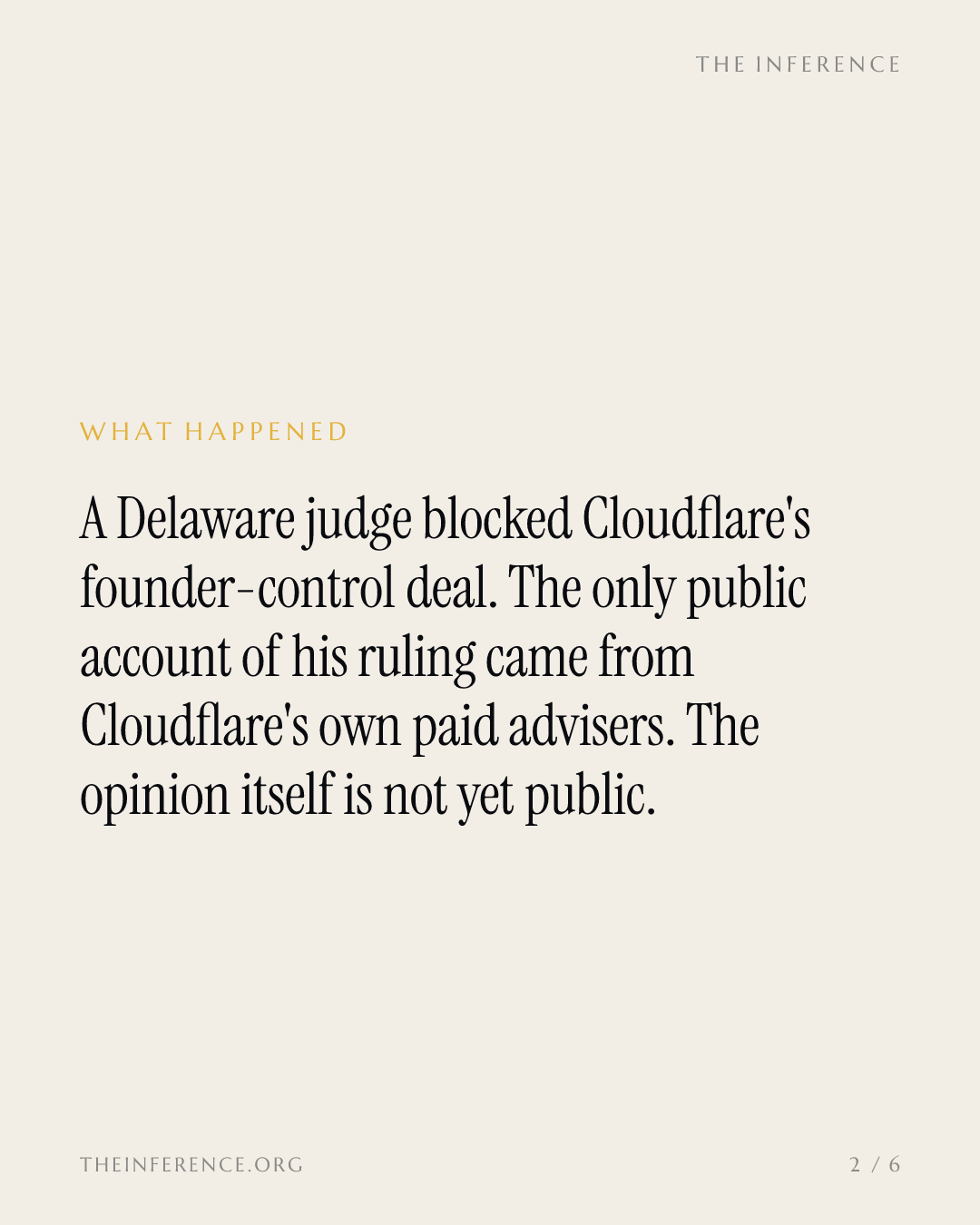
The only public account of the Delaware ruling that froze Cloudflare's+4.08% — Cloudflare, up 4.08 percent today founder-control deal was written by the losing side. Jeffrey Sonnenfeld and Steven Tian of Yale's Chief Executive Leadership Institute, retained by Cloudflare's special committee during its deliberations, published the first commentary on November 2. 1 No independent coverage has surfaced, and the 142-page opinion by Vice Chancellor J 4. Travis Laster is not yet on the Delaware courts' public opinions index as of today. 4 That gap is the story.
The court conceded nearly everything, then enjoined the deal anyway
The facts the advisers concede are striking. Laster held Cloudflare's committee of independent directors independent, not negligent, and its process showed "all the outward signs of diligent and careful effort." He enjoined the recapitalization anyway, ruling the process failed Senate Bill 21's good-faith requirement. 12
Laster wrote that without the defendants' "credibility problems" he "could have concluded" the safe harbor applied. 1 The statute, passed in March 2025 to stop activist injunctions, now protects a deal only until a trial judge reads the text messages. 1 The advisers argue the court inferred intent from Signal chats, auto-delete settings and a CEO's temper, none of it scienter, the legal term for knowing wrongdoing. 1 Maybe so, but it is their client's case in essay form. 1
The money moves on Wednesday
The stakes are concrete. Cloudflare sought the reclassification to retain founder voting control after a stock up about 1,800% since its 2019 IPO; the deal is frozen pending a possible Delaware Supreme Court review. 12 Meanwhile the stock, down 14% last week to $280.70 in an AI-software selloff unrelated to the ruling, reports Q3 on November 5 with a 31% growth guide at roughly 190 times forward earnings. 3
The business itself is intact but margin is bleeding: gross margin fell from 77.7% in Q3 2024 to a low of 71.2% in Q1 2026 over six quarters, with a slight uptick to 71.8% last quarter. 5
Gross margin slid from 77.7% to 71.2% in six quarters, then ticked up
Data
| GAAP gross margin | |
|---|---|
| Q3 '24 | 77.7% |
| Q4 '24 | 76.4% |
| Q1 '25 | 75.9% |
| Q2 '25 | 74.9% |
| Q3 '25 | 74% |
| Q4 '25 | 73.6% |
| Q1 '26 | 71.2% |
| Q2 '26 | 71.8% |
The exit ramp is already crowded
The wider ledger: 44 reincorporation proposals this year, up from 17 two years ago, against Delaware's hold on over two-thirds of the Fortune 500. 1 Committee-process deals now carry trial risk that no checklist clears, so founders pay with frozen restructurings and minority holders with litigation overhang, and boards that can leave will price that in. Watch the Delaware Supreme Court's docket and Wednesday's print; both reprice the founder-led names at once.
Get Policy & Labor by email, free
The rules governments write for AI, and what AI does to jobs. In our daily email, every weekday.