eMemory closed up 6.12% after a 'miss' wire; royalties grew 27.1%, up from 7.8%
Taipei answered the Taiwanese IP licensor's faster-royalty-growth guidance with a 6.12% close at NT$2,340, against a wire headline calling the quarter a miss. The promise leans on PUFrt security silicon inside Nvidia's Vera Rubin platform, whose royalties were promised for this half under an interim chief executive.
 Richard Tangthree-minute read
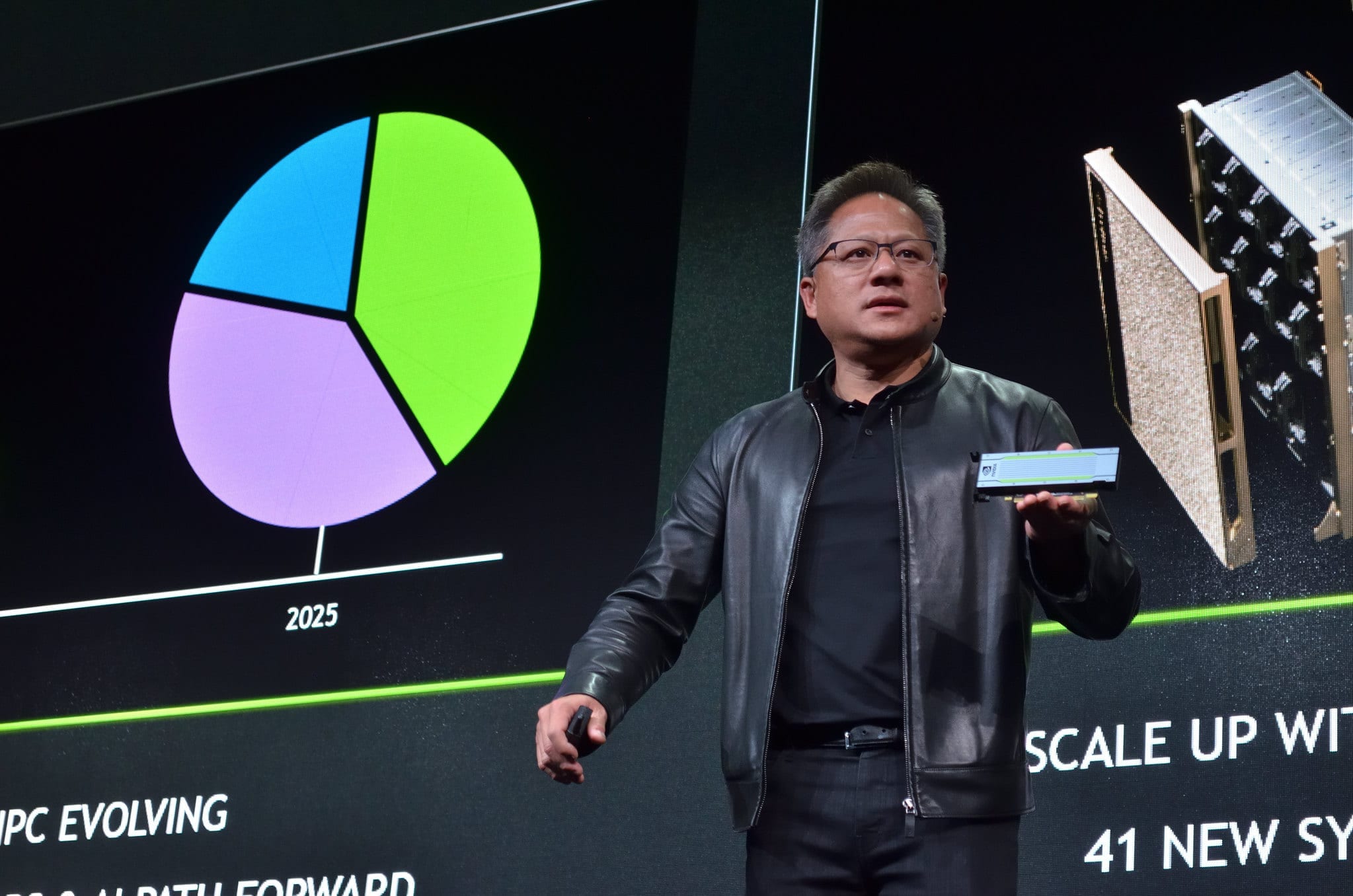
The transcript headline and the Taipei close disagreed, and the slides explain why. The wire read "eMemory Q3 2026 misses forecasts as stock slips" 3; by the November 13 close the shares stood at NT$2,340, up 6.12% 2. What the market bought was in the company's own deck: continued licensing momentum and faster royalty growth, on advanced nodes, product ramps and AI security demand 1.
The royalty acceleration promised in August arrived in the print
Third-quarter royalties grew 27.1% year on year 1. In the second quarter they grew 7.8%, after a first-quarter dip caused by a Taiwan foundry customer's sale, and management told investors then that royalty growth would accelerate in the second half as new designs reached mass production 78. Royalties are the heart of the model, about 70% of revenue, collected on every wafer carrying eMemory's circuitry+6.12% — eMemory's circuitry, up 6.12 percent today across hundreds of production processes 7. PUF-based security revenue, the fastest line in the deck, more than tripled 1.
The royalty acceleration eMemory promised for the second half arrived in Q3
Royalty growth more than tripled from Q2 to Q3; security IP grew even faster
- Q2 2026
- Q3 2026
Data
| Q2 2026 | Q3 2026 | |
|---|---|---|
| Royalties | +7.8% | +27.1% |
| PUF-based revenue | +153.8% | +213.1% |
Caliptra turned chip identity into a requirement, and eMemory sells the answer
The engine behind that line is a standard. Caliptra, the Open Compute Project's open specification for a hardware root of trust, gives every chip in a cloud server a verifiable identity and a trusted boot path, and it is spreading across CPUs, GPUs, accelerators and networking silicon 56.
The spec needs three things on the die: a unique device secret, secure one-time-programmable storage, and a qualified randomness source 7. PUFrt supplies all three, keyed to manufacturing variation no attacker can copy, and it already sits inside server-management chips from ASPEED and in security systems at major memory and networking chipmakers 5.
Vera Rubin carries it, and the royalty ramp with it
Nvidia's−3.21% — Nvidia, down 3.21 percent today next-generation Vera Rubin platform carries it too, adopted, by the chairman's February account, with royalties set to grow significantly this half 4. The spec creates the requirement; eMemory did the work of making it manufacturable, and is paid back one wafer at a time.
The royalty ramp rests on a shipping date, not a signed order
Every link up to here is observable in silicon or in reported revenue. The last one is a schedule. Vera Rubin was promised for volume in this half, and it now ships under finance chief Colette Kress, interim chief executive since founder Jensen Huang resigned on November 12 4.
Nvidia reports its own quarter on November 17 4, and no document yet says the royalty ramp holds its dates 4. That is what 73.7 times trailing earnings buys 2: a demand link already etched into data-center chips, and a timing link still a promise, in a stock that had already nearly halved from its peak before this week 4.
Get Chips by email, free
How AI demand is reshaping chipmakers, memory and the fabs behind them. In our daily email, every weekday.

More about NVIDIA
NVDAFiscal Q2 2027Revenue rose 106% to $96.2B, 92.5% of it from Data Center, “driven by the ramp of our Blackwell Ultra infrastructure”. Gains on equity stakes of $7.8B lifted net income to $59.7B.
Show as a table
| Line | Value |
|---|---|
| Revenue | $96.2B |
| Gross margin | 75.0% |
| Operating margin | 66.2% |
| Net income | $59.7B |
| Hyperscale | $48.7B |
| AI clouds & enterprise | $40.3B |
| Data Center | $89.0B |
| Edge Computing | $7.2B |
| Gross profit | $72.1B |
| Cost of revenue | $24.1B |
| Other income | $7.8B |
| Operating income | $63.7B |
| Operating expenses | $8.4B |
| Tax | $11.8B |
| R&D | $7.1B |
| SG&A | $1.4B |





Reader comments
0 comments