FERC accepted Duke's 15-year data center payment floor. The security behind it lasts 90 days
The federal regulator has accepted Duke's wholesale payment floor for big data center loads. The dissent's math is the story: one month of security behind a 15-year promise, and the upgrade bills stay out of public view.
 Vincent Jiang · 3 min read

On October 9 the Federal Energy Regulatory Commission accepted Duke Energy−0.16% — Duke Energy, down 0.16 percent today Carolinas' rewritten standard service agreement, the contract wholesale buyers sign to move power over Duke's lines. The buyer is often not the AI campus itself but a utility or public power agency serving it.
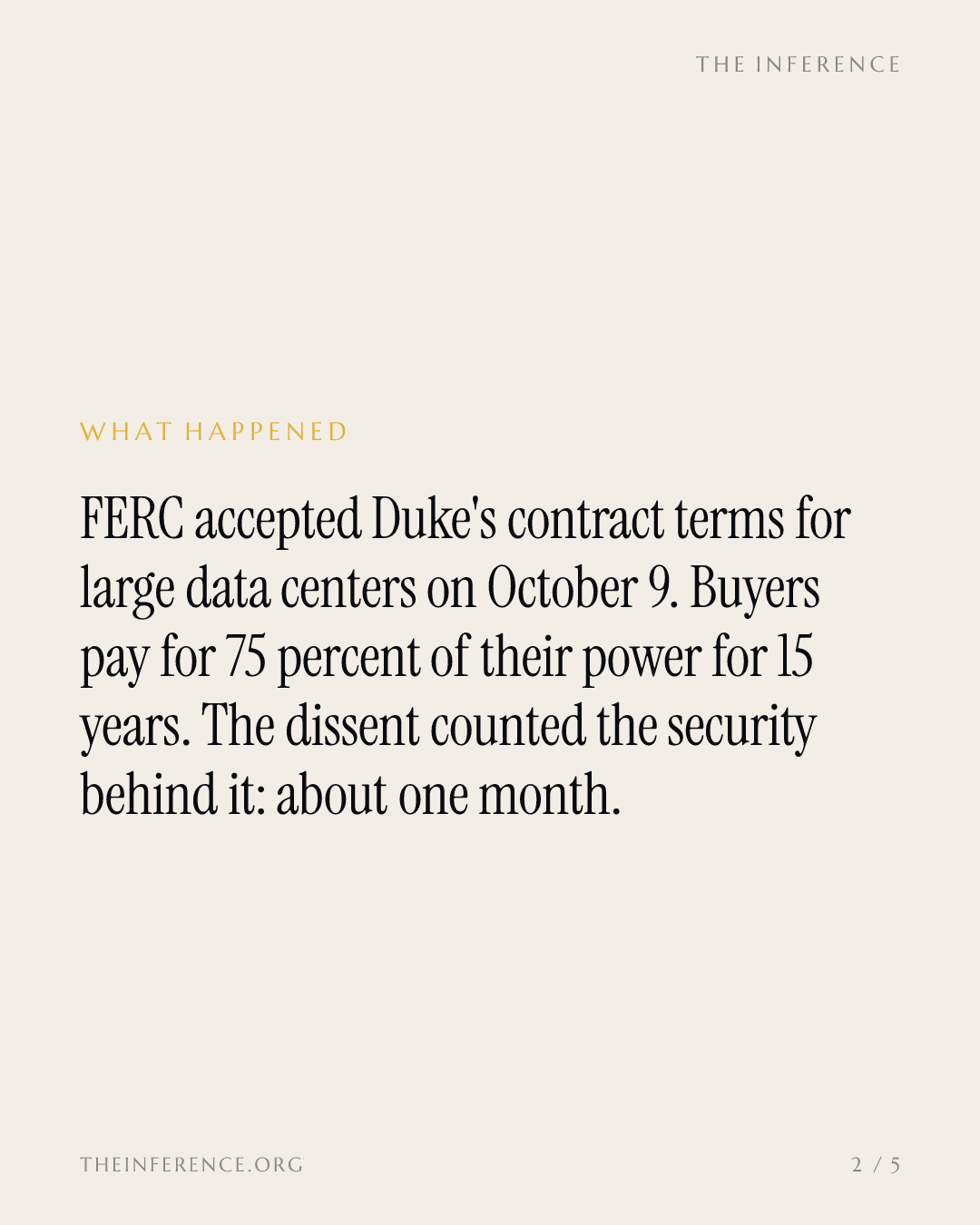
For any request of 100 megawatts or more, the contract now carries a Committed Revenue Contribution: the buyer pays for at least 75 percent of its scheduled megawatts every year for 15 years after the grid upgrades enter service, and a load scheduled at 200 megawatts pays for at least 150 even if the servers never spin 1. A shortfall invoice comes due within 20 days, and the requested size locks once Duke identifies the upgrades it needs 1.
The promise runs 15 years. The collateral runs 90.
That is the dissent's arithmetic. The order adds no new security against a default. Duke relies on its general terms, which release the buyer's collateral within 90 days after the upgrades enter service, leaving, the dissenting commissioner estimated, about one month, at most five, of revenue backing a 15-year promise 1. If the buyer walks, the remaining cost rolls into the rates every other customer pays. The contracts themselves are reported to FERC quarterly rather than filed, so the upgrade cost behind each AI deal generally stays out of public view 1.
Duke's own testimony shows what is at stake: a 200 megawatt load needing $40 million in upgrades, which Duke priced at $4.11 per kilowatt-month for the driving customer against $2.66 spread across everyone 1. FERC rejected that earlier version in December 2025, and one concurring commissioner now calls the 75 percent floor possibly the low end of lawful, urging a separate higher rate for unusually costly upgrades 1.
The market is pricing the risk, not celebrating the win
North Carolina's retail twin, a 75 percent minimum bill plus upfront connection costs settled October 7, still needs state approval, and state regulators must approve it before it takes effect 16. Attorney General Jeff Jackson calls it a "massive step forward," then adds the tell: more transparency, more accountability, more protections for ratepayers 6. Florida's commission is hearing Duke's data center proposal separately 4.
Seven brokers cut Duke Energy price targets in the two weeks after the order: Barclays+0.78% — Barclays, up 0.78 percent today to $124, Jefferies+0.20% — Jefferies, up 0.20 percent today to $121, JPMorgan to $130, KeyBanc to $128, Goldman Sachs+1.45% — Goldman Sachs, up 1.45 percent today to $143, BTIG to $135 and Morgan Stanley+1.60% — Morgan Stanley, up 1.60 percent today to $128, against a $121.33 close and a $132.78 consensus 23. The floor converts uncertain ratepayer exposure into contracted revenue, and the market still trimmed. Duke reports third-quarter results November 5 2.
After FERC's order, every new broker target sits above the close but below old highs
Data
| Value | |
|---|---|
| Jefferies | $121 |
| Barclays | $124 |
| KeyBanc | $128 |
| Morgan Stanley | $128 |
| BTIG | $135 |
| Goldman Sachs | $143 |
What is next
The counterpoint is real: a 15-year take-or-pay floor is exactly the protection ratepayer advocates asked for, and Virginia's regulator, by contrast, has settled only who pays for data center hookups, leaving the expensive upgrade question open 7. But a guarantee is only as good as the security behind it. Watch the North Carolina commission's ruling on the retail tariff, and the first quarterly report showing how much committed revenue actually sits behind these upgrades. Whether the market learns to price the 90-day gap the way the dissent did is the test that follows 7.
The daily newsletter