Figma's $16 seat now buys at most ten AI-generated flows a month
Figma's design agent left beta on October 6 and now burns credits Figma cannot price in advance and will not refund. The first billable month is the first reading on an AI revenue line investors doubted when they sold the stock down 16.5% after a beat-and-raise quarter.
 Vincent Jiang · 3 min read
A free habit gets a meter
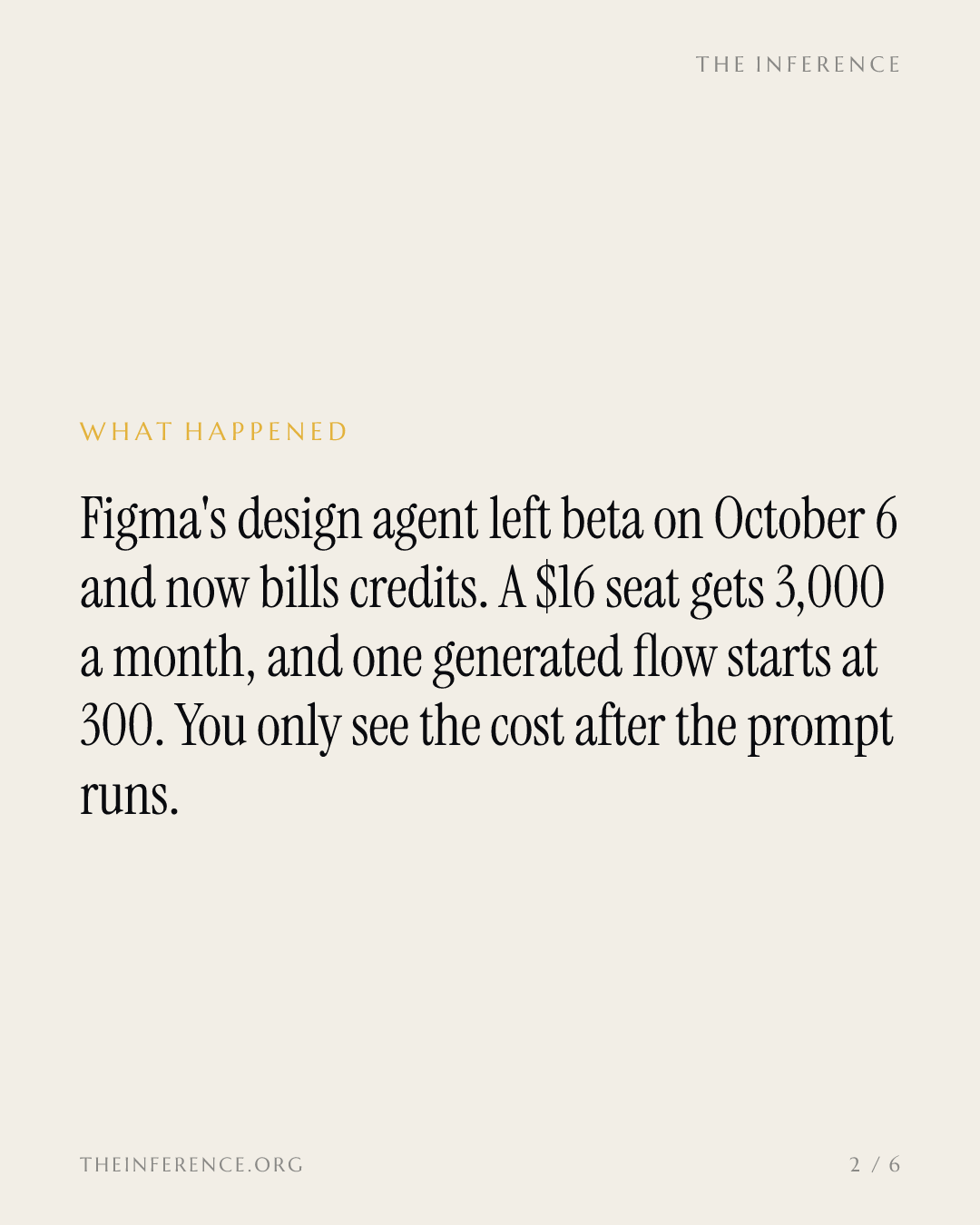
For four and a half months the Figma agent ran free. On October 6 the beta ended and every prompt began drawing from the one credit pool that also pays for Figma Make 124. The price list arrived as floors, not quotes: roughly 30 credits to change a design's fonts, 100 to summarize a canvas, 300-plus to generate a five-screen mobile checkout flow 1.
Full seats carry 3,000 credits a month on Professional, a $16 seat; Organization carries 3,500, Enterprise 4,250, and every cheaper seat gets 500, with Starter held to 150 a day 13. Ten generated flows a month is the ceiling on the seat Figma targets most 1.
Professional seats get 3,000 credits a month, about ten generated flows at the 300-credit floor
Data
| Value | |
|---|---|
| Starter | 500 credits |
| Professional | 3,000 credits |
| Organization | 3,500 credits |
| Enterprise | 4,250 credits |
3,000 credits, 300 at a time
The bill arrives after the work
Nothing can be checked in advance. Figma says it cannot predict a prompt's cost before it runs; the number appears only under the finished prompt, and undo restores the file while keeping the money 1. The pool is shared with Make, and when it runs dry mid-month the loser is the designer blocked mid-task and the admin forced onto paid add-on credits 17.
The one record of real burn, the admin beta-usage CSV, froze on October 6 1. Six weeks earlier, on August 25, Figma doubled the credits in Professional add-ons and lifted Organization and Enterprise add-ons 1.6 times, at the same price 13. Twice the credits for the same money halves the effective price of a credit, cut weeks before the first billable month.
Adoption is real. The revenue was not.
First quarter of metered AI credits beat, and the stock still sold off
Q2, printed August 5, was Figma's first full quarter of AI credit monetization: revenue of $370.1 million, up 48% and a third straight quarter of acceleration, gross margin of 85%, up 2.5 points quarter over quarter with growth the CFO called accretive to gross profit, and a full-year outlook raised by $40 million 56. Over 80% of customers above $10,000 a year consumed credits weekly, one infrastructure company multiplied its credit commitment fivefold inside a quarter, and more than half used the agent weekly by July 31 5. The stock still fell 16.5% after hours, to $23.50, having opened at $85 at its July 2025 listing and traded under $20 by June 68.
Revenue growth accelerated three straight quarters even as the stock sold off
Data
| Revenue | |
|---|---|
| Q3 '24 | $198.6M |
| Q4 '24 | $217M |
| Q1 '25 | $228.2M |
| Q2 '25 | $249.6M |
| Q3 '25 | $274.2M |
| Q4 '25 | $303.8M |
| Q1 '26 | $333.4M |
| Q2 '26 | $370.1M |
Through the beta, Figma Agent and its sibling products "do not currently consume paid credits," the CFO said, and Figma bore the inference cost without offsetting revenue 5. Half its biggest customers built a weekly habit that, until Tuesday, earned Figma nothing.
October decides it
One number settles the trade: credits burned per seat in the first billable month. Nobody outside Figma knows an average prompt's cost, and the invoices have not landed 1. The habit is proven at scale. October prices it.
Deepdive
AI-generated from this story and its cited sources. Not investment advice.