Five lawmakers ask FERC to kill the $33.4 billion AES buyout over its return math
Warren and four House members put the fight's number in front of FERC: buyers who underwrite at 15 to 20 percent agreed to take private a utility business that historically earns 10. The same public-interest test now sits in front of the $67 billion NextEra-Dominion merger.
 Vincent Jiang · 3 min read
The letter hangs the case on a 10 point gap
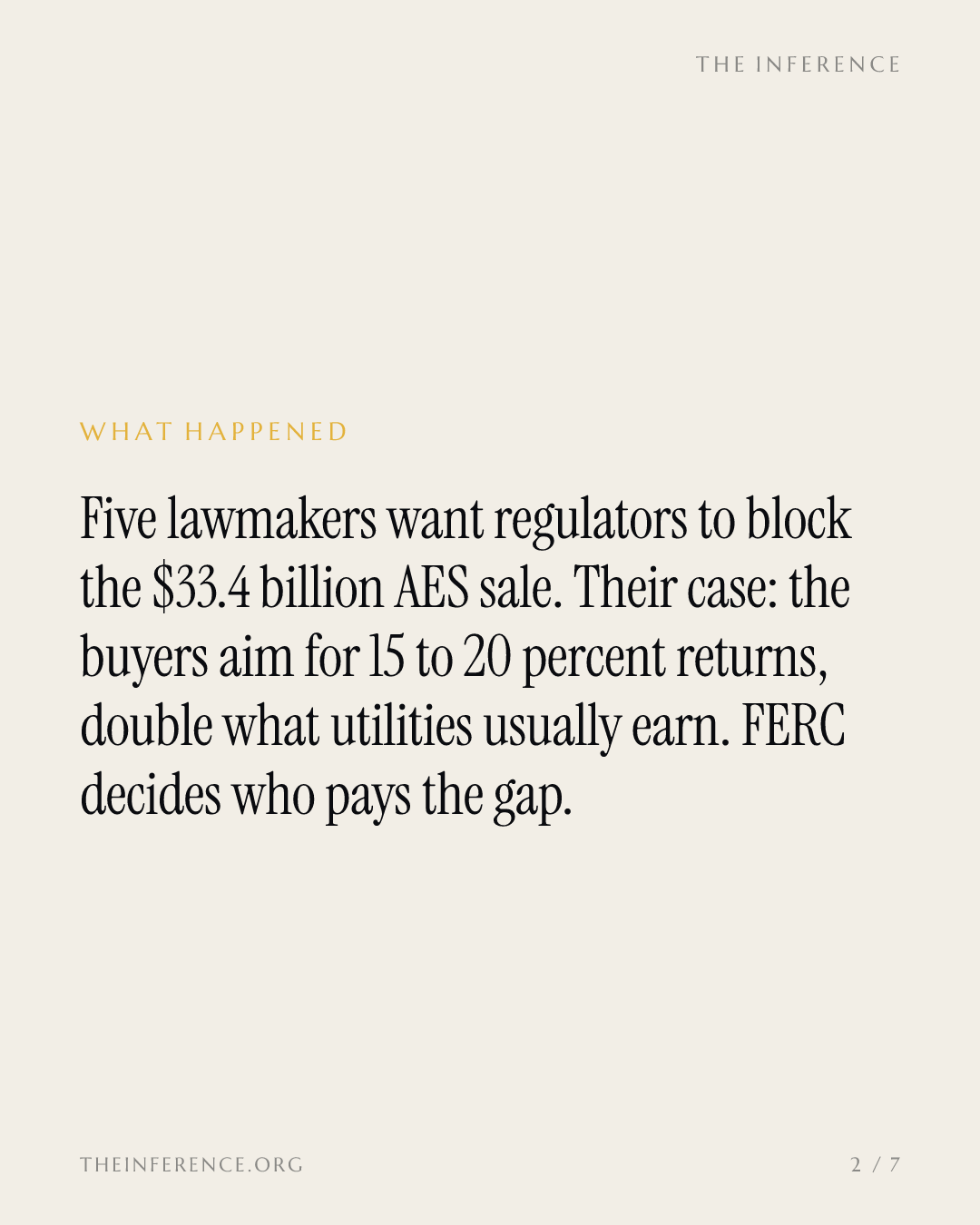
Five members of Congress asked federal energy regulators on 28 September to reject the sale of AES, one of the largest power sector transactions in recent years 12. Senator Elizabeth Warren and Representatives André Carson, Victoria Spartz, Rashida Tlaib and Ayanna Pressley signed the letter to Federal Energy Regulatory Commission Chair Laura Swett 12. The buyers, BlackRock's Global Infrastructure Partners, EQT Infrastructure, CalPERS and the Qatar Investment Authority, agreed in March to $15 a share in cash, $10.7 billion of equity and about $33.4 billion including debt 3.
Their exhibit A is one number: Global Infrastructure Partners generally seeks internal returns of 15 to 20 percent, roughly double the 10 percent historical median earned by regulated utilities 14. A business built to earn 10 has been sold to owners who underwrite at 20. The letter asks FERC to say who pays the difference.
The letter's math: the buyers underwrite at 15 to 20 percent, utilities have earned 10
Data
| Value | |
|---|---|
| Regulated utility median | 10% |
| GIP target, low end | 15% |
| GIP target, high end | 20% |
The charge reaches past one deal
The lawmakers argue structure, not just yield. BlackRock owns grid infrastructure and data centers on both sides of the meter, they write, inviting cross-subsidization: network upgrades steered toward affiliated compute, with costs spread across everyone else 1. Their sharpest line is a failure case: "if a data center fails, customers may continue paying for the unnecessary upgrades via increased utility bills" 1. Data centers are pushing United States power demand to record highs, spurring a flurry of utility mergers, some taking public utilities private 1.
AES answers with the deal's structure
AES says no premium, transaction expense or other acquisition cost will reach customers of its Indiana and Ohio utilities, which stay state-regulated, and that the sale improves its access to capital 14. Shareholders endorsed the deal by nearly 98 percent, CFIUS has cleared it, and Ohio's utilities commission signed off on 17 September 35. As The Inference reported on 27 September, Ohio drew a line while Indiana kept billing.
The capital need is real either way: AES has spent more on plant and equipment than its operations generated in every quarter since late 2024 6. Consumer groups led by the Private Equity Stakeholder Project asked FERC in July, in docket EC26-99, to block the sale outright or force BlackRock to shed its utility holdings 5.
AES capex has outrun operating cash in all eight quarters since late 2024
- Capex
- Operating cash flow
Data
| Capex | Operating cash flow | |
|---|---|---|
| Q3 '24 | $1.83B | $0.99B |
| Q4 '24 | $1.73B | $1.09B |
| Q1 '25 | $1.25B | $0.55B |
| Q2 '25 | $1.33B | $0.98B |
| Q3 '25 | $1.81B | $1.3B |
| Q4 '25 | $1.54B | $1.49B |
| Q1 '26 | $1.77B | $1.2B |
| Q2 '26 | $1.64B | $1.05B |
Two deals, one referee
The same week brought a second letter to the same commission. On 30 September, twelve Democrats led by Warren and Representative Suhas Subramanyam urged FERC to block the $67 billion NextEra-Dominion merger if it raises market concentration or consumer costs 7. The Connecticut and Massachusetts attorneys general are movants in that docket, which drew a FERC deficiency letter on 23 September 8. Five New England governors warned in August that one owner would hold plants generating nearly a quarter of the region's power 9.
How FERC prices a 20 percent buyer into a 10 percent business is likely to set the terms for every utility now chased by AI load, because its public-interest test is the one gate each of these deals must pass. The parties expect the AES sale to close in late 2026 or early 2027, pending FERC 13, which gives the gap between AES shares and the $15 offer its clock; docket EC26-99 is where to watch it run.
Deepdive
AI-generated from this story and its cited sources. Not investment advice.