Fractile, valued at $7 billion, says its product chip goes to the factory in a few months
Founder Walter Goodwin told the 20VC podcast that test chips are back and trial runs continue, with first systems promised for next year. He said most of the $720 million round is for locking up parts years ahead, from corners of the supply chain his rivals have left.
20VC with Harry StebbingsNov 14, 2026
Taking on NVIDIA: Fractile CEO on the Future of Chips
- Walter GoodwinFounder and CEO, Fractile
- Harry StebbingsHost, 20VC
 Vincent Jiangfour-minute read
Test chips are back, and the product design has not been sent
Walter Goodwin, founder and chief executive of Fractile, a British startup that designs chips for running AI models, gave the timing in an interview on the 20VC podcast published November 14 1. Three days earlier Fractile had announced a $720 million funding round that values it at about $7 billion 24.
Host Harry Stebbings put to him another founder's complaint that the chip industry has "a lot of marketing fluff, but there's not much actually in production." Goodwin answered: "Yes, Fractile has silicon that's gone through the foundries, has come back to us. Yes, we're running further trial runs, and we'll be doing sort of full product tape-outs in a few months" 1.
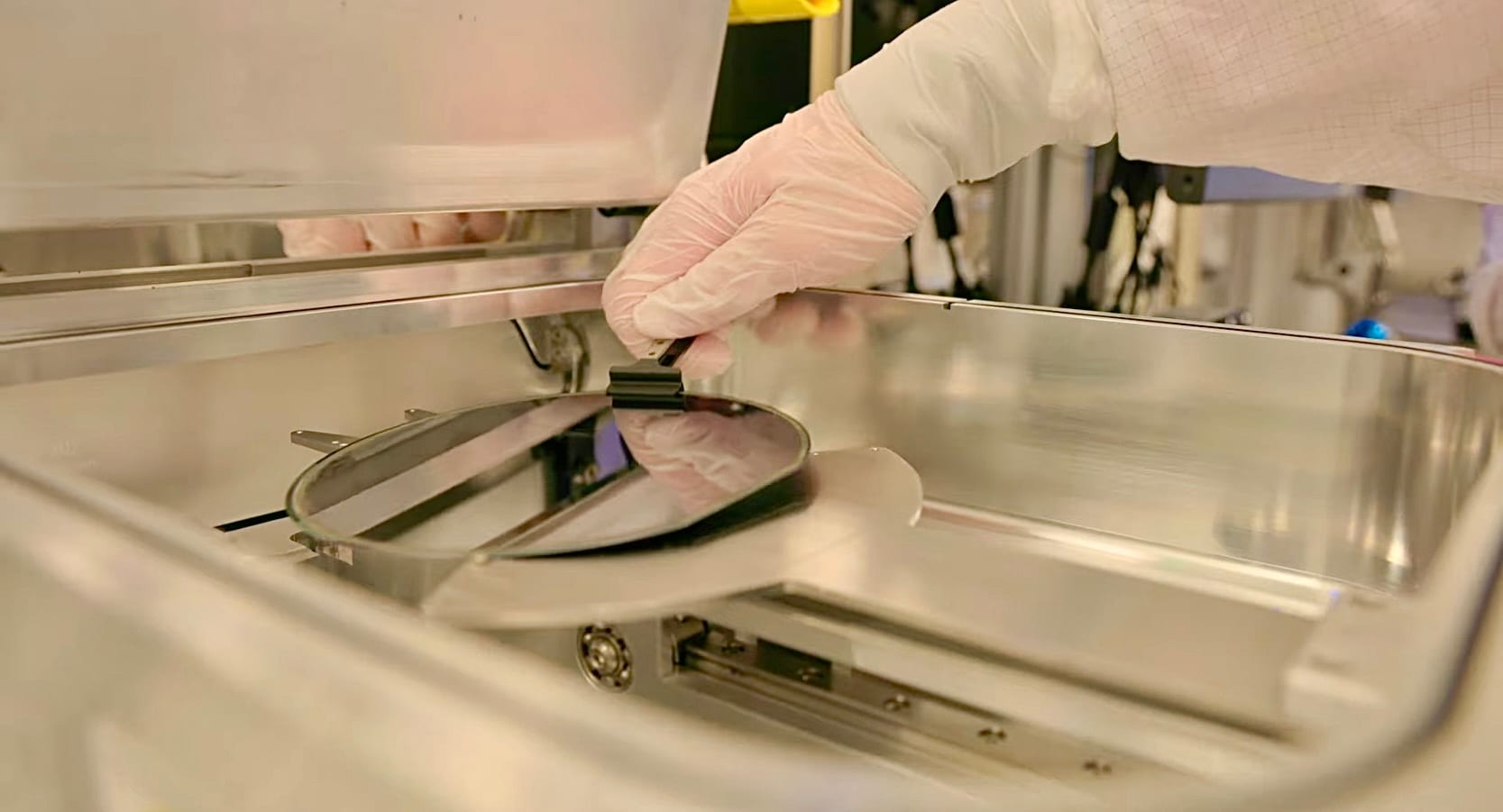
A tape-out is the day a finished chip design is sent to the factory, called a foundry, which builds the stencils used to print it. After that the design cannot be corrected, Goodwin said, so a bug in the file is built into the chip 1.
The schedule leaves little slack in 2027
Goodwin wrote on LinkedIn that the new money will let Fractile "ship [its] first chips and systems next year" 2. In August, Bloomberg reported that Anthropic$350B — Anthropic, private, latest valuation $350B, the maker of the Claude models, had reached an initial agreement to buy roughly $250 million of Fractile chips, and that they would not be ready for use until 2027 5.
By Goodwin's own account, a tape-out is followed by months of waiting for chips to return from the foundry, then by getting software to run on one chip, then on a whole rack of them 1. Fractile's internal finish line is what it calls task zero: "the day that a particular reference workload runs on an entire rack of Fractile chips" 1.
A design sent early next year would have to come back, pass testing and fill racks before the year ends for the shipping target to hold.
Fractile says it avoids the parts its rivals queue for
Goodwin said many custom AI chips, including Google's TPU, Meta's+2.23% — Meta, up 2.23 percent today MTIA and OpenAI's$1.18T — OpenAI, private, latest valuation $1.18T Jalapeno, "are rumored to be using Broadcom−6.53% — Broadcom, down 6.53 percent today" as their back-end partner, the company that does the final physical design and deals with the foundry 1. They also use similar manufacturing lines at TSMC−2.68% — TSMC, down 2.68 percent today, the Taiwanese foundry, and the same high-bandwidth memory, or HBM, which he said is short for years ahead 1.
He recalled Broadcom executive Charlie Kawwas showing a model of its next platform at a conference this summer and saying it would be in production "with six major customers in 2028" 1.
Fractile has "always had that in-house," Goodwin said 1, a point its investor Lightspeed also makes 3. Its design stacks ordinary memory, called DRAM, directly on top of the processor instead of placing HBM beside it 3. Goodwin said that lets it use "a different process node, maybe a slightly different DRAM node or DRAM generation" from the newest HBM, and "build gigawatts of capacity sort of down the back of the sofa" with supply that other chip platforms "have already moved away from" 1.
Memory, not arithmetic, sets how fast a model answers
The design follows from a gap Goodwin put numbers on. Over the last 25 years, he said, the calculating power of these chips has grown "about a million fold," while the rate at which data moves between memory and processor has grown "about 40 fold" 1.
Each word a model writes requires loading the model's weights from memory, so that slower link caps the speed 13. Chips that hold memory on the processor itself, the approach of Groq$3.5B — Groq, private, latest valuation $3.5B and Cerebras, are fast but hold too little, he argued: "You cannot solve LLM inference with these SRAM-based chips. There isn't enough capacity" 1.
Groq is reported to be moving the same way: ZDNet Korea said in October that its next chip will stack DRAM in place of SRAM 7. Goodwin sells a competing design, and Fractile has not shipped a product.
Most of the $720 million is for supply, not the first chip
Asked what the round changes, Goodwin said the cost of getting a first chip and first systems out has been "a kind of fixed cost for the last few years. And in some sense, that's not what most of this capital is used for" 1. He said it pays for "the placing of long-term agreements over certain components that we need to have years into the future," and for work on later chip generations, networking and Fractile's own AI research 1.
He also said Fractile was joined "just a few weeks ago" by Dan Rabinovitsj from Meta to run its systems work, from the chip up to racks, networking and data-center integration 1. Rabinovitsj was Meta's vice president for hardware and AI systems infrastructure engineering in October 2025 6.
Three markers: the tape-out, task zero and the Anthropic order
The first marker is the tape-out itself, which Goodwin placed a few months out 1. The second is task zero, a full rack running a real workload 1. The third is whether Anthropic's reported $250 million commitment becomes a delivery in 2027 5.
Get Chips by email, free
How AI demand is reshaping chipmakers, memory and the fabs behind them. In our daily email, every weekday.



Reader comments
0 comments