Gartner sees $4 trillion of AI spending in 2027, but a positive AI return now costs 18 times more
Gartner's own release credits part of the server bill to memory-price inflation, and its analysts told chief information officers this week that positive returns now cost 18 times more to reach than two years ago. Anyone marking AI vendor revenue against the first number has to price the second.
 Richard Tangthree-minute read
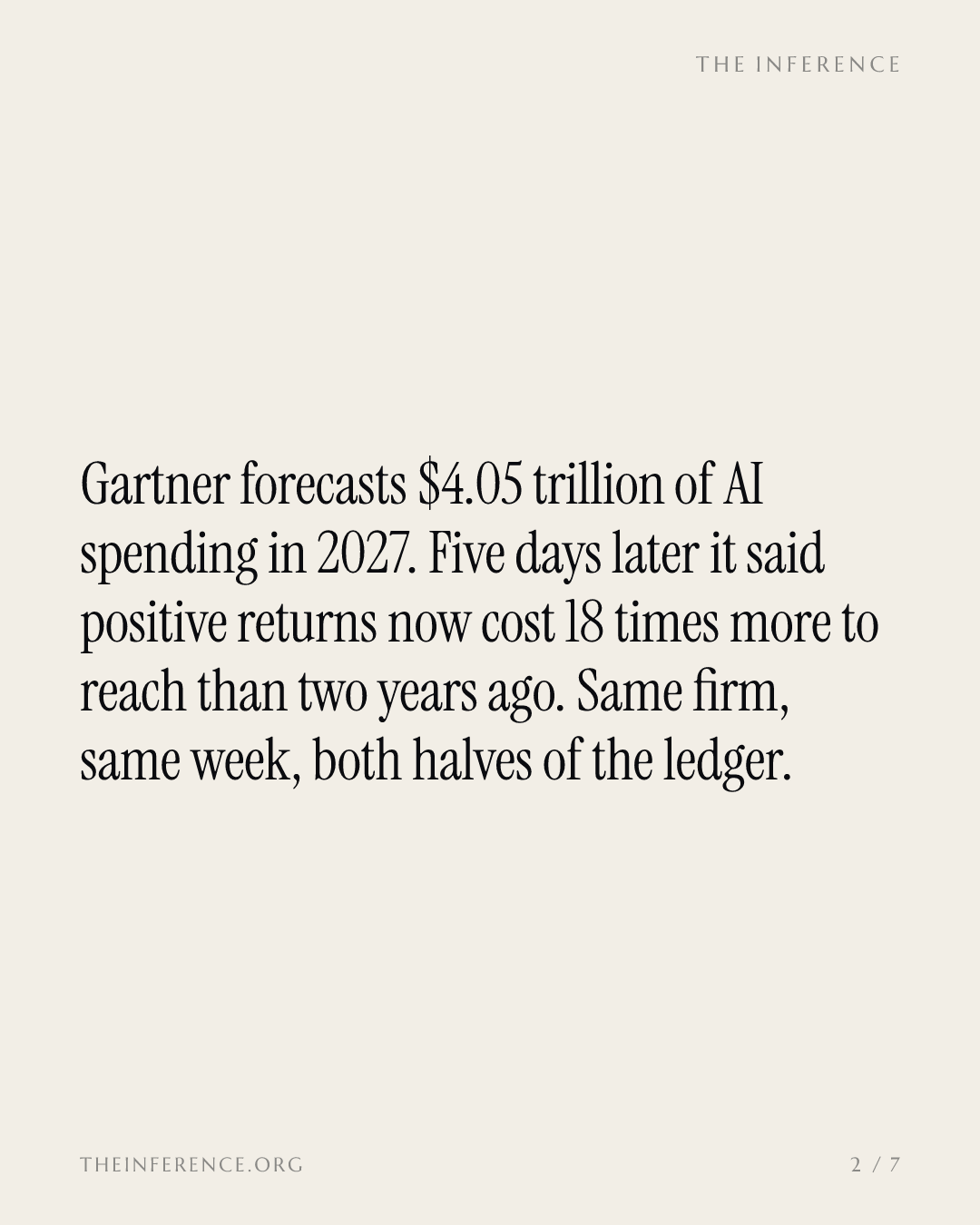
Within five days, Gartner−2.16% — Gartner, down 2.16 percent as of its last quote published both halves of the AI trade's ledger. On November 12 the research firm forecast $4.05 trillion of global AI spending for 2027, 59% of it infrastructure 1; today, at its IT Symposium/Xpo in Kochi, India, its analysts reported that companies now spend 18 times more to reach positive returns on AI than two years ago 2.
The forecast is the demand anchor the AI supply chain trades on; the symposium findings say what that spend is actually buying. Coming from the same firm days apart, each softens the other.
Infrastructure takes 59% of Gartner's $4.05 trillion 2027 AI forecast
Infrastructure alone outspends every other segment combined
- Estimate
Data
| Value | |
|---|---|
| AI infrastructure (estimate) | $2,397B |
| AI services (estimate) | $746B |
| AI software (estimate) | $649B |
| AI cybersecurity (estimate) | $86B |
| AI agents and assistants (estimate) | $67B |
| Generative AI models (estimate) | $51B |
The server bill is partly a memory-price story
The infrastructure line is not only more machines. Spending on AI-optimized servers climbs from $528 billion this year to $957 billion in 2027, and Gartner credits part of the rise to what it calls memflation, rising memory prices lifting server prices 13. The firm said in April that relief was unlikely before late 2027, and its chief of research, John-David Lovelock, said in October the squeeze could persist into 2030 3. The release never splits price from volume, so the inflation slice cannot be sized from it 1.
The forecast touches the server suppliers Nvidia−3.99% — Nvidia, down 3.99 percent today, Dell and Super Micro−6.80% — Super Micro, down 6.80 percent today 3, and part of what reads as demand growth on that line is price inflation.
Nvidia and Super Micro revenue has multiplied fivefold since late 2023
- Nvidia
- Dell
- Super Micro
Data
| Nvidia | Dell | Super Micro | |
|---|---|---|---|
| Q3 '23 | $18.12B | $22.25B | — |
| Q4 '23 | $22.1B | $22.32B | $3.67B |
| Q1 '24 | $26.04B | $22.24B | $3.85B |
| Q2 '24 | $30.04B | $25.03B | $5.36B |
| Q3 '24 | $35.08B | $24.37B | $5.94B |
| Q4 '24 | $39.33B | $23.93B | $5.68B |
| Q1 '25 | $44.06B | $23.38B | $4.6B |
| Q2 '25 | $46.74B | $29.78B | $5.76B |
| Q3 '25 | $57.01B | $27.01B | $5.02B |
| Q4 '25 | $68.13B | $33.38B | $12.68B |
| Q1 '26 | $81.62B | $43.84B | $10.24B |
| Q2 '26 | $96.22B | $46.97B | $11.12B |
| Q3 '26 | — | — | $19.95B |
Buyers still convert one project in five
On the paying side, conversion has not moved. Neha Kumar, Senior Director Analyst at Gartner, told the Kochi audience the success rate is still one project in five, unchanged from the same stage a year ago, and only 52% of more than 1,000 surveyed leaders report any positive value at all 2. That sits in the same family as the finding we reported on October 29, that 97% of companies could not turn AI into savings 4, so the stall reads as a trend rather than a one-off.
The buildout needs $8.5 trillion it will not earn
Gartner's October analysis already priced the supply-side consequence: AI data center owners need $8.5 trillion of revenue through 2030 to cover announced capital spending, against at most $3.6 trillion it expects them to earn, and it expects more than 80% of neoclouds, the specialized AI cloud providers, to stop operating independently by 2030 5. The missing link is the redesign of work between buying compute and banking savings; as Gartner VP Analyst Nate Suda put it in Kochi, time saved is not money saved 2.
The tollbooth collects on both sides
Gartner sells research to the vendors who quote the forecast and to the chief information officers who must convert it, so both camps keep paying it. Its shares closed the week at $192.15 on a hold consensus, with full-year results due February 2 6; the subscription book we examined on November 3, contract value up 2.5%, is the quiet core underneath 7. This week gave both camps a fresh reason to renew.
Underwrite AI infrastructure at the $2.4 trillion line only after the two haircuts its own source applied in the past five days: memory-price inflation inside the bill, and conversion failure behind it 12. The forecast already assumes the spend, so what actually moves vendor revenue is whether that one-in-five success rate changes 2. The buildout is still worth backing, because capability keeps compounding, and buyers who redesign work will keep the gains that Gartner warns could otherwise leak to vendors and outsourcers 2.
Get Data Center by email, free
Who is building AI's data centers, and who is paying for them. In our daily email, every weekday.


Reader comments
0 comments