Gartner's 506% profit jump leans on a year-ago write-down; subscription contract value grew 2.5%
The headline profit jump is an accounting comparison plus a buyback. Contract value, the demand line for Gartner's research subscriptions, grew 2.5% as its own survey shows clients now rank misjudging AI among their biggest risks.
 Richard Tang · 3 min read
Gartner−11.59% — Gartner, down 11.59 percent today reported two earnings this morning, and the one in the headlines is the least informative. The 506% profit jump at the research and advisory firm (NYSE: IT) mostly measures a depressed year-ago quarter 1. The line that describes the business is contract value, Gartner's forward book of subscription commitments: up 2.5% year over year on a currency-adjusted basis, to $5.3 billion 1. Paid advice is still growing in the AI era, barely. 1
The profit spike is a comparison effect, and the EPS beat is the buyback
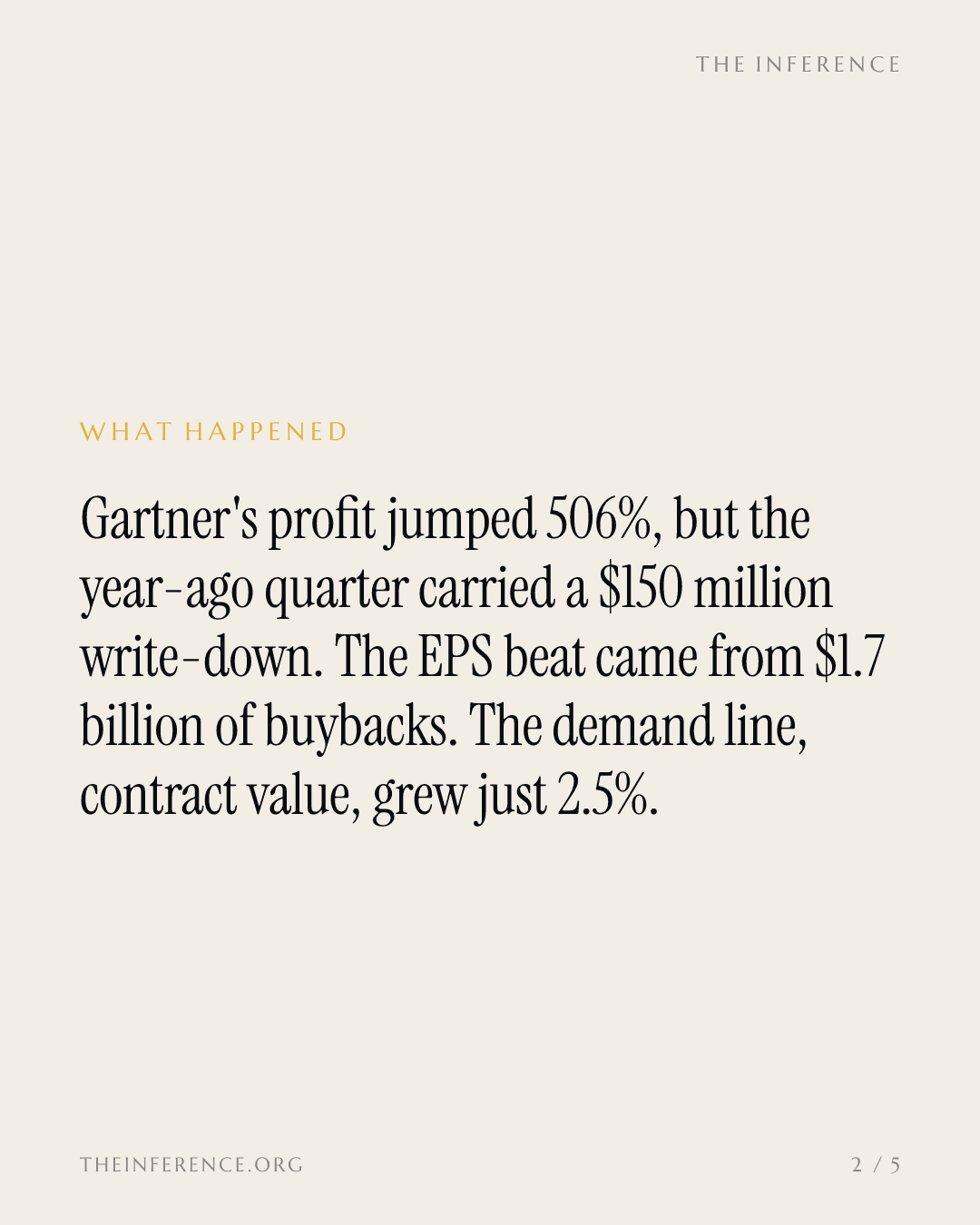
The 506% is arithmetic 12. The year-ago quarter swallowed a $150 million goodwill write-down on Digital Markets, the unit Gartner sold in February. 12 Adjusted earnings per share rose 30% on a diluted share count about 11 million lower than a year ago. 1 Gartner spent $1.7 billion on buybacks across the last four quarters while operating cash flow slipped. 1 The consensus beat was large, and it came from the treasury rather than the sales force. 3
Buybacks can manufacture earnings per share. They cannot manufacture demand for advice.
The lines closest to customer demand grew the slowest
Data
| Value | |
|---|---|
| Adjusted EPS | 30.1% |
| Adjusted EBITDA, ex-divested | 7.5% |
| Contract value, total | 2.5% |
| Contract value, tech side | 2.1% |
| Revenue, as reported | -1.3% |
Demand did accelerate, just not to where the street's tracker pointed
Chief executive Gene Hall's claim that "Contract Value growth accelerated again" checks out: 2.5%, up from 1.7% in the second quarter. 14 Morgan Stanley's+0.41% — Morgan Stanley, up 0.41 percent as of its last quote research tracker had pointed to 4.4%. 3 The drag Gartner identified last quarter was the US federal government; excluding it, contract value grew 3.3%. 4 Three weeks ago we argued Gartner's contract book contradicted the market's AI-casualty narrative. The new print supports that, with a limit: the book is growing, and it is crawling.
Revenue growth turned negative this year after a two-year slide
Data
| Revenue, % year over year | |
|---|---|
| Q1 '24 | 4.5% |
| Q2 '24 | 6.1% |
| Q3 '24 | 5.4% |
| Q4 '24 | 8.1% |
| Q1 '25 | 4.2% |
| Q2 '25 | 5.7% |
| Q3 '25 | 2.7% |
| Q4 '25 | 2.2% |
| Q1 '26 | -1.5% |
| Q2 '26 | -0.6% |
| Q3 '26 | -1.3% |
Clients fear misjudging AI, and the growth rate shows the caution
The same firm's quarterly risk survey, published on Monday, debuts "AI strategy miscalculation" as the third-ranked concern among 308 enterprise risk leaders, with "AI-driven competitive displacement" newly named. 5 Gartner's own CEO survey finds 44% of them cannot demonstrate AI's financial returns, even as three quarters plan to increase technology spending. 6 Its Symposium keynote told 7,500 CIOs that AI risk is compounding faster than AI value. 7
Follow the hops: promised AI returns fail to show up, discretionary advisory budgets get scrutinized, and the result lands in a 2.5% book 8. Gartner's own forecast has next year's technology spending up 15% 8. Services, the bucket advice sits in, gets 4.9%. 8 The money is flowing to machines faster than to counsel; that budget hop is inference, the numbers on either side of it are published.
Price the 2.5%, and learn what the fear points to
The EPS line keeps working as long as the balance sheet does. The contract-value line is the one that says whether companies still pay people to tell them what to do, and it is the one to watch at the fourth-quarter print.
For everyone else, Gartner's diagnosis is the actionable part: value stalls when AI is bolted onto unchanged workflows, and governance alone "will not drive value; the only thing that can do that is people." 67 The fear in that risk survey is a reason to learn AI faster, on a task you understand, and to redesign the work around it. Not a reason to wait.
Get Applications by email, free
How AI is changing the software people and companies use. In our daily email, every weekday.