GE HealthCare's manganese MRI agent matched gadolinium, a route past China's rare earths
About 65 million contrast-enhanced MRI scans a year run on gadolinium, a rare earth whose export China licenses. A manganese substitute that matched the incumbent in GE HealthCare's Phase 2 trial opens a route off that chain for the company's highest-margin segment, if Phase 3 holds.
 Vincent Jiangthree-minute read
GE HealthCare−2.00% — GE HealthCare, down 2.00 percent today said on November 19 that mangaciclanol, its investigational manganese-based MRI contrast agent, met the primary endpoint of the LUMINA trial's Phase 2 stage: blinded independent readers found overall diagnostic preference similar between it and gadobutrol, the market-leading gadolinium agent 1. It was well tolerated, with no safety concerns identified, and the Phase 3 dose is set at 0.1 mmol/kg 1. The first patient was dosed at Mayo Clinic in April 2026, and the candidate carries the US Food and Drug Administration's Fast Track designation 1.
Sixty-five million scans a year ride on one rare earth
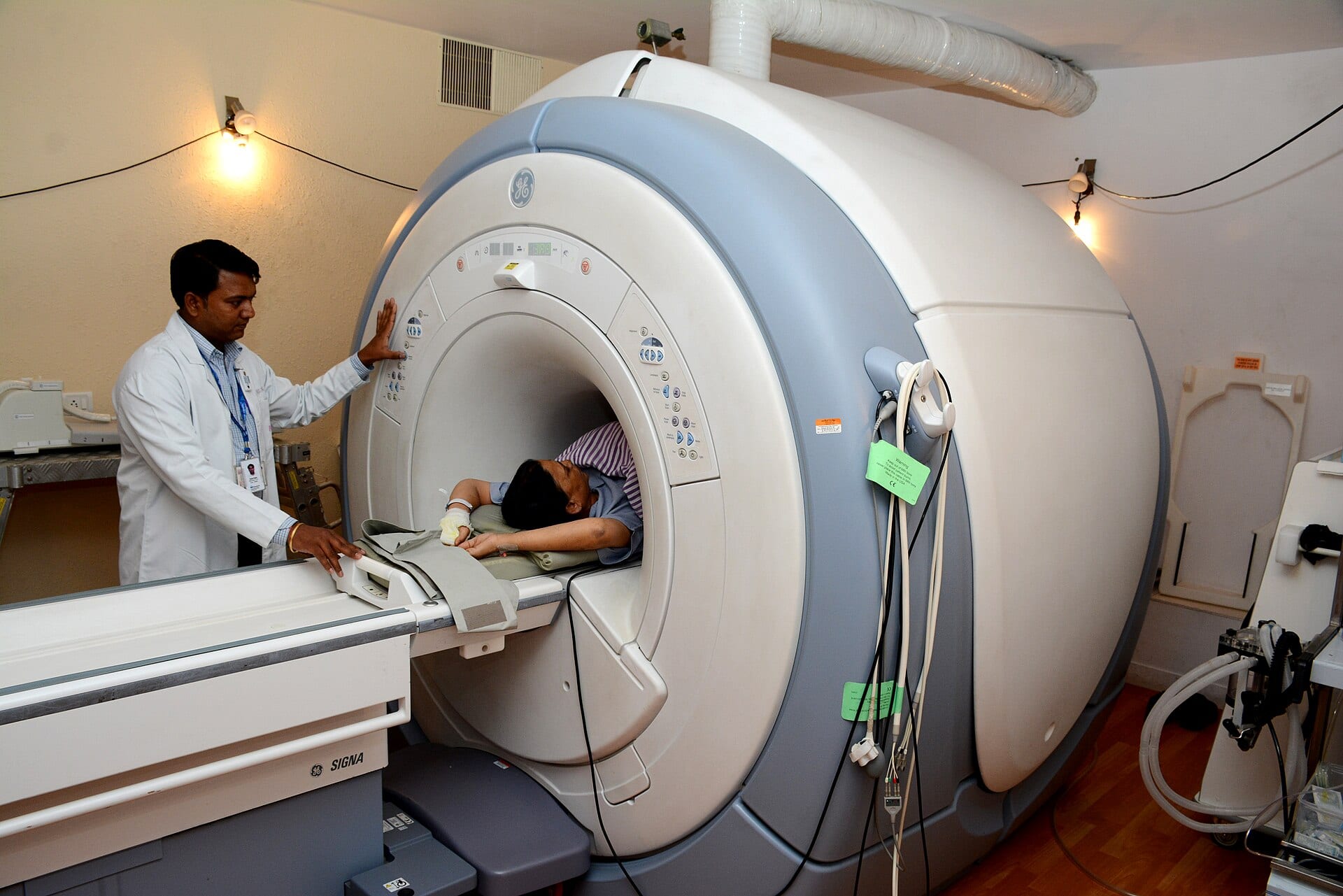
Around 65 million contrast-enhanced MRI procedures a year run on gadolinium agents, roughly a third of all MRI scans 1. GE HealthCare calls the rare earth largely dependent on Chinese mining and processing 1, and Beijing's April 2025 export licensing of seven medium and heavy rare earths, gadolinium among them, has stayed in force through every truce since 2. Manganese, an essential element the body already regulates, is available from multiple countries 1.
China's grip tightens to 97 percent down the rare-earth chain
Gadolinium sits at the end of a chain China already controls
- Estimate
Data
| Value | |
|---|---|
| Mining and extraction (estimate) | 70% |
| Refining and processing (estimate) | 90% |
| Heavy rare-earth separation (estimate) | 97% |
The hedge guards a 29.9 percent margin
Pharmaceutical Diagnostics, the unit that sells contrast agents, booked $846 million of third-quarter revenue, up 13.0 percent, or $97 million, as reported 3. Its segment EBIT margin, operating profit as a share of revenue, came to 29.9 percent, against 15.3 percent for the imaging segment, the highest of the company's three segments 3.
The contrast-agent unit earns twice the imaging unit's operating margin
Data
| Operating margin | |
|---|---|
| Pharmaceutical Diagnostics | 29.9% |
| Imaging | 15.3% |
| GE HealthCare total | 14.6% |
The unit supports 140 million patient procedures a year 1, added a $138 million plant expansion in Cork, Ireland 1, and agreed in October to pay $945 million for SOFIE Biosciences, a 15-plant PET isotope network, with the antitrust review running toward a first-half 2027 close 4. Mangaciclanol's case is supply security for a segment that already runs on gadolinium agents, not new chemistry.
Parity is a low bar, and manganese has lost before
The release carries no price, no approval date and no Phase 3 budget, and its endpoint was similarity, not superiority 1. The data stay company-reported until December 1, when the images screen at the RSNA radiology congress in Chicago 1. Manganese has lost here before: Teslascan, an earlier agent for liver MRI, was withdrawn from the US market in 2003 and from Europe in 2012 for commercial reasons 5.
The incumbent is dug in: Bayer's Gadavist, the gadobutrol brand, has sold more than 44 million US vials since 2011 at the same 0.1 mmol/kg dose, in a cage rated at more than 1,000 years before it lets gadolinium go 6. GEHC shares slipped 1.14 percent on the day 1.
December 1 puts the images on the record
Watch December 1 at RSNA, when outside readers see the images the blinded readers saw 1. The open question is whether those readers stay indifferent in Phase 3, which widens the test from the brain and spine to the rest of the body 1.
Get Health by email, free
AI in medicine, pharma and biotech. In our daily email, every weekday.





Reader comments
0 comments