Glean passed $300 million ARR, and ZoomInfo and Databricks are already ingesting its data
In two weeks Glean opened agent building to outside coding tools, its CEO preached portable context, and ZoomInfo and Databricks started pulling its data onto their own rails. The seat that paid for the knowledge graph is no longer the only way to consume it.
 Richard Tang · 3 min read

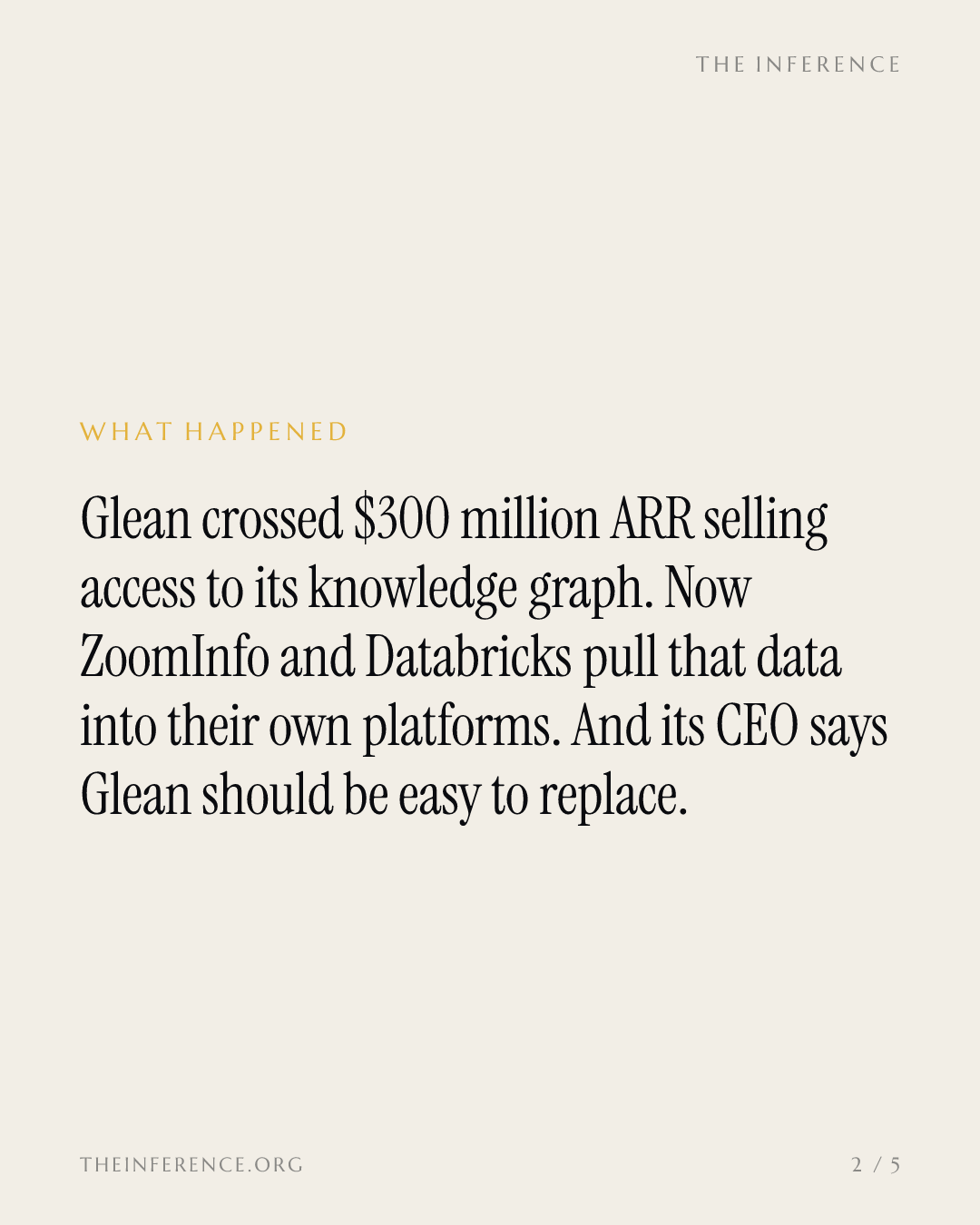
Glean's~$7.2B — Glean, private, latest valuation ~$7.2B seat business is being unbolted from both ends, and its own chief executive is doing some of the unbolting. On October 21 Glean made headless agent building generally available, letting a developer in Claude Code, Cursor or Codex write an agent as files and publish it to Glean's managed runtime, where it inherits the permissions and audit trail 1. In the same fortnight, the platforms around Glean started treating it as a source to ingest rather than a seat to buy.
The enterprise context layer Arvind Jain wants everyone to treat as a utility is exactly what Glean is trying to keep behind its own wall.
The utility pitch and the wall are the same product
The tension sits inside Glean's strategy, not between vendors. Jain, Glean's CEO, told The Next Web that Glean has passed $300 million ARR, prefers cheaper GPT models over Claude for most tasks, and wants agent memory kept portable so customers could swap Glean out 4. That is the utility pitch.
Yet the new headless builder only pays off the way Glean wants if the agent stays on Glean's runtime, where it inherits permissioned access across more than 275 enterprise sources; an agent that leaves inherits none of it 1. Jain is selling a context layer while shipping the permission wall that makes context hard to carry.
The platforms are ingesting, not subscribing
ZoomInfo+3.51% — ZoomInfo, up 3.51 percent today, the B2B data platform, is already pulling on its side: its GTM.AI headless context layer counts Glean among its integrations, and this month it shipped a ClickUp connector whose agents read live from a context graph holding more than 100 million companies and 500 million contacts 5. Databricks'$216.58B — Databricks, private, latest valuation $216.58B Lakeflow Connect names Glean, alongside Confluence, Notion, SharePoint and Google Drive, as knowledge it ingests into Unity Catalog to feed its own agents 2. When your index is an input to ZoomInfo and Databricks, the seat stops being what customers pay for.
Capability can be rented, so the moat has to be the runtime
Glean bought capability to defend the layer: it trained a search model on Thinking Machines' Tinker, a fine-tuning API, that cut search latency in half and token use by a quarter 3. Tinker's own momentum, a $100 million run-rate and a mooted $1 billion round at a $40 billion-plus valuation 3, says the fine-tuning route to differentiated context is open to any buyer. That is the pressure on Glean's moat.
The listed expression is ZoomInfo (GTM): it sells its headless context layer into Salesforce−2.64% — Salesforce, down 2.64 percent today, HubSpot−4.14% — HubSpot, down 4.14 percent today and Microsoft−0.35% — Microsoft, down 0.35 percent today seats, and it reads Glean, not the reverse. No raise or IPO is planned, so a secondary print is where any Glean mark lands. Our call: Glean's next mark should be priced as a data business with a contested runtime, not a seat-software compounder.
The listed context-layer trade has gone sideways: ZoomInfo revenue, twelve flat quarters
Data
| ZoomInfo revenue | |
|---|---|
| Q3 '23 | $313.8M |
| Q4 '23 | $316.4M |
| Q1 '24 | $310.1M |
| Q2 '24 | $291.5M |
| Q3 '24 | $303.6M |
| Q4 '24 | $309.1M |
| Q1 '25 | $305.7M |
| Q2 '25 | $306.7M |
| Q3 '25 | $318M |
| Q4 '25 | $319.1M |
| Q1 '26 | $310.2M |
| Q2 '26 | $310.4M |
Get Platforms by email, free
The cloud, data and developer software AI is built on. In our daily email, every weekday.