Goldman turns Alphabet's $514 billion backlog into a $300 billion a year bill
Google Cloud's $514 billion order book sits inside an industry pile above $1.5 trillion. Goldman's math says hyperscalers need $300 billion a year of AI revenue to break even, and $1 trillion of user spending to earn real returns.
 Vincent Jiangthree-minute read
Drafted with AI from the documents listed under Sources, then edited and fact-checked by Vincent Jiang. How we work
The charge: one order book holds a third of the promises
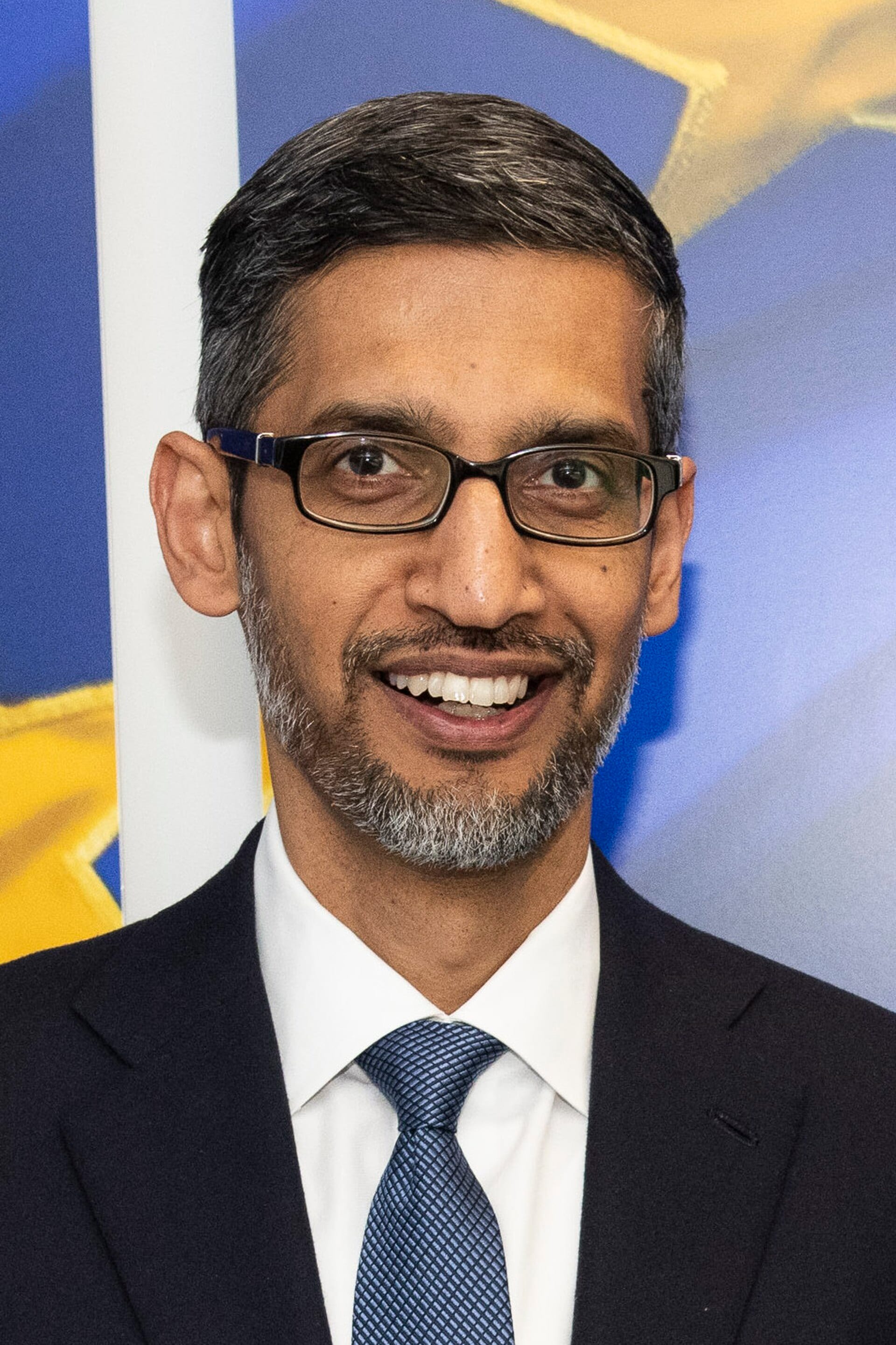
On 22 July, Sundar Pichai told Alphabet's earnings call that Google Cloud revenue grew 82% year over year and its backlog hit $514 billion 1. That order book now exceeds the $446 billion Alphabet−1.14% — Alphabet, down 1.14 percent today sold across the whole trailing twelve months 1. It swelled by more than $50 billion in a single quarter on multi-year AI commitments 2.
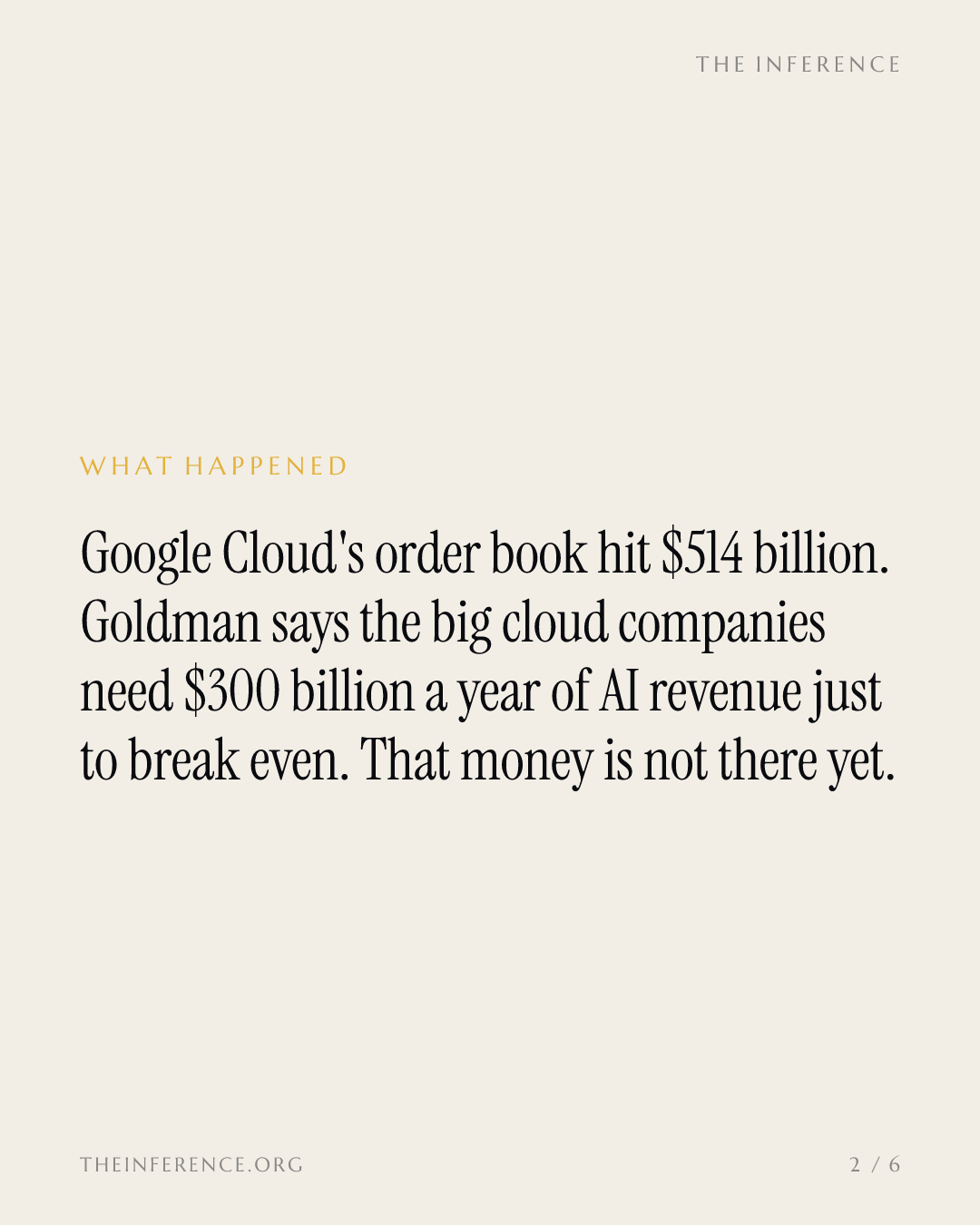
Nine weeks later, Goldman Sachs−2.62% — Goldman Sachs, down 2.62 percent today priced the other side of the promise. The largest hyperscalers need roughly $300 billion a year of AI revenue just to break even, against more than $1.5 trillion of signed backlog across the industry 3. Alphabet's book alone is roughly a third of that total.
The bill arrived before the cash
Cloud itself earned real money. The segment booked $24.8 billion of revenue, and operating income tripled year over year to $8.8 billion, a 35.6% margin 2. Cloud now supplies more than 20% of Alphabet's revenue, up from 14% a year earlier 4.
The spend side moved faster. Management lifted 2026 capex guidance to $195 billion to $205 billion, the stock fell about 7%, and the quarter closed free-cash-flow negative 5. Quarterly capex doubled in a year to $44.9 billion, now 37 cents of every revenue dollar 6. Revenue beat estimates by $2.82 billion while EPS of $2.85 missed by six cents 7.
Alphabet's capex has climbed from 15% to 37% of revenue in eight quarters
- Revenue
- Capex
Data
| Revenue | Capex | |
|---|---|---|
| Q3 '24 | $88.27B | $13.06B |
| Q4 '24 | $96.47B | $14.28B |
| Q1 '25 | $90.23B | $17.2B |
| Q2 '25 | $96.43B | $22.45B |
| Q3 '25 | $102.35B | $23.95B |
| Q4 '25 | $113.83B | $27.85B |
| Q1 '26 | $109.9B | $35.67B |
| Q2 '26 | $119.8B | $44.92B |
Backlog is a promise, not revenue
Goldman counts $800 billion of hyperscaler capex landing in 2026 and $1.2 trillion penciled in for 2027, a share of GDP it calls larger than any technological investment cycle since the railroad build-out of the late 1800s 38. Against that bill, hyperscaler cloud revenue is annualizing only about $70 billion above the pre-AI trend 3.
Solid returns need far more than break-even. Ryan Hammond's math has AI users spending about $1 trillion a year on applications, close to two-thirds of the roughly $1.5 trillion the world spends on software in a year 3. Goldman phases the build-out at $633 billion for 2023 to 2025 and $1.73 trillion for 2026 to 2027, with payback expected between 2028 and 2030 9.
Break-even needs $300B a year; real returns need two-thirds of world software spend
- Estimate
Data
| Value | |
|---|---|
| AI revenue to break even (estimate) | $300B |
| AI user spend for solid returns (estimate) | $1,000B |
| World software spending (estimate) | $1,500B |
Demand still outruns supply
Pichai's camp has receipts too. Serving very large cloud customers is "highly ROI-positive" over the life of a deal, and only a "very small percentage" of enterprise workloads have shifted to cloud at all 51. Nearly 90% of the Fortune 100 already runs Gemini Enterprise 2. Goldman expects token consumption to rise 24-fold by 2030, with enterprise AI showing up in earnings "in coming quarters" and the skepticism already partly in the price 103.
Every Q4 print gets priced against a $230 billion gap
Every hyperscaler reporting into Q4 gets measured against one arithmetic: $70 billion of cloud revenue above trend, against a $300 billion break-even bar, a $230 billion gap 310. Alphabet's clock is shorter and more specific: management says half the backlog converts to revenue within two years 25. The backlog is a promise with a schedule. The capex is a bill with one.
Sources
- 1The Motley Fool, "Sundar Pichai Says Alphabet's Cloud Backlog Hit $514 Billion After 82% Revenue Growth Last Quarter", 13 September 2026
- 2Crypto Briefing, "Alphabet's cloud backlog hits $514B after 82% revenue growth", 13 September 2026
- 3StreetInsider (Investing.com), "Hyperscalers need $300 billion in annual AI revenue to break even: Goldman", 25 September 2026
- 4StockScreener, "Sundar Pichai Reported Alphabet's Cloud Backlog Hit $514 Billion After 82% Revenue Growth Last Quarter", 25 September 2026
- 5The Motley Fool, "Sundar Pichai Raised Alphabet's 2026 Capex Forecast to as Much as $205 Billion, Sending the Stock Down 7%", 28 August 2026
- 6Sharadar quarterly fundamentals from Alphabet's SEC filings, retrieved 28 September 2026
- 7Seeking Alpha, "Alphabet Inc. (GOOGL) Q2 2026 Earnings Call Transcript", 22 July 2026
- 8PYMNTS, "Goldman Sachs Projects Big Tech AI Infrastructure Spending to Hit $1.2 Trillion in 2027", 25 September 2026
- 9Crypto Briefing, "Goldman Sachs calculates the revenue hyperscalers need to justify $1.7T in AI capex", 26 September 2026
- 10International Business Times, "The AI boom faces a $300 billion a year test. Goldman Sachs says hyperscalers still have a long way to go", 26 September 2026
Get Data Center by email, free
Who is building AI's data centers, and who is paying for them. In our daily email, every weekday.

Reader comments
0 comments