Health

Google Opens a 9-Billion-Variant DNA Atlas. Proof Still Costs.

Google DeepMind put a petabyte of DNA predictions behind a search box. The 22% gain only shows up when you pair it with the old methods, and someone still has to pick up the pipette.

In this storyGoogle DeepMind
Vincent JiangVincent Jiang · 2 min read
Share
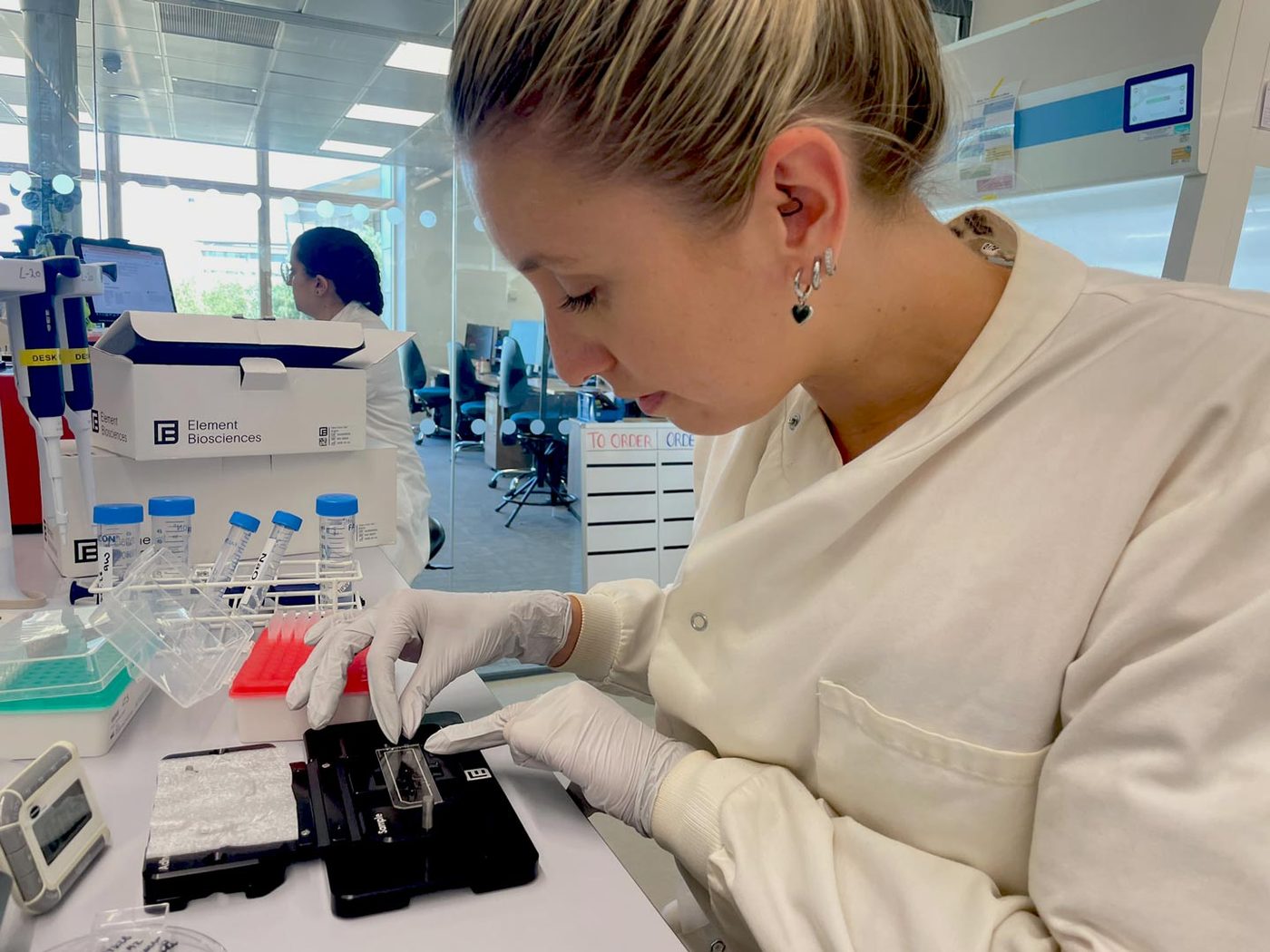
A scientist in a white coat and gloves loading a sequencing sample cartridge at a laboratory bench
Ashleigh Williams preparing sequencing samples at the Wellcome Sanger Institute. Photo: Ashleigh Williams / Wellcome Sanger Institute, published August 11, 2026.

Nine billion possible DNA changes now fit behind a browser search box. On September 8, Google DeepMind released AlphaGenome Atlas, a petabyte of predictions that researchers previously had to compute themselves.1,8

Where the opportunity actually sits

The opportunity lies partly in the roughly 98% of human DNA that does not encode proteins.2 Some regulates genes; some still has no known function.

On X, Sundar Pichai emphasized browser access3. Pushmeet Kohli highlighted a score for ranking variants4. Both point toward choosing experiments more efficiently.

One result worth a closer look

One result deserves a closer look. In 54,189 UK Biobank participants5, combining Atlas features with baseline methods found 728 significant associations between rare non-coding variants and circulating protein levels, versus 595 for baselines alone. That is roughly 22% more. Atlas alone found 460.6 The gain came from combining methods.
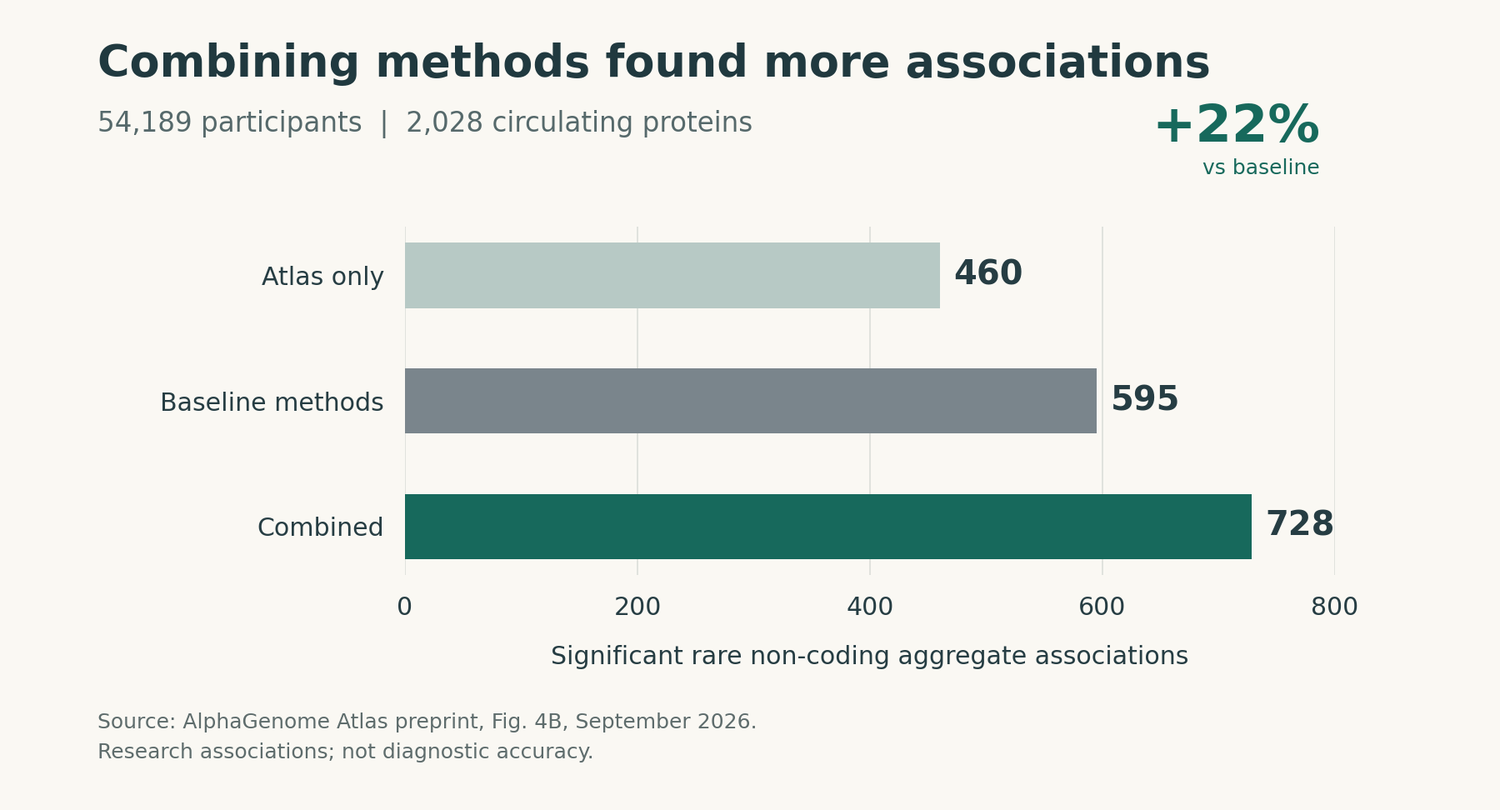
Horizontal bar chart of significant rare non-coding aggregate associations: Atlas only 460, baseline methods 595, combined 728.
Neither method wins alone. Atlas by itself found fewer associations than the established baselines. The 22% gain appears only when the two are combined. Source: AlphaGenome Atlas preprint, Fig. 4B, September 2026.

Research associations, not diagnoses

Those are research associations, not diagnoses. In GREGoR rare-disease research, Broad scientists used Atlas to flag a DNM1 variant, then added experimental evidence.7

The underlying model matched or beat leading rivals in 25 of 26 variant-prediction evaluations.9 Yet tissue-specific predictions remain difficult, and clinical decision-making is excluded.10

The commercial distinction

The commercial distinction matters. The Atlas portal is free for non-commercial research11, with commercial Cloud access announced as forthcoming8. The underlying AlphaGenome model already requires a paid Cloud subscription plus infrastructure costs.12

For biotech, the opportunity is a better shortlist for the lab. Whether that produces cheaper medicines remains unproven. Someone still has to pick up the pipette.

Get Health by email, free

AI in medicine, pharma and biotech. In our daily email, every weekday.

Loading Google DeepMind

Reader comments

0 comments

    More in Health

    All in this topic →

    Health

    Bristol Myers locked Tempus data through 2031 and led Pathos' $237 million round; Tempus reports November 2

    Bristol Myers Squibb extended its Tempus oncology data license through 2031 and, the same week, led rival Pathos AI's $237 million Series E. Tempus reports Q3 on Monday, November 2, and the print decides which layer of its own stack the market pays for.

    Health

    Lilly raises guidance to $92 billion and hits a record close, while Novo Nordisk bets November on CagriSema

    Lilly just priced its clinical lead at 31 times earnings while Novo Nordisk trades at 12x, and Novo's November congress calendar is the last scheduled chance to argue back before retatrutide's FDA filing closes the record.

    Health

    Ozempic blindness suits top 200 as Novo Nordisk spends DKK 11 billion on buybacks

    Maria David Patten says Ozempic left her permanently blind on a label that never mentioned the risk. Europe ordered semaglutide labels updated in 2025; the FDA has not, and the suits now top 200 while Novo returns cash to shareholders.

    Health

    Philips pitches Azurion software while 3,000 of its cath lab systems sit on the FDA recall list

    The same week Philips launched UniGuide 3D Live Guidance on Azurion, the FDA logged a Class 2 recall covering more than 3,000 Azurion systems over off-spec solid-state drives, with repairs starting in December. Q3 results land with earnings per share expected at 33 cents, and the service bill arrives in Q4.

    Health

    Novo's Wegovy pill inherits a $32 billion franchise as a judge declines to block Lilly's ads

    A federal judge in Trenton declined on October 26 to block Eli Lilly's obesity-drug ads without ruling on their merits, and three days later Lilly printed 39% revenue growth built on price cuts. Novo Nordisk reports on November 4 with its pill carrying the load.

    Health

    OpenAI makes UK startup Anima its healthcare showcase as patients call the same bot a wall to care

    OpenAI's October 23 customer story hands UK startup Anima a vendor endorsement just as it enters the US and Australia. The 75% wait cut is Anima's own measurement, and this month Wantage patients called the same bot a wall to care.

    Get the newsletter

    The day's AI and market news, in your inbox every weekday.