Hedra cut Krea 3's edit time from 22.9 to 3.3 seconds on AMD, and the app doesn't own the speed
The eight-second edit Krea advertises is manufactured in the serving stack, and a partner's measurement shows the app does not own the speed. Inference efficiency accrues to the optimizer and the chip vendor, which caps a per-image app's margin and hands AMD a demand channel beyond hyperscalers.
 Richard Tangtwo-minute read
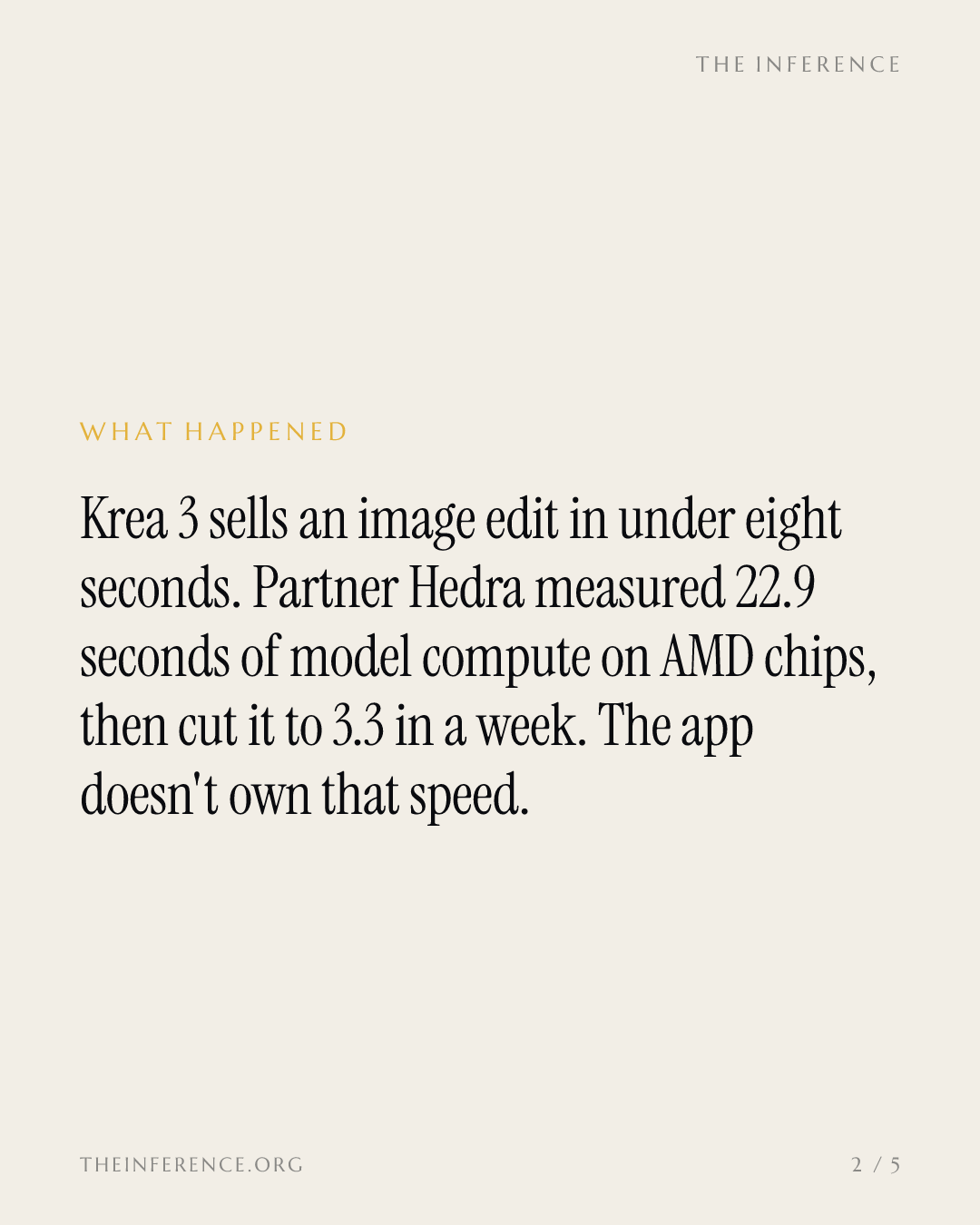
Hedra, an inference company, put a number in its November 10 platform launch that Krea's~$290M — Krea, private, latest valuation ~$290M marketing leaves out 12. Krea 3, the image editor Krea released on October 28, is sold as an edit that finishes in under eight seconds at 2K 3. On four AMD−10.90% — AMD, down 10.90 percent today Instinct MI355X GPUs, before tuning, the same edit burned 22.9 seconds of model compute 1. A week of joint work cut that to 3.3 12. The speed a creative app sells is manufactured in the serving stack and on the silicon, and Krea buys both through distribution partners, Hedra among them 3.
The speedup was stack work, not a new model
The mechanism is ordinary, and that is the point. The sampler was distilled from 30 steps to 14, and Hedra tuned precision and kernels, keeping only changes that survived a quality check against the full-precision reference; it credits the model-level changes to Krea and the stack work to itself 12. Its caveat is honest: 3.3 seconds measures the diffusion transformer, not the full request, so it is not like-for-like with Krea's claim 1.
The optimizer is the one being paid
Krea charges six cents for a 2K edit 3. When compute seconds per edit collapse, the saving lands first on whoever operates the GPUs, and the operator can sell it again: Hedra says revenue rose fifteenfold in 12 months, and its new Model Factory sells the same tuning and deployment to robotics, manufacturing and defense teams 2. The model was already good enough to sell; making it cheap to run was silicon-interface engineering, and the market pays the party that did it.
AMD's second channel, beyond hyperscalers
For AMD, one design tool moves nothing: data center revenue was $8.5 billion in the September quarter, up 97% on the year 4. Nvidia's last reported data center quarter was $89 billion 5. But Krea 3 running on Instinct through Hedra's infrastructure is inference demand that does not wait on hyperscaler training budgets 2.
AMD now out-earns Intel in the data center; Nvidia is still in another class
Data
| Value | |
|---|---|
| Nvidia | $89B |
| AMD | $8.55B |
| Intel | $7.3B |
The week closed with Jensen Huang resigning as Nvidia's chief on November 12; Nvidia−3.21% — Nvidia, down 3.21 percent today fell 4.3% that day while AMD rose for a fifth straight session 67. Whether that demand channel is broadening or an anecdote, AMD's next Instinct shipment disclosure will say.
For anyone underwriting AI-native creative apps, assume the optimizer and the chip vendor capture inference efficiency; the app's per-image price is a ceiling on its margin. The distance between a capable model and silicon people can afford is engineering, and this month the money went to whoever closed it.
Get Model by email, free
The AI labs, their models, and the business behind them. In our daily email, every weekday.





Reader comments
0 comments