Heron's shared fraud network lets rival loan funders flag defaults early, against $2 billion of yearly losses
A New York underwriting startup has quietly launched a shared early-default network for merchant cash advance funders, turning competitors' losses into everyone's early warning. It is live on the site, absent from the press feed, and the moat is the member list itself.
 Vincent Jiang · 3 min read

A funder can run every check on a small-business loan applicant and still fund a fraud ring. That is the problem Heron, a New York startup legally called Open Credit Technologies, has quietly gone after. Its site now carries a Fraud Consortium page, live since September, that no press release and no news outlet has mentioned 12.
Every member's defaults feed a map of connected businesses
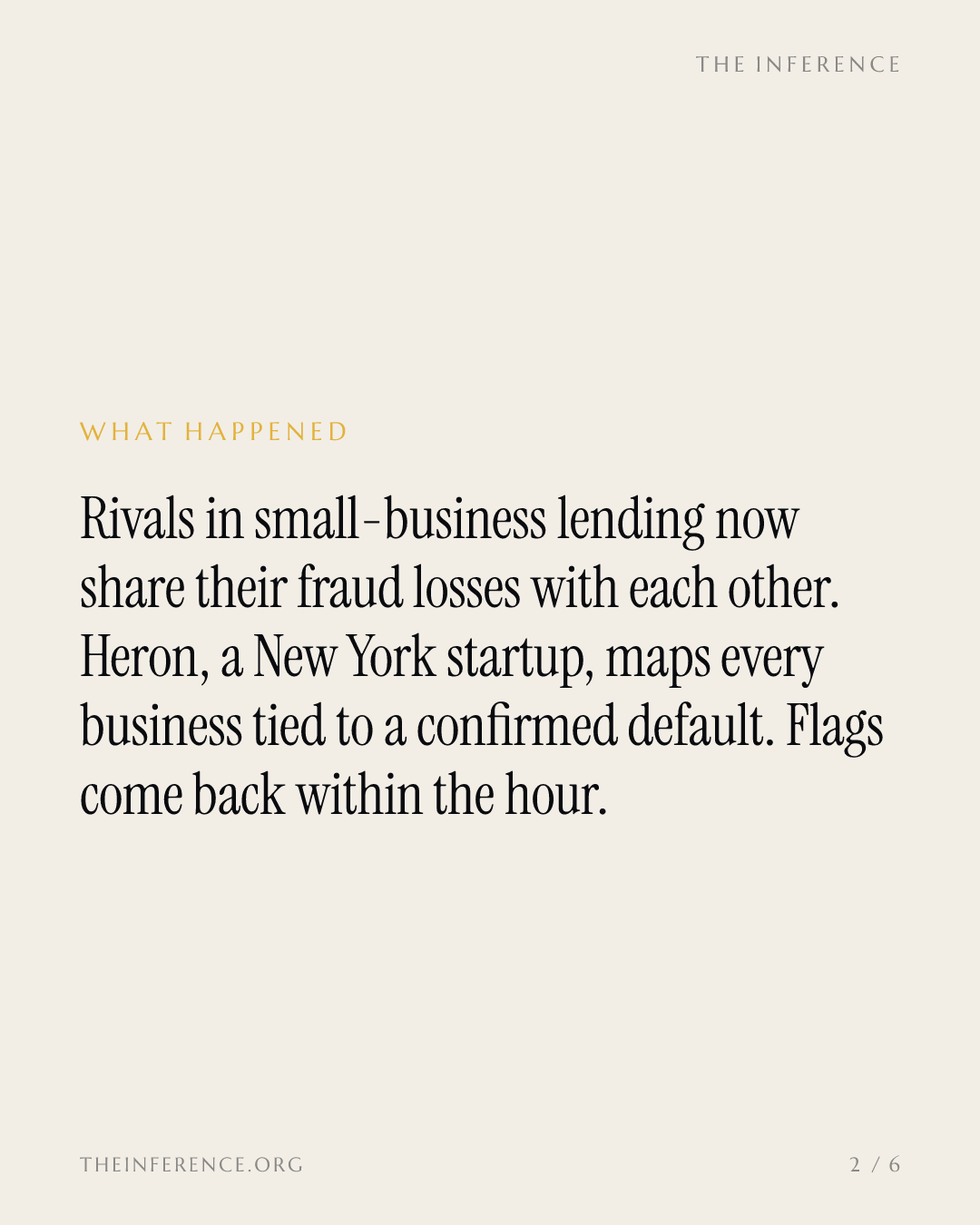
The mechanism on the page is simple. Members, mostly merchant cash advance funders, report confirmed early defaults to Heron each month with just a name, state and EIN, the business's tax ID. Heron maps every company connected to that default outward along the money, a Heron analyst reviews each linked business before it can trigger anything.
Every deal a member submits is then checked against the map before funding. A match returns a yes/no flag with the reason within the hour, wired to the member's CRM for auto-decline; funded deals stay monitored for 30 days 1.
Roughly $2B a year in losses, and a demo ring flagged in 27 minutes
The stakes are real money. Heron's page cites an industry estimate of roughly $2B lost to early-pay defaults every year 1. Its anonymised, illustrative walk-through shows a clean trucking applicant whose deposits are the ring paying itself: 19 businesses moving $2.1M among them, five reported early defaults, five merchant cash advance lawsuits, flagged 27 minutes after the file landed 1.
The moat is the member list itself
Pricing is a flat monthly fee with unlimited checks; the page quotes a consortium member saying one caught fraud pays for over a year of it 1. The strategic point is bigger. Heron already reads 60,000-plus submissions a day for 200-plus funders and brokers, and claims a 15% share of US businesses seeking capital 3.
The consortium turns that workflow position into a shared-data network: every member's defaults sharpen the flag for all, a moat a rival must rebuild member by member. The displacement is already proven. Good Funding's case study describes dropping its LexisNexis background pulls outright for Heron, with 59% of approvals now fully automated 4.
Competitors sharing losses through one vendor
Members are competitors sharing loss data through one vendor, and the demo file is illustrative, not a documented case 1. Non-members inherit the rings the network pushes away. Watch for member counts, a formal launch, and whether the August press cadence picks the product up; the latest release on Heron's PR feed is still the August 11 background-check announcement 2. With Insight Partners and Y Combinator backing it and a Head of Sales role posted at up to $400K OTE 5, the sales push is coming.
Get Security by email, free
The breaches, flaws and security vendors AI is putting to the test. In our daily email, every weekday.