Isomorphic Labs' reported $40 billion raise prices Biohub's $1.8 billion cell-data pact
Biohub's virtual-cell commons counts $300 million of new corporate money inside a $1.8 billion headline that leans on federal funds and already-bought assets, and gives commercial partners a one-year exclusive window on the data they fund. That is the substrate under Isomorphic Labs' reported $40 billion ask.
 Vincent Jiang · 3 min read
Two headlines, one commons
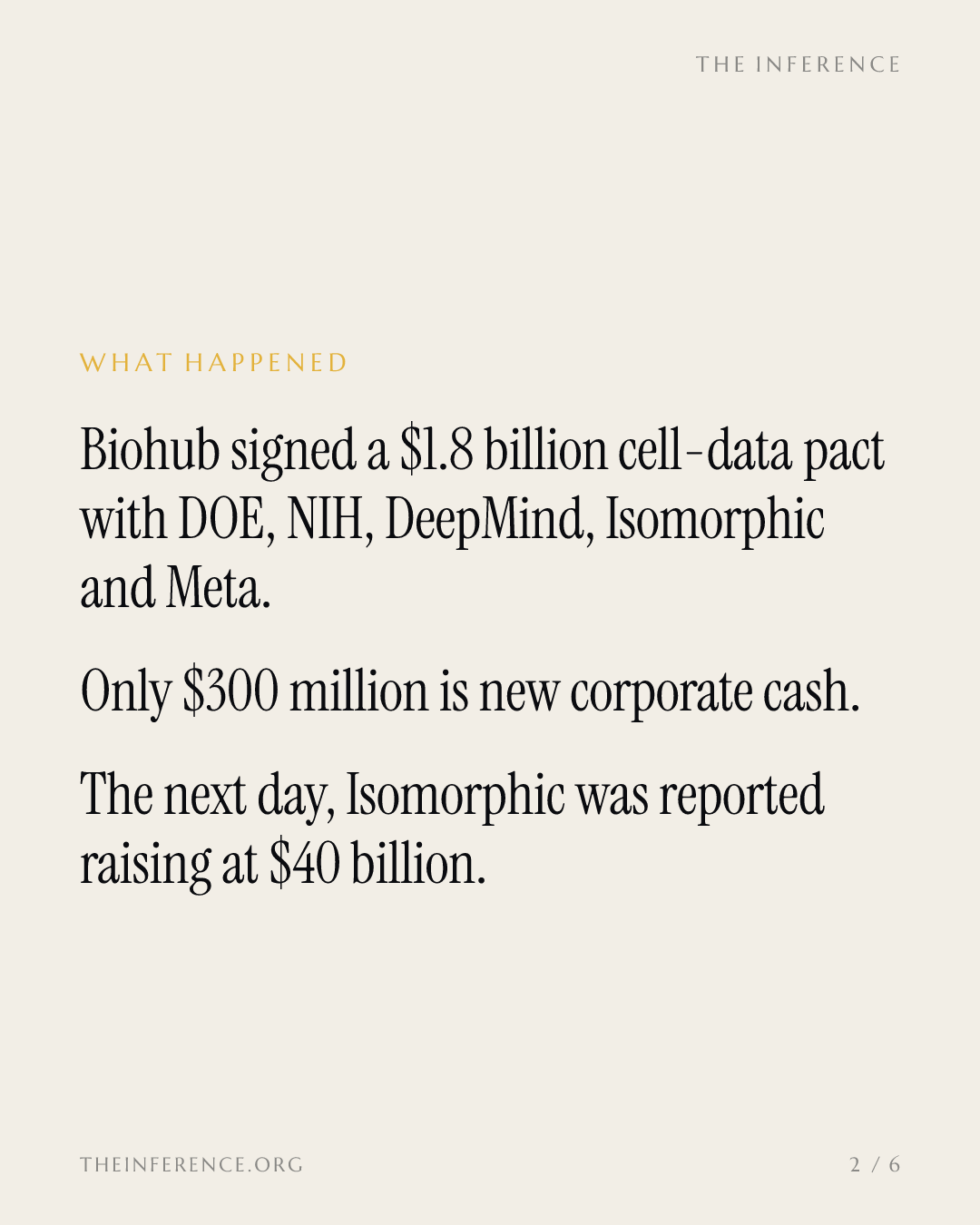
On October 7, 2026, Biohub widened its Virtual Biology Initiative into a $1.8 billion pact with the Department of Energy, the National Institutes of Health, Google DeepMind, Isomorphic Labs$600M — Isomorphic Labs, private, latest valuation $600M and Meta−0.26% — Meta, down 0.26 percent today, a commitment of funding, data, computing and measurement technology 1. The next morning, people familiar with the effort said Isomorphic, Alphabet's−0.50% — Alphabet, down 0.50 percent today DeepMind-spun drug unit, was in early talks to raise at a valuation of at least $40 billion, as much as $50 billion 2. The second story prices the first.
What the $1.8 billion actually counts
The headline mixes cash with counted assets. Biohub's founding $500 million is a five-year plan, launched April 29 inside the federal Genesis Mission umbrella 13. The DOE pledges more than $500 million over five years for measurement and computing at national labs: exascale supercomputers, X-ray and neutron scattering, cryo-electron microscopy, autonomous laboratories 14. The NIH slice is datasets and repositories from more than $500 million of past federal investment, standardized for training rather than newly bought 14. The new corporate cash, split three ways in undisclosed shares, is $300 million 45.
New corporate cash is the smallest slice of the $1.8 billion cell-data effort
- Biohub, 5-year plan$500M27.7%
- DOE, over 5 years$500M27.8%
- NIH, past-funded data$500M27.8%
- DeepMind, Isomorphic & Meta$300M16.7%
Data
| Slice | Value | Share |
|---|---|---|
| Biohub, 5-year plan | $500M | 27.7% |
| DOE, over 5 years | $500M | 27.8% |
| NIH, past-funded data | $500M | 27.8% |
| DeepMind, Isomorphic & Meta | $300M | 16.7% |
Twelve months at the gate
Commercial partners get one year of exclusive use of the data they develop before it goes public 5. "We have to have some incentive for commercial players to be a part of this, and the embargo period creates that," said Biohub head of science Alex Rives. "But it's a one-year embargo" 5. Government-funded work in the same effort carries no embargo 4. Rives expects a first dataset in about a year and accurate predictive models within five 4. Isomorphic president Max Jaderberg frames the bet as scaling "past the limits of what any single organization can produce" 1.
The benchmark still beats the models
The field's own scoreboard counsels a discount. In Arc Institute's 2025 Virtual Cell Challenge, nearly all entrants scored worse than a simple baseline on mean absolute error, the measure of predicting how large a gene-expression change will be 6. Organizers watched that metric stop influencing competitors' optimization and added a prize for balance instead 7. "We're not yet at a point where pure scaling in size can reliably lead to improved outcomes," said Arc investigator Hani Goodarzi 7.
The price of a head start
Isomorphic raised a $2.1 billion Series B in May, after $600 million in 2025 8, with Alphabet providing a "large part" of it 2. Its first clinical trial is targeted for end-2026, slipped from end-2025 8, in a field where no AI drugmaker has yet brought a medicine to market 2. Watch the first dataset for which slices arrive embargoed, and whether the 2026 challenge, scored on cell lines models have never seen, humbles the leaders again 6. On the announced numbers the edge is a lease: twelve months on a commons more than half federally funded.
Deepdive
AI-generated from this story and its cited sources. Not investment advice.