Johnson Controls flags weak credit behind its record $23 billion AI backlog
The same filing shows the 74% pre-tax jump had help: $149 million of firefighting-foam insurance money inside the cost lines, and a prior year flattered by the Bosch sale, so net income fell anyway. Shareholders are left pricing two things at once: earnings help the company cannot promise to repeat, and a $23.0 billion order book whose buyers need financing to pay.
 Vincent Jiangthree-minute read
The customers behind the order book are the risk
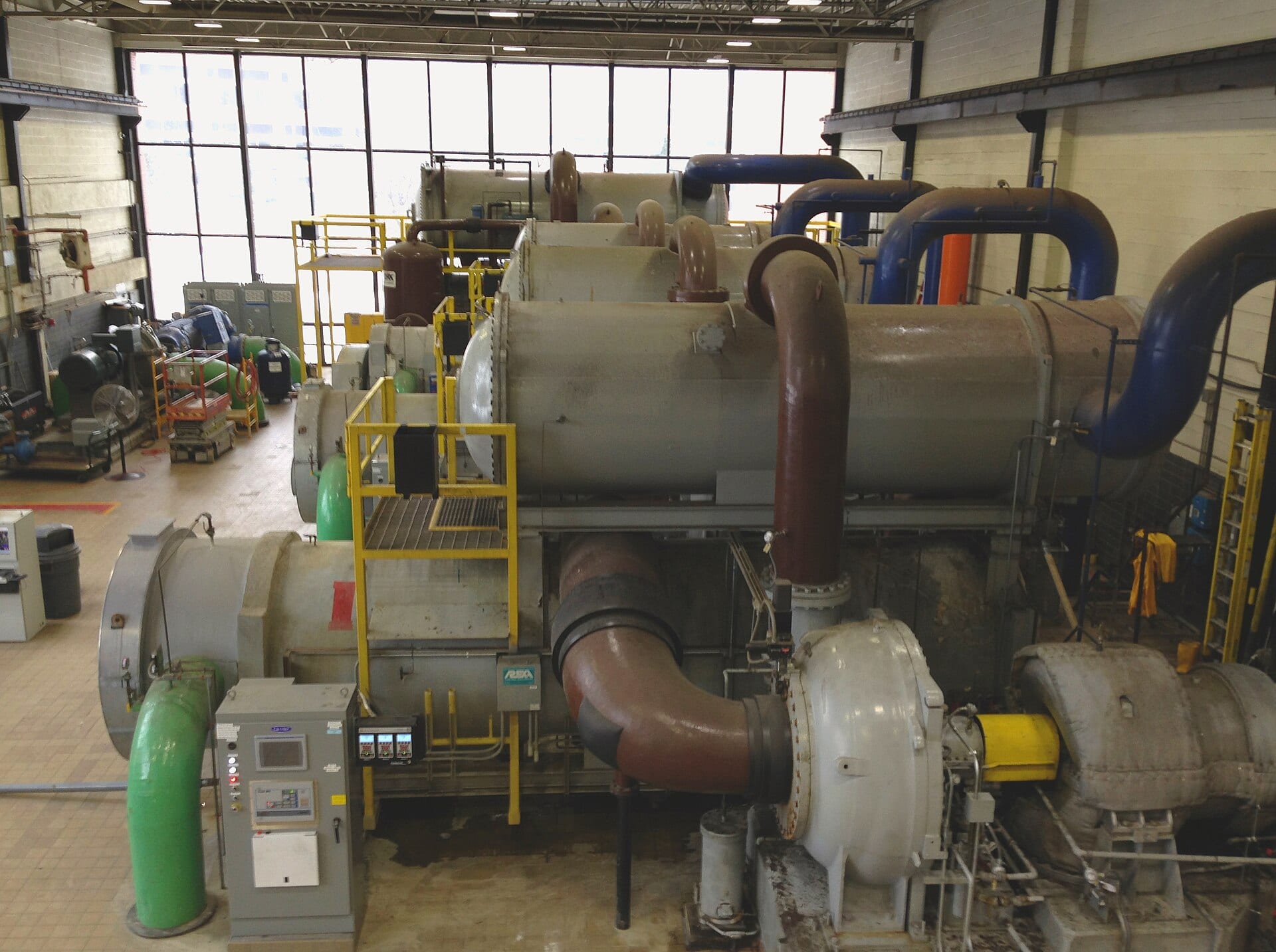
Johnson Controls−2.25% — Johnson Controls, down 2.25 percent today, which makes the chillers and controls that AI data centers run on, filed its fiscal 2026 annual report on November 12, and the sentence that matters is not about chillers 1. Its risk factors say some buyers are "newer counterparties with limited operating histories, weaker credit profiles or dependence on project financing," which could make data-center orders "subject to greater uncertainty compared to other sectors" 1. Those are the customers behind the record order book announced on October 27: fiscal-year orders of $29.7 billion, up 35%, and backlog of $23.0 billion, up 43% 12.
Sales grew 9%; the order book grew four to six times faster
The demand is in the order book, not yet in revenue
Data
| Value | |
|---|---|
| Americas backlog | 54% |
| Americas orders | 48% |
| Total backlog | 43% |
| Total orders | 35% |
| Net sales | 9% |
Demand rests on a handful of hyperscalers
The same passage ties demand to "the capital expenditure plans of a limited number of hyperscale technology companies," the largest cloud and AI operators, and warns that capacity built on forecast demand could bring "excess capacity, inventory write-downs and asset impairments" 1. About $900 million of fiscal 2027 capital expenditure is earmarked to expand thermal-management capacity 1. Working capital slid to negative $1.241 billion from negative $779 million, a swing the filing attributes mainly to higher deferred revenue, accounts payable and current debt, with receivables only a partial offset 1.
Deferred revenue rose 36% last quarter, more than three times the pace of sales
- Net sales
- Deferred revenue
Data
| Net sales | Deferred revenue | |
|---|---|---|
| Q4 '23 | $5.21B | $2.12B |
| Q1 '24 | $5.6B | $2.33B |
| Q2 '24 | $5.9B | $2.14B |
| Q3 '24 | $6.25B | $2.16B |
| Q4 '24 | $5.43B | $2.21B |
| Q1 '25 | $5.68B | $2.38B |
| Q2 '25 | $6.05B | $2.43B |
| Q3 '25 | $6.44B | $2.47B |
| Q4 '25 | $5.8B | $2.54B |
| Q1 '26 | $6.14B | $2.85B |
| Q2 '26 | $6.61B | $2.94B |
| Q3 '26 | $7.11B | $3.37B |
The earnings line had help
Pre-tax income from continuing operations jumped 74% to $3.426 billion on net sales of $25.666 billion, up 9% 1. Net income attributable to Johnson Controls still fell 13% to $2.853 billion, diluted EPS of $4.68 against $5.03; the filing aggregator Screw Street led with the starker "down 19%" 14.
The comparison was loaded. Fiscal 2025 held the gain on the residential HVAC sale to Bosch, worth $2.40 per share in discontinued operations 15. Fiscal 2026 had its own help: selling costs fell 4%, mostly on $110 million of firefighting-foam insurance recoveries and a $70 million divestiture gain 1.
Foam recoveries across the year totaled $149 million, against $39 million a year earlier 13. After the year's 16% tax rate, that is roughly $0.20 of the $4.68 13.
Pre-tax profit rose 74% in fiscal 2026 while net income fell 13%
The two profit lines crossed: operations up, bottom line down
- Pre-tax income, continuing operations
- Net income attributable to JCI
Data
| Pre-tax income, continuing operations | Net income attributable to JCI | |
|---|---|---|
| Fiscal 2024 | $1.52B | $1.71B |
| Fiscal 2025 | $1.97B | $3.29B |
| Fiscal 2026 | $3.43B | $2.85B |
The foam bill outlasts the recovery
The foam is not finished with the company, either. Tyco, the fire business Johnson Controls merged with in 2016, finished paying its $750 million water-systems settlement in December 2024 6. Dutch authorities named a Tyco affiliate a co-polluter of a Netherlands site in June, and the environmental reserve still fell to $163 million from $187 million 16.
The chief financial officer says demand is not the constraint
The bull case is on the record too. Chief Financial Officer Marc Vandiepenbeeck expects 70% to 80% of the backlog to convert to revenue within 12 months and says the constraint "really is not demand" but customers' power and electrical infrastructure 27. Adjusted free cash flow was $3.2 billion, and net debt fell to $8.659 billion from $9.501 billion 12.
The company is also selling whole modular data centers with Armada, 500 megawatts of distributed edge capacity planned for 2027, not just the cooling inside them 2.
The first quarter is where a canceled campus would surface
No filing says how many dollars of the $23.0 billion sit with the weaker-credit customers 1. The balance sheet already shows the seam: receivables rose 17% to $7.316 billion, nearly twice the pace of sales, while the allowance for expected credit losses fell to $159 million from $205 million 1.
The first-quarter report, which landed on February 4 last year, is where a canceled campus would surface 6. Watch receivables against sales, whether that allowance turns up, and any disclosed order cancellations, a risk the filing itself names 1. Capacity built for a campus that never gets financed comes back as write-downs on Johnson Controls' books.
Get Data Center by email, free
Who is building AI's data centers, and who is paying for them. In our daily email, every weekday.


Reader comments
0 comments