Kawasaki Heavy Industries to test Beckhoff software in its robots after Beckhoff's €1.5 billion year
The memorandum names no product and no timetable, but Beckhoff, family-owned and paid for the control runtime in machines it does not build, just closed a EUR 1.5 billion year that funds the bet. Kawasaki trades a closed-controller franchise for openness just as robot intelligence becomes software.
 Richard Tangthree-minute read
Drafted with AI from the documents listed under Sources, then edited and fact-checked by Richard Tang. How we work
Kawasaki Heavy Industries signed a memorandum of understanding with Beckhoff Automation on November 26 at SPS, the big Nuremberg automation trade fair, to evaluate Beckhoff's EtherCAT and TwinCAT control stack inside Kawasaki's own industrial robots 1. No product, price or timetable is attached to it 1.
The interesting part is the business model underneath: Kawasaki trades a closed-controller franchise for openness, and Beckhoff, a family-owned control-technology maker in Verl, Germany that sells its stack into machines it does not build, gets paid for the runtime whichever arm it sits in. Beckhoff just closed a good year to fund that bet, with FY2026 revenue of about EUR 1.5 billion, up about 20 percent 3.
Kawasaki is buying openness it cannot build alone
Kawasaki's robot franchise has always been the arm plus its own closed controller, and a closed controller is a problem the moment a factory wants AI software on its robots: the integrator cannot open it, so the robot cannot join the software stack the plant is building around it. Kawasaki already showed an open EtherCAT-based control concept at iREX 2025 in Japan; this memorandum is the first named step toward putting Beckhoff's stack inside it 1.
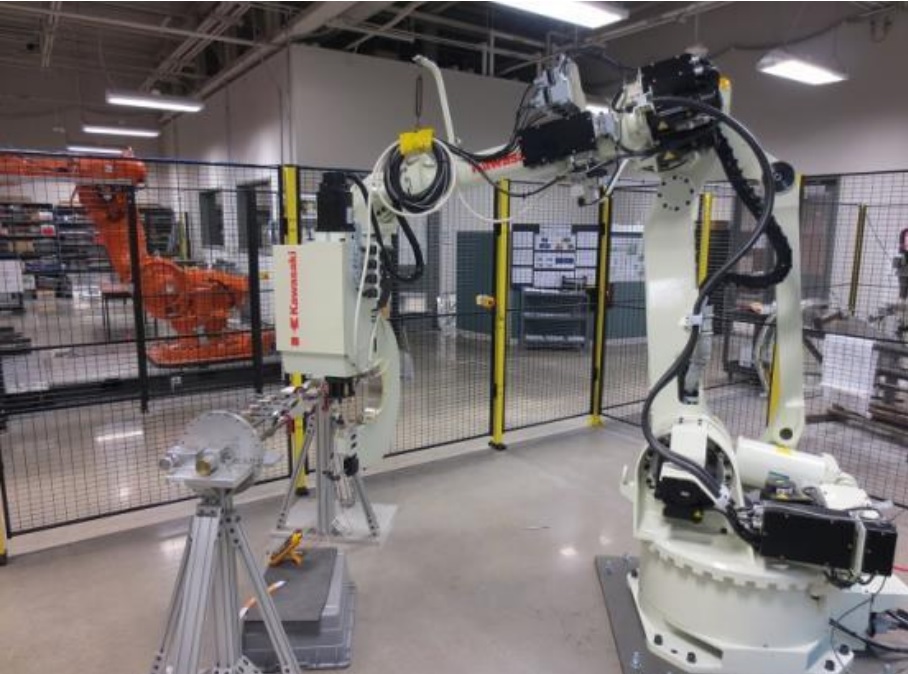
The work covers joint training and support with system integrators, EtherCAT inside Kawasaki's robots, and what PC-based control can take over 1.
The runtime is the layer both companies are betting on
Beckhoff's own AI roadmap shows why the deal makes sense for it: users describe task and rules, the AI writes the application, and execution stays in the deterministic runtime 3. Whoever pays for robot intelligence as software still has to pay for the layer that runs the machine deterministically, and on this reading that is the layer buyers actually pay for, not the model.
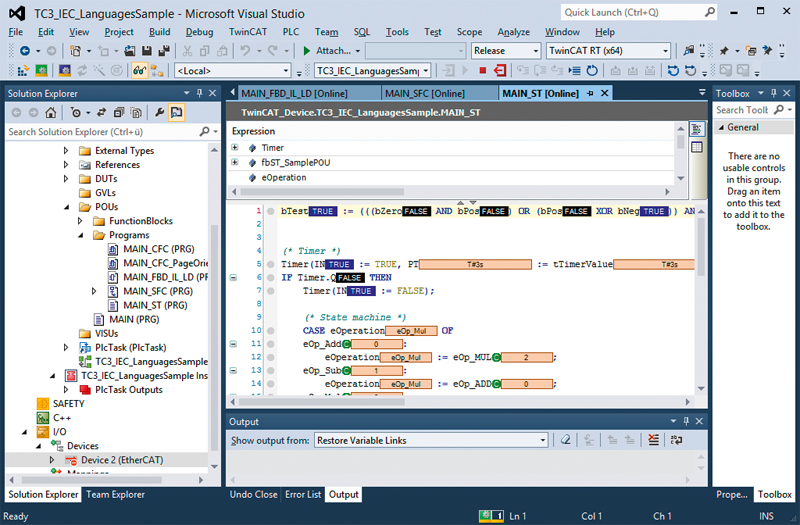
Beckhoff is putting R&D money there, about EUR 80 million a year 3, and it now sits as standard-setter inside a rival's robot with nothing yet sold. Kawasaki is betting its controller was never the moat. The humanoid makers, Apptronik~$1B — Apptronik, private, latest valuation ~$1B, Figure and 1X, are running the same trade one layer down: they sell bodies meant to run someone else's model 3.
The annual report adds China and a memory-chip warning
Beckhoff published its FY2026 annual report on November 4 3, three weeks before the handshake. It shows China revenue up roughly half and order intake rising sharply since autumn 2025 3. It also carries a warning: memory chips are getting dearer and slower to arrive, so Beckhoff plans production up to two years ahead 3.
Since our October 29 report on Schirmer, Beckhoff's machine-building subsidiary, breaking ground on its biggest factory in 47 years, the new Schirmer headquarters in Vorarlberg, Austria is now open, with about 20,000 square metres of production space 3.
Nothing lands until Kawasaki names a product
The memorandum itself carries no revenue. The signal to watch is concrete: Kawasaki's next control announcement, and whether a named product or date from its robot division replaces the MOU. When that happens, Kawasaki Heavy Industries in Tokyo is the listed trade; Beckhoff stays private either way.
Sources
Get Robotics & Defense by email, free
Robots, self-driving vehicles, drones and AI in defense. In our daily email, every weekday.
Reader comments
0 comments