LG Chem feeds the market 2.5 trillion won of LG Energy Solution stock, with more queued to 2030
LG Chem filed on October 28 to sell 2.5 trillion won of LG Energy Solution stock, its fourth cut since 2022, and said it wants to hold only 70% by 2030. LGES shareholders absorbed an 8.6% drop the next morning, while the parent keeps 400 billion won of the proceeds for itself.
 Vincent Jiang · 3 min read
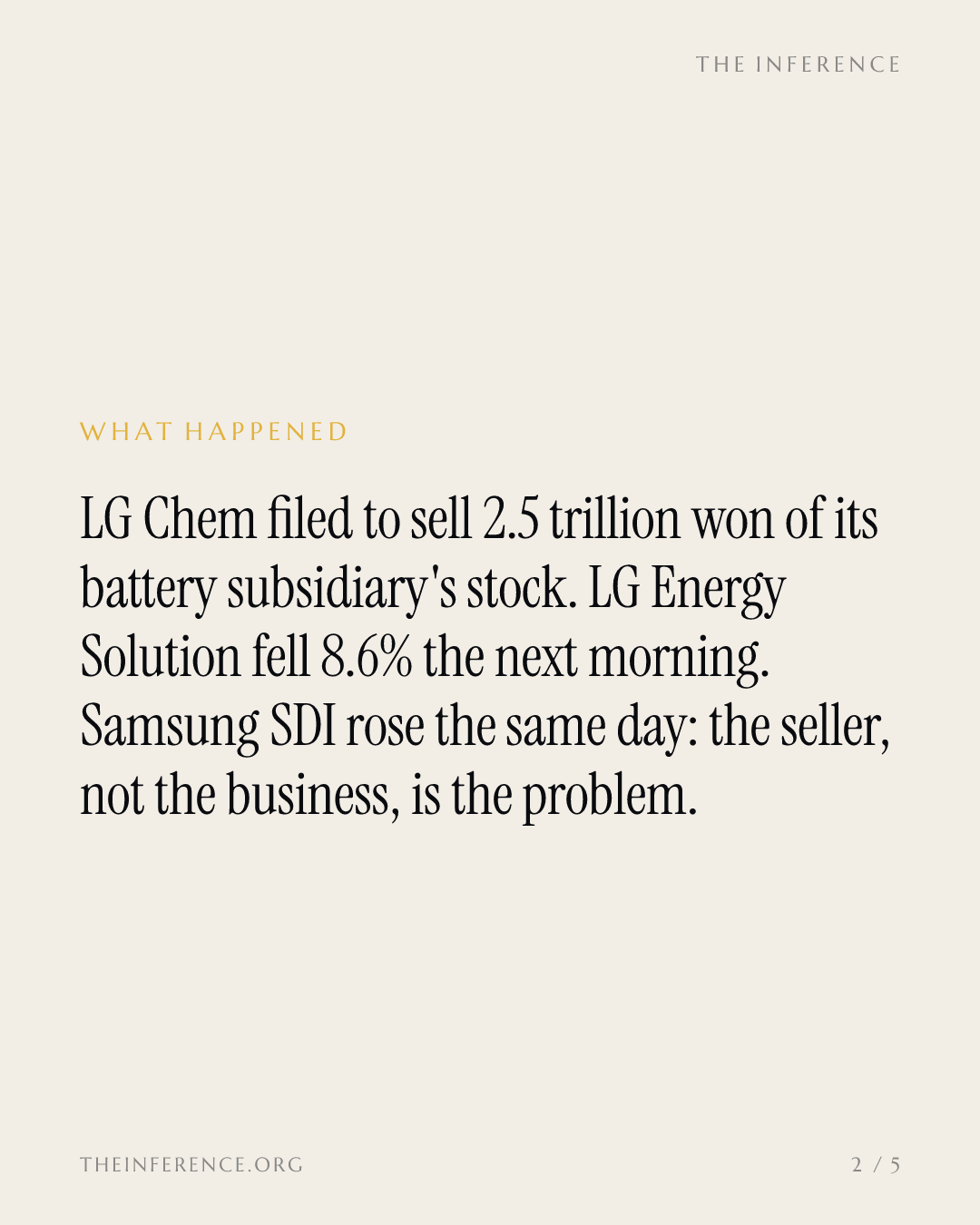
LG Chem's board met on October 28 and filed to sell 6,535,939 shares of its battery subsidiary LG Energy Solution+0.98% — LG Energy Solution, up 0.98 percent today, about 2.79% of the company, for roughly 2.5 trillion won ($1.88 billion) through a price return swap 12. By 10:01 the next morning LG Energy Solution was down 8.6% at 356,000 won on the Korea Exchange, and touched a 10.01% intraday loss 35.
Samsung SDI, a rival battery maker with no such seller, rose 1.1% the same day 5. That gap is the whole story: the stock's trouble is not the battery business, it is the shareholder.
A parent that sells on a schedule
The transaction runs from November 27 to December 24, structured as a two-year price return swap: LG Chem hands the shares to buyers now and settles the price difference in 2028, keeping upside gains and owing compensation if the stock falls 12. This is the second such sale in a year.
LG Chem sold 8.5 million shares for 2.55 trillion won at LG Energy Solution's 2022 IPO, raised about 2.6 trillion won through exchangeable bonds in 2023, and sold 5.75 million shares for about 2 trillion won through a PRS last October 25. Cumulative disposals now reach 9.6 trillion won 25.
The 2026 sale is the fourth cut; the queue to 2030 is the largest block yet
- Estimate
Data
| Value | |
|---|---|
| 2022 IPO sale | 2.55 |
| 2023 exchangeable bonds | 2.6 |
| 2025 PRS | 2 |
| 2026 PRS | 2.5 |
| Remaining to 70% target (estimate) | 5.9 |
The queue does not end in December
The sale cuts LG Chem's stake from 79.38% to 76.59% 1. But in November 2025 LG Chem said it wants to hold only about 70% by 2030, leaving another 6.59 percentage points, roughly 15.4 million shares, worth about 5.9 trillion won at this deal's reference price, still queued for market 25. The reference price here is 382,500 won per share, set below Friday's recovery hopes 23.
The seller's math, and who pays for it
LG Chem's motive is its own balance sheet: petrochemicals are squeezed by Chinese oversupply, and Shinhan Investment & Securities calculates that even at an 80% discount the LGES stake is worth 14.5 trillion won, about 87% of LG Chem's 16.7 trillion won market cap 45. Of the after-tax proceeds, 400 billion won, double the previous 10% minimum policy, goes to LG Chem shareholders: 300 billion won in buybacks and 100 billion won in dividends 14.
LGES shareholders supply the cash and the overhang. An LG Chem official called the sale "an unavoidable measure to improve our financial structure"; an LGES official countered that freeing the float could, long term, activate institutional trading 5. Both can be right. Our October 27 piece tested whether ESS demand supports the build-out; the filing changes the question 5. Demand now has to outrun a dated, signposted seller 5.
What to watch
The window opens November 27 25. Watch whether LGES absorbs the block without breaking the reference price, because a broken reference price costs LG Chem and may pause the glidepath; and watch the Q3 print, preliminary sales of 9.6434 trillion won and operating profit of 756 billion won, up 59.0% and 25.7% year on year, for proof the demand story is real 25. Until the stake hits 70%, every rally is a selling opportunity for the parent 25.
Deep dive in below to learn more.
Get Economy by email, free
How AI moves rates, banks, payments and the wider economy. In our daily email, every weekday.