S&P Global bought OpenZeppelin and signed Kalshi while ratings fees grew just 2%
In three days the ratings giant closed OpenZeppelin, signed Kalshi and put its vault risk assessments live onchain. Ratings fees grew just 2% last quarter, and the crypto buildout is now the test of whether SPGI's fee pool stays durable.
 Richard Tang · 3 min read

S&P spent the week building new toll booths onchain
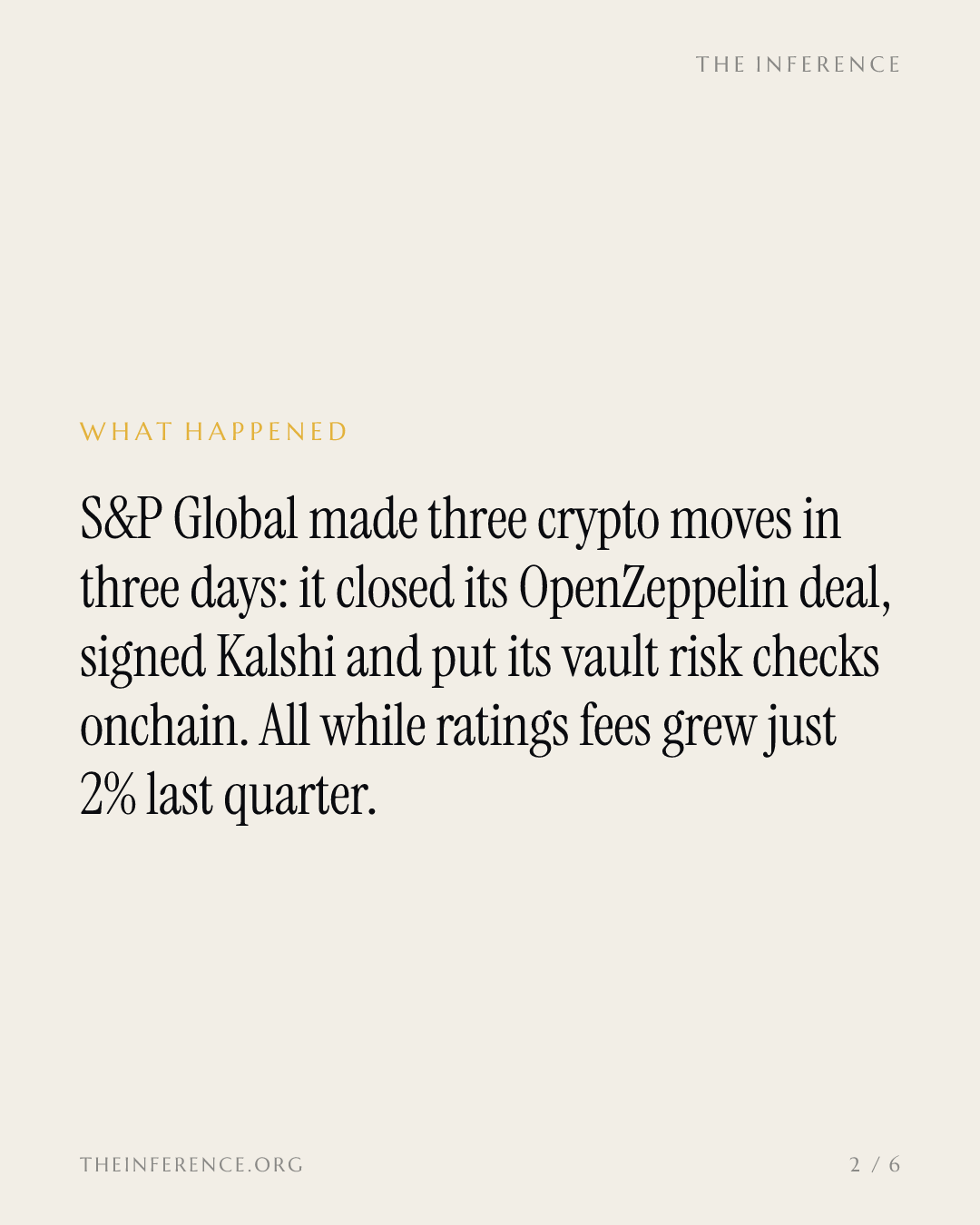
Three moves in three days, none of them in bonds. On October 26, S&P Global+1.36% — S&P Global, up 1.36 percent today closed its purchase of OpenZeppelin, whose open-source smart-contract libraries underpin more than $38 trillion in value transferred, and put the unit under the leadership of its ratings arm 1.
The same day its index business made Kalshi, a prediction-market exchange, the preferred venue for event contracts that settle on official S&P index values, while exploring new benchmarks built from Kalshi's market data 2. Two days later, Chainlink's oracles began publishing S&P's Vault Risk Assessments onchain, live first on the Base blockchain 3. The company is rebuilding its toll booth where credit is actually growing.
The old booth has stopped growing. S&P billed 8% more debt in the third quarter 4. Ratings fees rose just 2%, fourth-quarter transaction revenue is guided down, and outside the hyperscalers financing AI data centers, billed issuance grew only in the low single digits 4.
Ratings was S&P Global's slowest division in the AI bond boom
Data
| Value | |
|---|---|
| Indices | 20% |
| Market Intelligence | 7% |
| Energy | 6% |
| Ratings | 2% |
The missing hop was risk opinion delivered where the money sits
Lending vaults, pooled deposits run by smart contracts much like managed fixed-income funds, held about $10 billion in September, by S&P's own count 5. Two years earlier the pool was $1.5 billion 5. Depositors never lacked transaction data; they lacked an independent view of risk.
S&P's six-factor assessment, from portfolio credit quality to protocol governance, is deliberately not a credit rating 5, and Chainlink now delivers it into the applications where capital is deployed, so a depositor can compare assessed vaults and watch for downgrades 3. The analysis existed; delivery to the point of allocation did not, and that delivery is worth paying for.
The race is on before the stablecoin rules land
Moody's+1.04% — Moody's, up 1.04 percent today drew first blood on the neighboring pool, rating Ripple's RLUSD stablecoin investment grade on October 27, its first under a rulebook published in March 6. It expects the GENIUS Act, the US stablecoin law, to bite when it takes effect in January 2027 6. S&P's answer is breadth: stablecoin assessments, a rating for the Sky DeFi protocol, vault assessments, and now the technology-risk layer itself via OpenZeppelin 15. No terms are disclosed for any of the three deals, so whether they mint real fees is unanswered 12.
The stock trades at about 25 times guided earnings on the belief that the fee pool is durable 4. The bond booth is not closing, and the refinancing wall management cites still runs through it 4. But the marginal fee is being minted onchain, and the agency that makes onchain risk legible will collect it. On February's earnings call, count assessed vaults and graded stablecoins; that count is the leading indicator.
Get Economy by email, free
How AI moves rates, banks, payments and the wider economy. In our daily email, every weekday.