Merchants have collected $631.7 million from Visa and Mastercard in 21 years; November 16 sets the fee rules
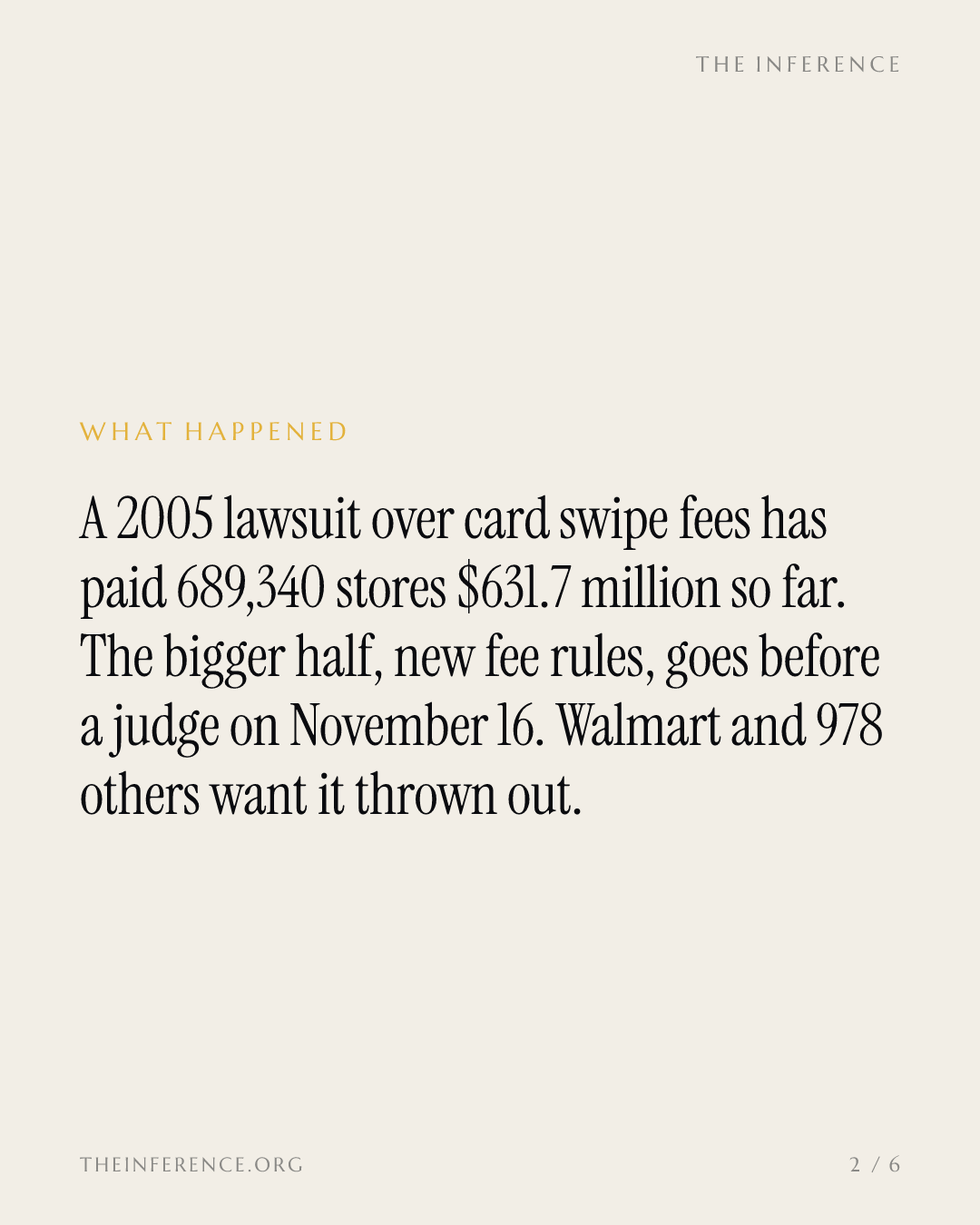
The damages half of the swipe fee case that began in October 2005 has now reached 689,340 merchants. On November 16, Judge Brian Cogan weighs the half that would set card fees for years, over 978 objections and a promised appeal.
 Vincent Jiang · 3 min read
Two ledgers on Judge Cogan's desk
Brooklyn's federal courthouse is holding both halves of the swipe fee war, in litigation dating to October 2005 1. In a Friday filing, class administrator Epiq said the $5.5 billion damages settlement, covering merchants that took Visa+0.90% — Visa, up 0.90 percent today or Mastercard+1.05% — Mastercard, up 1.05 percent as of its last quote cards from 2004 to 2019, has paid $631.7 million to 689,340 merchants, with $5.02 billion still in the fund 1. The other half would rewrite the rules merchants pay under, and 978 businesses and trade groups are asking Judge Brian Cogan to throw it out 2.
The arithmetic behind the anger
Merchants paid $198.25 billion in credit and debit swipe fees in 2025, roughly $543 million a day 23. The whole damages fund is worth about ten days of that bill, and what has actually reached merchants is a little over one day 12.
The whole $5.5B damages fund is ten days of US swipe fees
Data
| Value | |
|---|---|
| Swipe fees paid in 2025 | $198.25B |
| 2018 damages fund | $5.5B |
| Paid to merchants so far | $631.7M |
What ten basis points buy
The deal would cut credit interchange, the fee card-issuing banks collect on each transaction, by 10 basis points, a tenth of a percentage point, for five years, cap standard consumer cards at 1.25 percent for eight years, and let merchants refuse some premium cards 24.
The cut reaches only the interchange that goes to issuing banks, never the networks' own fees 5. Against the $118.8 billion merchants paid Visa and Mastercard in credit fees last year at an average 2.36 percent rate, a tenth of a point is worth roughly $5 billion a year, about nine days of the total fee bill 34. The objectors' letter says the cut would "merely return the average Visa/Mastercard rate to its 2023 level", while plaintiffs' experts Joseph Stiglitz and Keith Leffler put the whole package at $38 billion of savings by 2031 45.
What 978 merchants reject
More than 90 percent of credit card spending runs on rewards cards, so the right to refuse premium cards means refusing nearly everyone 5. Objectors say the deal would still let the networks raise their own fees "in response to market conditions" 6. The class is mandatory, about 12 million merchants with no right to opt out, and the release covers claims that even "could have" been raised 456.
Walmart's 299-page filing calls forcing merchants into that class a due process violation, and the National Association of Convenience Stores has promised a Second Circuit appeal if the deal is approved 26.
What the networks buy
Mastercard says the deal "balances the interests of all parties" and Visa calls it meaningful relief for merchants of all sizes 46. The Electronic Payments Coalition, whose members include Chase, Bank of America, Citibank and Capital One, backs it 4.
Interchange is issuer revenue, so the rate cut does not directly touch what the networks earn. What they buy is the release 56. Cogan already found the deal "fair, reasonable, and adequate", ruling the question is not the best possible recovery but the best one "in light of what can be gained and lost through trial" 4.
The dates that decide it
Class counsel answers the objections on October 14 2. Mastercard reports on October 29 against consensus of about $9.64 billion, having grown revenue at a double-digit rate in each of the last 12 quarters 78. Cogan hears final approval arguments on November 16 2. If he approves and the appeal follows, merchants keep about one day of fees in hand while the rules that set the rest of the bill wait on the Second Circuit into 2027 2.
Mastercard has grown revenue double digits for 12 straight quarters
- Revenue
- Estimate
Data
| Revenue | |
|---|---|
| Q3 '23 | $6.53B |
| Q4 '23 | $6.55B |
| Q1 '24 | $6.35B |
| Q2 '24 | $6.96B |
| Q3 '24 | $7.37B |
| Q4 '24 | $7.49B |
| Q1 '25 | $7.25B |
| Q2 '25 | $8.13B |
| Q3 '25 | $8.6B |
| Q4 '25 | $8.81B |
| Q1 '26 | $8.4B |
| Q2 '26 | $9.28B |
| Q3 '26 (estimate) | $9.64B |
Deepdive
AI-generated from this story and its cited sources. Not investment advice.