Micron's $50 Billion Quarter Meets an AI Stack That Moves Its Cache
Micron reports Wednesday on a $50 billion revenue guide at an 86% gross margin, and even the Overweight camp expects smaller estimate hikes. New serving measurements show frontier models relocating cache from GPU HBM to host DRAM instead of shrinking it, a shift this week's earnings previews do not touch.
 Vincent Jiang · 3 min read
Micron reports fiscal Q4 after the close on Wednesday, 30 September 2026, guided to $50 billion of revenue plus or minus $1 billion at an 86% gross margin 123. Last quarter printed $41.46 billion at an 84.6% gross margin 27. The stock has more than tripled this year, up over 230% 1, a run priced for another round of big estimate hikes.
Consensus sits above the guide at $51.24 billion, up 353%, the fastest on record 4. Morgan Stanley stays Overweight at a $1,200 target and still expects estimates to rise, just "less so than prior quarters" 15. Fiscal 2027 profit estimates jumped from $95.80 to $154.70 in three months, then rose just 1.2% in the month through early August 6. For holders, the size of the next hike is the trade.
From $4 billion to a guided $50 billion in three years
- Revenue
- Estimate
Data
| Revenue | |
|---|---|
| Q4 FY23 | $4.01B |
| Q1 FY24 | $4.73B |
| Q2 FY24 | $5.82B |
| Q3 FY24 | $6.81B |
| Q4 FY24 | $7.75B |
| Q1 FY25 | $8.71B |
| Q2 FY25 | $8.05B |
| Q3 FY25 | $9.3B |
| Q4 FY25 | $11.32B |
| Q1 FY26 | $13.64B |
| Q2 FY26 | $23.86B |
| Q3 FY26 | $41.46B |
| Q4 FY26 guide (estimate) | $50B ($49–51B) |
Frontier models push cache into host memory
None of that math prices what the newest frontier serving stack does to memory. Z.ai's GLM-5.x models, 744 billion parameters with 40 billion active per token, use sparse attention to read less of the cache at each step 8. The catch: picking which tokens to read requires the full context to sit in HBM first, so the capacity bottleneck survives 8.
SGLang's HiSparse layer offloads cache entries to host DRAM, and Z.ai says GLM-5.3 adds local storage as a further tier 8. Measured on a B200 serving GLM-5.2, doubling concurrency from 8 to 16 requests cut GPU-memory token reuse from 90.3% to 54.8% while host-memory reuse rose from 6.0% to 40.3%, with the overall hit rate above 95% 8. Agents, which recycle long histories and write little, are the workload doing this 8.
Sparse attention does not shrink the memory bill. It forwards the bill to a cheaper tier.
Doubling concurrency moved B200 cache reuse from GPU memory to host DRAM
- 8 concurrent requests
- 16 concurrent requests
Data
| 8 concurrent requests | 16 concurrent requests | |
|---|---|---|
| GPU memory (HBM) | 90.3% | 54.8% |
| Host DRAM | 6% | 40.3% |
| Overall hit rate | 96.3% | 95.1% |
Conventional DRAM delivers the volume while HBM keeps the margin
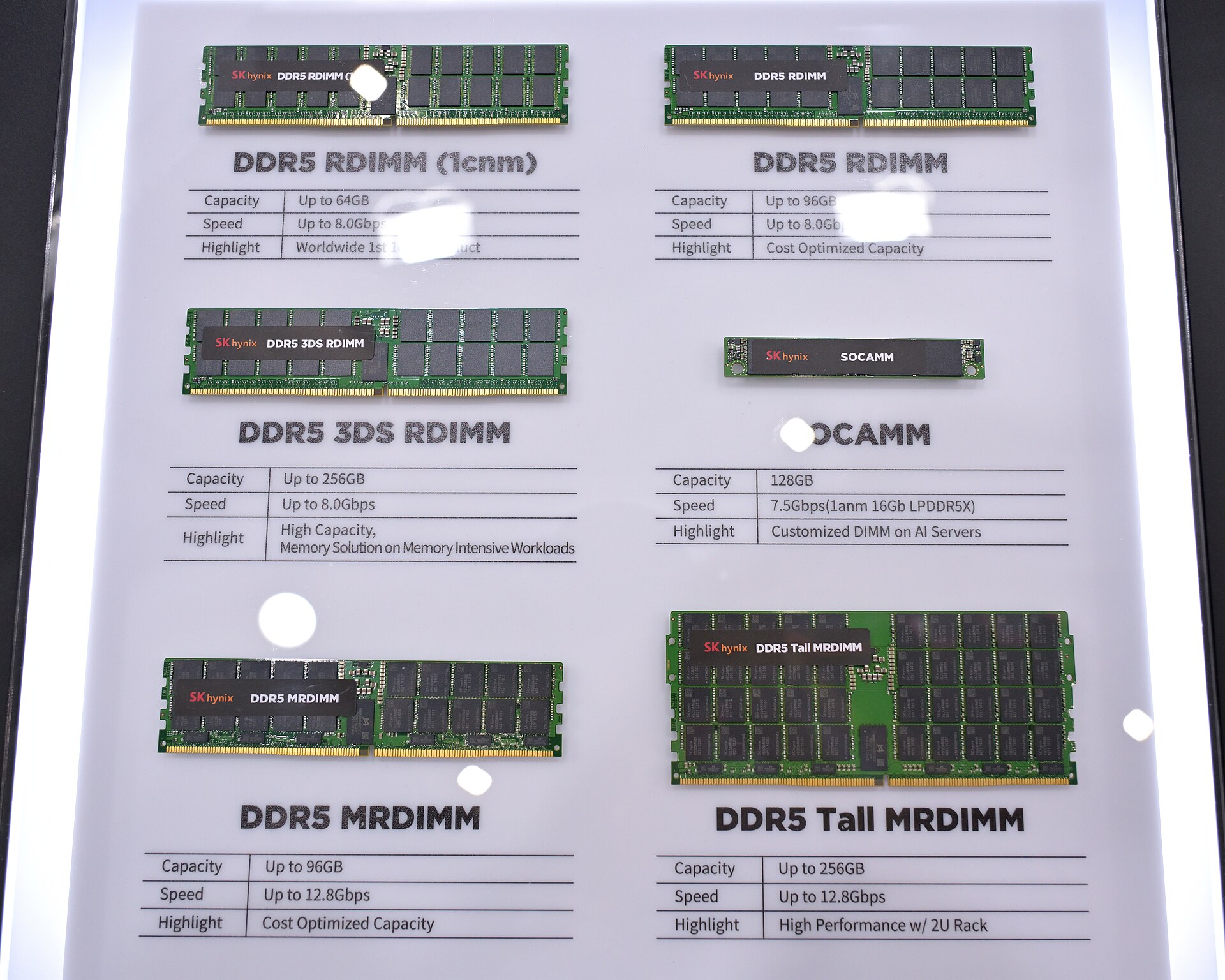
Micron sells both ends of that ladder, and its growth already lives at the bottom. Its June-quarter DRAM revenue rose 65.5% from the prior quarter to $36.0 billion, the fastest of the big three, while its share of the HBM market slid from 21% to 18% 9.
The premium stays with HBM. SK Hynix holds about half that market and runs a 76% operating margin, and each HBM4 wafer eats roughly three DDR5 wafers of capacity, part of why conventional DRAM prices jumped 58% to 63% in a quarter 9.
Micron's own investor site pitches agentic AI under a white paper titled "Agentic AI in Data Centers: The Critical Role of High-Bandwidth Memory" 10; the serving measurements put agentic traffic one tier down.
Long-term purchase pacts cannot resolve where future margins settle
The bull case has receipts: 16 strategic customer agreements worth about $100 billion through 2030, with roughly $22 billion of customer cash and other commitments 23. It also has arithmetic: $100 billion is about two quarters of revenue at the guided pace 2. Synovus sees supply tight through fiscal 2027 1, and SK Hynix is weighing a Solidigm IPO that values its NAND unit at up to $150 billion 11.
Even the Overweight camp concedes there is "no real way to prove that near term" 1. The beat will take care of itself; at an 86% margin, scarcity is not the question. Which memory the agentic era pays a premium for is. The test on Wednesday's call: whether Micron's HBM share keeps sliding while conventional DRAM does the growing, and whether management's DRAM pricing talk credits scarcity or substitution 9.
How this brief was made
01Gathered & sourced407 channels · 1,800 articles▾
Agents swept 407 channels and ingested 1,800 articles, then de-duplicated and ranked them for signal.
02Verified & cross-validated11 claims · 36 data feeds▾
Every one of 11 load-bearing claims was checked against primary sources, with 36 live data feeds reconciling the figures and charts.
- 1StockTwits via Yahoo Finance, "Micron's Post-Earnings Estimate Hikes May Lag Previous Quarters, Flags Morgan Stanley," 28 September 2026
- 2Forbes (Jim Osman), "Micron Stock: Earnings May Show Why $100 Billion Won't Save The Rally," 28 September 2026
- 3Simply Wall St via Yahoo Finance, "Micron (MU) Lands $100 Billion In Customer Deals After Blowout Q3," 27 June 2026
- 4StockTwits via Yahoo Finance, "Micron Earnings Preview: Analysts See Over 350% Revenue Jump As Retail Bulls Bet On Fresh Buyback," 27 September 2026
- 5MT Newswires via Yahoo Finance, "Micron's 'Conditions' Likely Remain Strong, Morgan Stanley Says," 28 September 2026
- 6The Motley Fool (Manali Pradhan), "Micron Has Surged 207% This Year. Brace for a Steep Pullback.," 9 August 2026
- 7Sharadar quarterly fundamentals for Micron, from SEC filings, retrieved 29 September 2026
- 8SemiAnalysis, "How GLM5.3 Sparse Attention Affects HBM Memory Usage," 28 September 2026
- 9Tech Times (Oscar Lazenby), "Micron posted fastest DRAM revenue growth in Q2 2026; SK Hynix's HBM lead was its liability," 7 September 2026
- 10Micron Technology Investor Relations, company overview and white papers, accessed 29 September 2026
- 11Reuters (Milana Vinn and Echo Wang), "SK Hynix's Solidigm weighs IPO that could value the unit at up to $150 billion, sources say," 25 September 2026
03Reviewed & edited1 human editor▾
One editor read the draft against the evidence, tuned the framing, and signed off before it shipped.
Become a contributor
Reporting on the business of AI and want it read? We take pitches from outside contributors who bring primary sources and a number worth arguing about.
Deepdive
AI-generated from this story and its cited sources. Not investment advice.