Midjourney Wants to Scan Your Body. Diagnosis Isn’t Included.
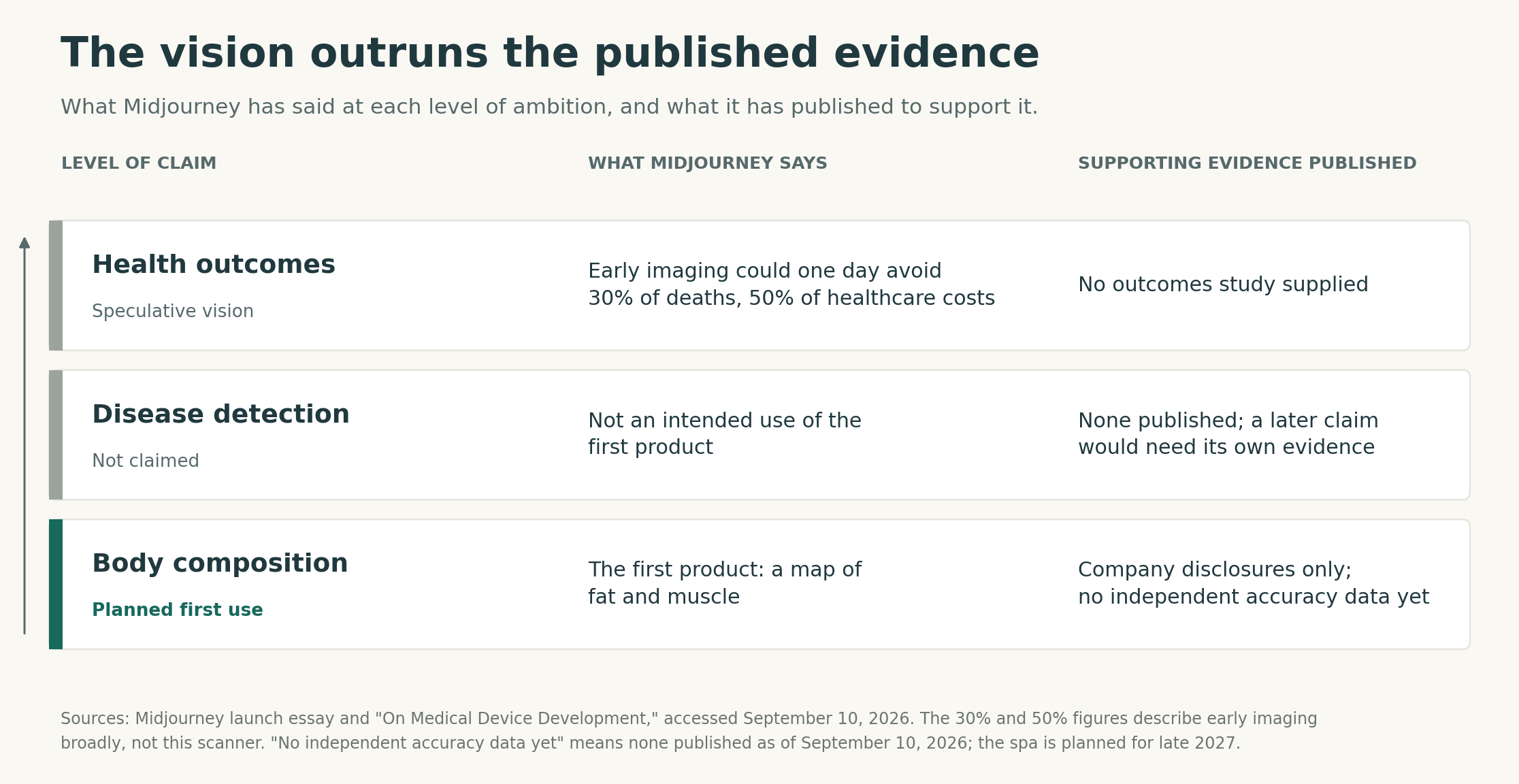
Midjourney's launch essay imagines early imaging avoiding 30% of deaths. The scanner it is actually building is meant to map fat and muscle. The evidence for the bigger story has not been published.
 Vincent JiangSeptember 10, 2026 · 3 min read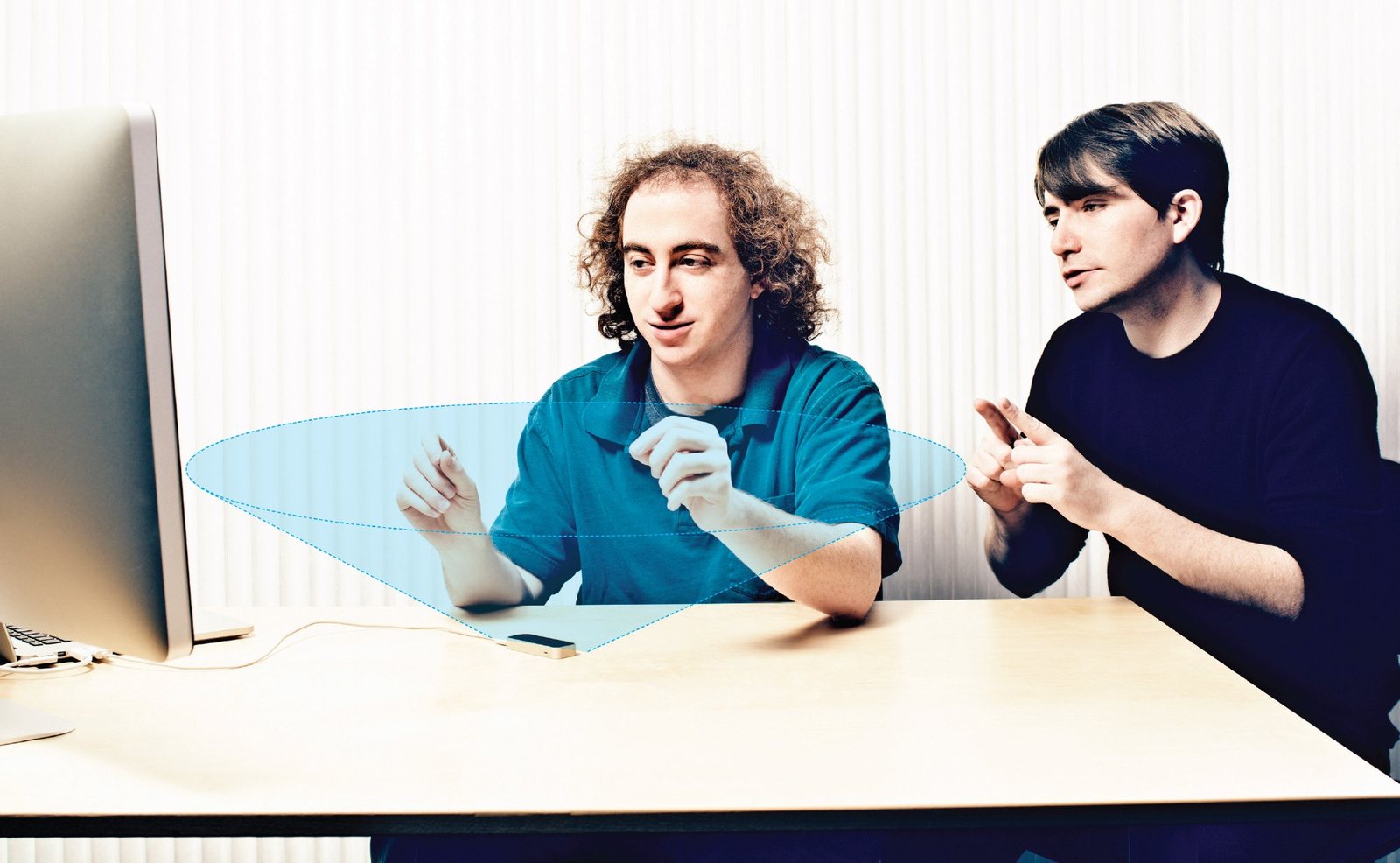
David Holz announced an astrology acquisition in July while planning a spa that will scan your body. His company, Midjourney, reportedly generated $300 million in 2024.1 Selling images has given him room to pursue something considerably more intimate.
The medical vision reaches far beyond the first product, which is intended to measure body composition, not diagnose disease.
The promise is bigger than the product
In its June launch essay, Midjourney imagines a future where early imaging could avoid 30% of deaths and 50% of healthcare costs.8 Those are speculative possibilities for early imaging broadly, not demonstrated benefits of its scanner. The essay supplies no supporting outcomes study for those estimates.
That is an enormous amount of hope to hang over a product that starts with a map of your fat and muscle.
The competition is cheap and fast
That map already has a market price. BodySpec sells DEXA scans, a common benchmark for body composition, that take 6 to 11 minutes26 and cost $40 with a membership27. Gym bioimpedance machines such as InBody finish in 15 seconds to two minutes.28 Midjourney reports its prototype takes 20+ minutes, against a final goal of one minute.9
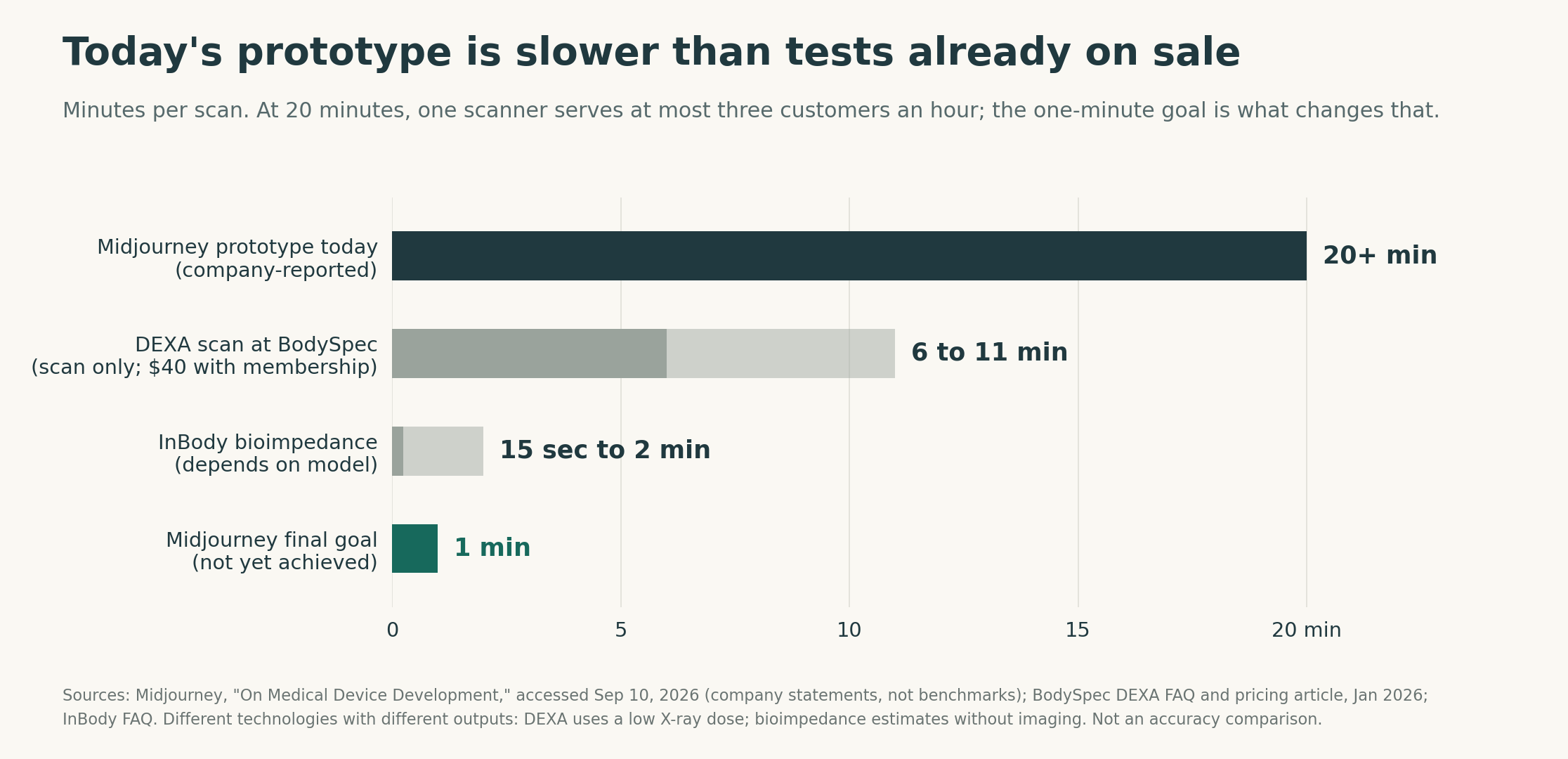
Scan time sets the economics. At 20 minutes, one scanner serves at most three customers an hour; near the one-minute goal, the scan itself stops being the bottleneck. Both figures are company statements, and there is more than a year to close the gap before the planned late-2027 opening. Until then, the scanner has to win on what its images show. Avoiding X-rays is a thin edge: BodySpec puts its DEXA dose at about four bananas' worth.26
Selling the visit
A body scan is not a health outcome; somebody still has to decide what to do next.
That decision is where the business gets uncomfortable. Midjourney describes a spa people would visit even without a scanner, with scans becoming incidental to the experience.8 The company could succeed at making customers return before establishing that repeated scans improve their health. That distinction matters whenever the health story helps sell the visit.
The Co-Star acquisition fits this consumer ambition.21 Holz says Banu Guler and her team will strengthen product and design across Midjourney.20 Building an experience people want to return to is useful expertise. It does not settle what their body data means.
If the scan finds something
If a future version starts flagging possible disease, somebody must interpret the finding, arrange follow-up and carry the cost. The American College of Radiology warns that whole-body MRI screening of people without symptoms or relevant risk factors can generate unnecessary investigations without established life-extension benefits.15,16 That is MRI evidence, not a verdict on this ultrasound device. It explains why a faster scan cannot, by itself, complete the healthcare job.
The case for Holz
Holz has a serious answer to the skeptics. He previously built hardware at Leap Motion.19 Butterfly Network's annual filing confirms Midjourney paid $15 million upfront for ultrasound technology.10,11 Midjourney openly limits the initial use and reports ethics oversight for volunteer image collection.9 That oversight protects research participants; it is not independent performance validation.
Narrowing the first product is sensible. The problem is asking a narrow product to carry such a vast health narrative before it publishes evidence supporting that narrative.
What to watch next
Before the planned late-2027 opening, look for independent evaluation of body-composition accuracy. Any later diagnostic or health-benefit claim needs evidence for that expanded use. The useful milestone is a result a customer can act on with justified confidence.
When Holz opens the spa, watch what the scan lets a customer decide.
How this brief was made
01Gathered & sourced233 channels · 1,131 articles▾
Agents swept 233 channels and ingested 1,131 articles, then de-duplicated and ranked them for signal.
02Verified & cross-validated28 claims · 30 data feeds▾
Every one of 28 load-bearing claims was checked against primary sources, with 30 live data feeds reconciling the figures and charts.
- 1Forbes, Midjourney company profile, updated Apr 16 2026 (2024 revenue via PitchBook; profitability; not audited).
- 2The Information, 2023 (expected $200M revenue; a forecast, not a result).
- 3The Information, Mar 2026 (founder says revenue significantly above $200M; no precise figure).
- 4Sacra, Midjourney profile (2023 ARR estimate; internally inconsistent, not relied on).
- 5DemandSage, Midjourney Statistics 2026 (daily-user range; no current measurement period).
- 6Skim AI, Jun 2024 (older provenance for the user range, describing Nov 2023).
- 7Official Midjourney Discord listing (members and online counts, not daily usage).
- 8Midjourney, “A New Era of Midjourney,” Jun 2026 launch essay (scanner vision; 30% / 50% projections; spa concept).
- 9Midjourney, “On Medical Device Development,” accessed Sep 10 2026 (20+ min vs 1 min goal; body-composition first use; ethics oversight).
- 10Butterfly Network Form 8-K, filed Nov 17 2025 ($15M upfront, $10M annual licensing, conditional milestones).
- 11Butterfly Network 2025 Form 10-K, Feb 2026 (confirms the $15M upfront payment was made).
- 12Butterfly Network press release, Jun 2026 (40 Ultrasound-on-Chip modules per prototype; supplier, not independent validation).
- 13FDA, Section 513(g) procedures guidance, Aug 2024 (a 513(g) response is not clearance or approval).
- 14FDA, General Wellness: Policy for Low Risk Devices, Jan 2026 (regulatory context).
- 15American College of Radiology, statement on total-body MRI screening, Apr 17 2023.
- 16Kwee & Kwee, preventive whole-body MRI systematic review, 2019 (incidental findings; limited verification).
- 17Preventive MRI management strategies and clinical implications, 2021 (treatment-triggering findings; counterevidence).
- 18Chen et al., Cochrane whole-body MRI/CT screening protocol, Aug 25 2026 (a protocol, not a completed review).
- 19The Register, David Holz interview, Aug 1 2022 (Leap Motion hardware background).
- 20Midjourney, “Midjourney's First Acquisition,” Jul 23 2026 (Co-Star; Banu Guler's product and design role).
- 21Bloomberg, Jul 24 2026 (Midjourney buys astrology app Co-Star; terms undisclosed).
- 22Midjourney, “Edit Model for V8,” Aug 27 2026 (image business still shipping).
- 23r/medicine discussion of Midjourney's scanner, Jun 2026 (follow-up ownership; not clinical evidence).
- 24TechCrunch, Sep 5 2025 (Warner Bros. suit; Midjourney's fair-use defense; no judgment).
- 25TechCrunch, Aug 22 2025 (Meta licenses Midjourney technology; licensing, not equity).
- 26BodySpec, DEXA FAQ (scan takes 6 to 11 minutes; appointment under 15; dose from 0.4 microsieverts, likened to eating four bananas).
- 27BodySpec, “What's the Real Cost of a DEXA Scan?,” Jan 6 2026 (as low as $40 with a membership).
- 28InBody FAQ (a bioimpedance test lasts 15 to 120 seconds, depending on model).
03Reviewed & edited1 human editor▾
One editor read the draft against the evidence, tuned the framing, and signed off before it shipped.
Confidential tips
Know something about this story? We protect our sources. Reach the editor directly, or read our guide to sharing securely.
Deepdive
AI-generated from this story and its cited sources. Not investment advice.