This AI Startup Raised $15 Million amid Employer Cuts to Weight-Loss Drug Coverage, but Its Proof Is Shaky.
Ilant Health pitches obesity care to employers. Its headline result sets its one-year 15% weight loss against a drug-free program's five-year 5.8%. At one year, that same program reported 12.4%.
 Vincent JiangSeptember 10, 2026 · 3 min read
Elina Onitskansky says she referred herself for a bariatric procedure after doctors failed to offer the medical help she needed.1
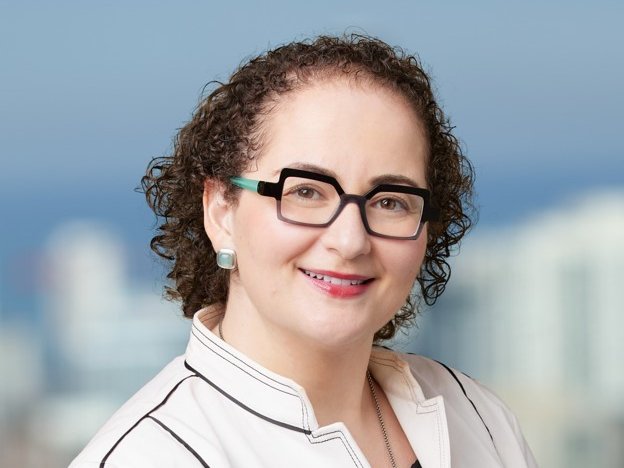
On June 2, 2026, her company, Ilant Health, announced a $15 million Series A led by Cornucopian Capital, bringing total funding above $22 million.2 It sells AI-supported obesity care. Its precision pitch starts with a sloppy comparison.
The 15% claim, checked
Ilant reports 15% average weight loss. Its homepage identifies that as a one-year result.4 The funding release places it above a 5.8% “real-world” benchmark.2 Click the citation: a 2018 Kaiser Permanente study measuring five-year outcomes from a nonsurgical, nonpharmacologic program involving meal replacements and behavioral support. The same paper reports 12.4% average loss at one year.5
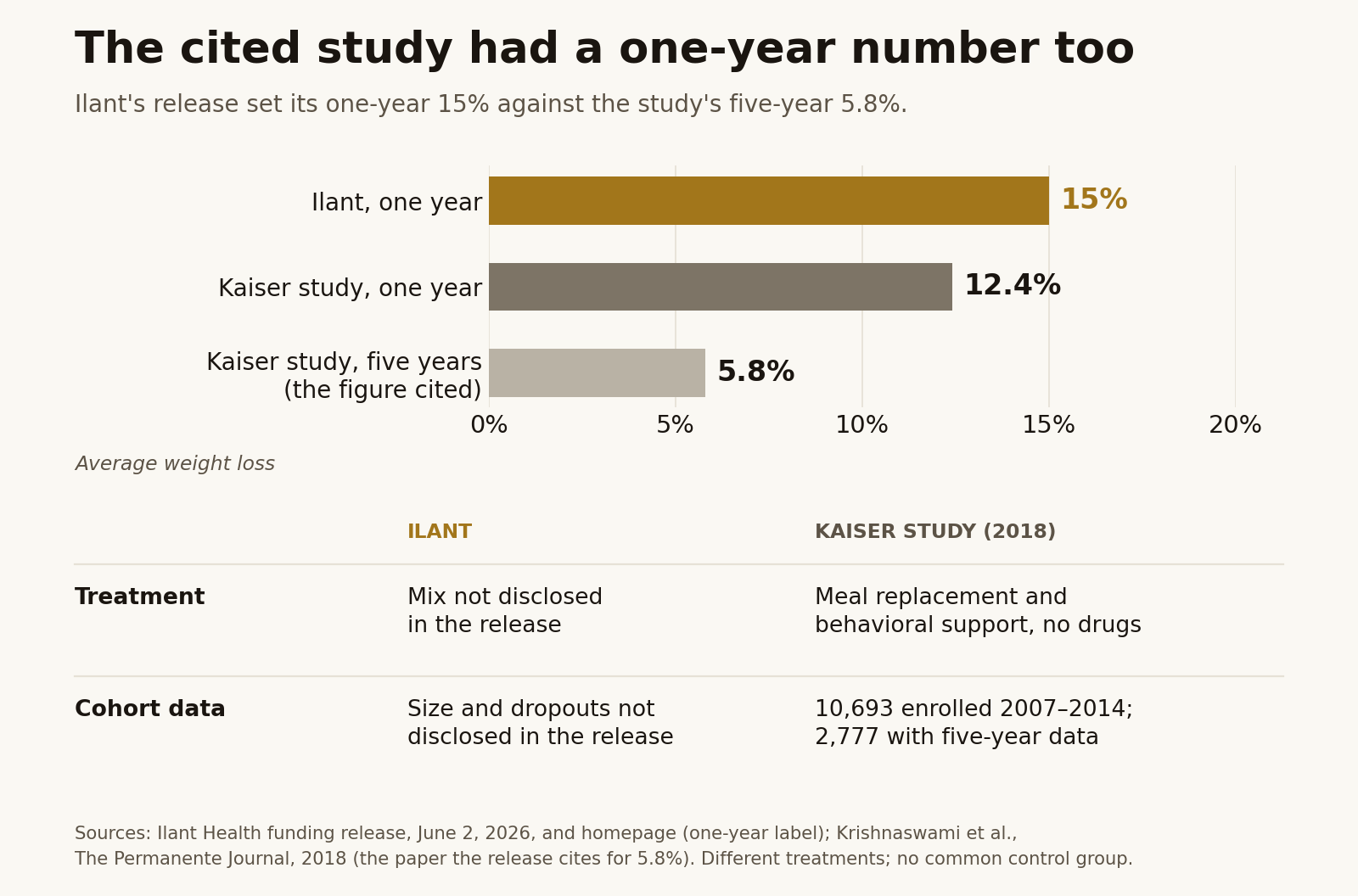
Different treatments. Different follow-up periods. No common control group. The release does not disclose Ilant's cohort size, treatment mix or handling of dropouts. That comparison cannot establish Ilant's superiority, much less isolate what its AI contributed. Real-world research shows why retention and dose matter when comparing weight loss.21
Employers want savings. Patients need care.
This matters because the company sits between people seeking treatment and institutions trying to spend less. Its health-plan pitch explicitly prioritizes expensive members and near-term financial returns.7 That can fund useful care. It also creates pressure to make the savings look better than the evidence permits.
The pressure is real. Business Group on Health's August 25, 2026 survey reported obesity GLP-1 coverage falling from 72% of surveyed employers in 2025 to 60% in 2026. This is a large-employer survey, not a national coverage rate.8
A smaller drug bill is not a health outcome.
Patients on Reddit discuss changing jobs to get coverage.11 These are unverified anecdotes, but they show what the employer's savings calculation can leave out.
ICER's December 2025 assessment found these medicines cost-effective while warning about their budget impact.22 Both can be true: treatment can be worth paying for without paying for itself. Withdrawal studies also show substantial weight regain after stopping semaglutide or tirzepatide.19,20 “Fewer prescriptions” needs a clinical explanation before it becomes a victory.
Who is vouching for Ilant
The founders understand the buyer. Onitskansky previously worked at Molina Healthcare and McKinsey; Jessica Muse joined as an early investor, cofounder and COO.3 In July, Onitskansky coauthored a commentary piece with Bryan Sivak, whose fund Evidenced joined the Series A.12 By August, Cornucopian's Aryeh Ganz was predicting a billion-dollar company.13 These are commercially interested voices. Their confidence is not clinical validation.
The best case for Ilant, and its limits
The strongest defense is that Ilant addresses a real delivery failure. Its Amtrak webinar described coordinated clinical support and performance guarantees16; its Galway Holdings partnership includes distribution through EPIC Insurance Brokers' employer clients.15 Those relationships could matter more than the algorithm. SELECT demonstrated cardiovascular benefit from semaglutide in adults with cardiovascular disease and overweight or obesity, without diabetes.17 The FDA recognized that benefit in 2024.18 Keeping appropriate patients in effective care creates real value.
But neither drug efficacy nor employer adoption validates Ilant's incremental results. Even manufacturer access is shared: Eli Eli Lilly's March 2026 launch listed 18 program administrators, counting the names, including Ilant.14 A place on that list is distribution access, not exclusivity.
What would prove it
The commercial test is whether Ilant can preserve better care if drug discounts and competitors narrow its room to charge. The clinical test is whether savings survive scrutiny of who enrolled, who stayed, who stopped and who paid.
For the next announcement, publish comparable cohorts and medical plus pharmacy spending after program fees, with dropouts included. Onitskansky's original problem was being failed by the care system. The next evidence should show whether patients are escaping that failure.
How this brief was made
01Gathered & sourced388 channels · 2,139 articles▾
Agents swept 388 channels and ingested 2,139 articles, then de-duplicated and ranked them for signal.
02Verified & cross-validated23 claims · 26 data feeds▾
Every one of 23 load-bearing claims was checked against primary sources, with 26 live data feeds reconciling the figures and charts.
- 1Ilant Health, leadership page, checked Sep 10 2026 (founder's self-reported bariatric referral; not independently verified).
- 2HIT Consultant, Jun 2 2026 (Ilant Health Series A: $15M led by Cornucopian; over $22M total; the 15% vs 5.8% comparison; no cohort methods).
- 3Ilant Health seed extension release, Business Wire, Apr 17 2024 (Jessica Muse as angel investor, cofounder and COO; $5.5M seed).
- 4Ilant Health homepage, checked Sep 10 2026 (15% labeled a one-year result; 2 to 4 times in-year ROI claim; unaudited).
- 5Krishnaswami et al., The Permanente Journal, Jan 22 2018 (the paper behind the 5.8% citation; drug-free meal-replacement program; 12.4% at one year, 5.8% at five years; 10,693 enrolled, 2,777 with five-year data).
- 6Ilant Health platform page, checked Sep 10 2026 (AI for member identification and treatment selection; no public controlled estimate).
- 7Ilant Health health-plan page, checked Sep 10 2026 (high-cost members and near-term returns; not evidence of improper denials).
- 8Business Group on Health, 2027 employer strategy survey, Aug 25 2026 (72% to 60%; 127 employers surveyed in June 2026).
- 9KFF 2025 Employer Health Benefits Survey (19% of firms with 200+ workers cover GLP-1s for weight loss; different sampling).
- 10North Carolina State Health Plan, Mar 7 2024 (weight-loss coverage removed from Apr 1 2024; historical retrenchment).
- 11r/Zepbound, Aug 13 2026 (patients discuss job changes for coverage; unverified anecdotes, not Ilant customers).
- 12Fortune, Jul 23 2026 (founder and investor commentary; opinion).
- 13AgFunderNews, Aug 11 2026 (Cornucopian's Aryeh Ganz predicts a billion-dollar company; an investor forecast, not a valuation).
- 14Lilly Employer Connect launch, Mar 5 2026 (18 program administrators including Ilant; shared access, not exclusivity).
- 15Ilant Health and Galway Holdings, Business Wire, Nov 12 2024 (employee access from Jan 2025; distribution through EPIC's clients).
- 16Shortlister, Ilant and Amtrak vendor webinar recap, 2026 (coordinated care; performance guarantees; promotional, no contract terms).
- 17Lincoff et al., SELECT trial, NEJM, Nov 11 2023 (semaglutide cardiovascular benefit; Novo Nordisk funded; not an Ilant effect).
- 18NPR, Mar 8 2024 (FDA approves Wegovy's cardiovascular-risk indication; relies on SELECT, not an independent trial).
- 19Wilding et al., STEP 1 extension, 2022 (about two-thirds of weight loss regained within a year of stopping semaglutide).
- 20Aronne et al., SURMOUNT-4, Dec 11 2023 (substantial regain after switching from tirzepatide to placebo).
- 21Gasoyan et al., Jun 10 2025 (7,881 patients; one-year loss varies with discontinuation and dose; observational).
- 22ICER obesity assessment, Dec 2025 (cost-effective at modeled prices; serious budget-impact concerns).
- 23CMS Medicare GLP-1 Bridge, Jul 1 2026 ($50 monthly access through Dec 31 2027; not universal coverage or an Ilant contract).
03Reviewed & edited1 human editor▾
One editor read the draft against the evidence, tuned the framing, and signed off before it shipped.
Confidential tips
Know something about this story? We protect our sources. Reach the editor directly, or read our guide to sharing securely.
Deepdive
AI-generated from this story and its cited sources. Not investment advice.