Nvidia guarantees up to $105 billion of OpenAI's Ohio campus; CoreWeave's bonds imply near 63% default odds
Nvidia's own filings show $36 billion of neocloud backstops, a $105 billion guarantee on OpenAI's Ohio campus and up to $125 billion of residual value promises, while default insurance on its biggest neocloud prices a 63 percent chance of failure. The credit market is pricing the case where the guarantor pays.
 Vincent Jiangfour-minute read

Last week CoreWeave+16.01% — CoreWeave, up 16.01 percent today, the largest of the Nvidia−5.72% — Nvidia, down 5.72 percent today-backed "neoclouds" renting out AI computing power, slid as much as 8.3 percent to its lowest since May 2025, and the trigger was not earnings: it was the bond market 3. Its April-issued bonds traded around 15 percent, at 79.15 cents on the dollar, and default insurance on its debt climbed to about 1,000 basis points, a spread implying a nearly 63 percent chance of default within five years, up from about 30 percent a year ago 3.
CoreWeave is Nvidia's second-largest investment, and Nvidia's whole strategy now rests on companies like it 3. The guarantees behind that strategy are in Nvidia's own filings.
The guarantor's book is in its own filings
Nvidia has spent the past year quietly standing behind its customers with guarantees nobody counts as debt. As of its July filing: $36 billion of off-balance-sheet backstops for neoclouds, a guarantee of up to $105 billion on the chips, land and power at OpenAI's$1.18T — OpenAI, private, latest valuation $1.18T proposed 10 gigawatt Ohio campus, and $20 billion of data center leases Nvidia signed as tenant for later assignment 1.
In August came the biggest line: over $500 billion of off-balance-sheet commitments, mostly maturing through fiscal 2029, including up to $125 billion in residual value guarantees promised to six asset managers on GPU financings 1. New Constructs, a financial research firm, values the net present value of these liabilities above $153 billion for fiscal 2026, up more than $100 billion in a year, more than twice the $70 billion of free cash flow Nvidia generated in the first half 1.
Three named books of Nvidia guarantees add to $266 billion
Data
| Value | |
|---|---|
| Neocloud backstops | $36B |
| OpenAI Ohio guarantee | $105B |
| GPU residual guarantees | $125B |
The guarantor only pays if the borrower breaks
The guarantees are contingent, which is the whole argument. Nvidia pays only on default, and the OpenAI guarantee ends if OpenAI posts its own collateral or earns a high enough credit rating 1. So the book is priced not by Nvidia's $5 trillion market cap but by its borrowers 1.
CoreWeave carries roughly $50 billion of debt and is expected to lose $2.13 billion this year on nearly $13 billion of revenue, and its bonds yield above the level that usually signals distress 3. That is despite an Nvidia commitment to buy any unsold CoreWeave capacity through April 13, 2032 3. Huang's answer is demand: he told reporters in Stockholm that CoreWeave's "financial strength is improving every day" and its cost of capital is "actually decreasing"; in Berlin this week he called neocloud demand "off the charts" 31.
CoreWeave's debt has quintupled in six quarters while revenue tripled
- Revenue
- Total debt
Data
| Revenue | Total debt | |
|---|---|---|
| Q4 '24 | $0.75B | $10.62B |
| Q1 '25 | $0.98B | $11.9B |
| Q2 '25 | $1.21B | $14.56B |
| Q3 '25 | $1.37B | $18.81B |
| Q4 '25 | $1.57B | $29.82B |
| Q1 '26 | $2.08B | $35.15B |
| Q2 '26 | $2.58B | $51.61B |
The contested number underneath is the chip
On September 25 Elon Musk replied "Interesting" to an estimate by analyst Ed Zitron that roughly half of AI chip sales, $200 billion to $300 billion or more, are sitting in warehouses, with data centers years behind Nvidia's advance deliveries 2. If resales fall below the residual values Nvidia guaranteed, Nvidia pays. If chips hold value, as Moody's+0.83% — Moody's, up 0.83 percent today, the credit rating agency, likely expects near term, the book mostly expires worthless 1.
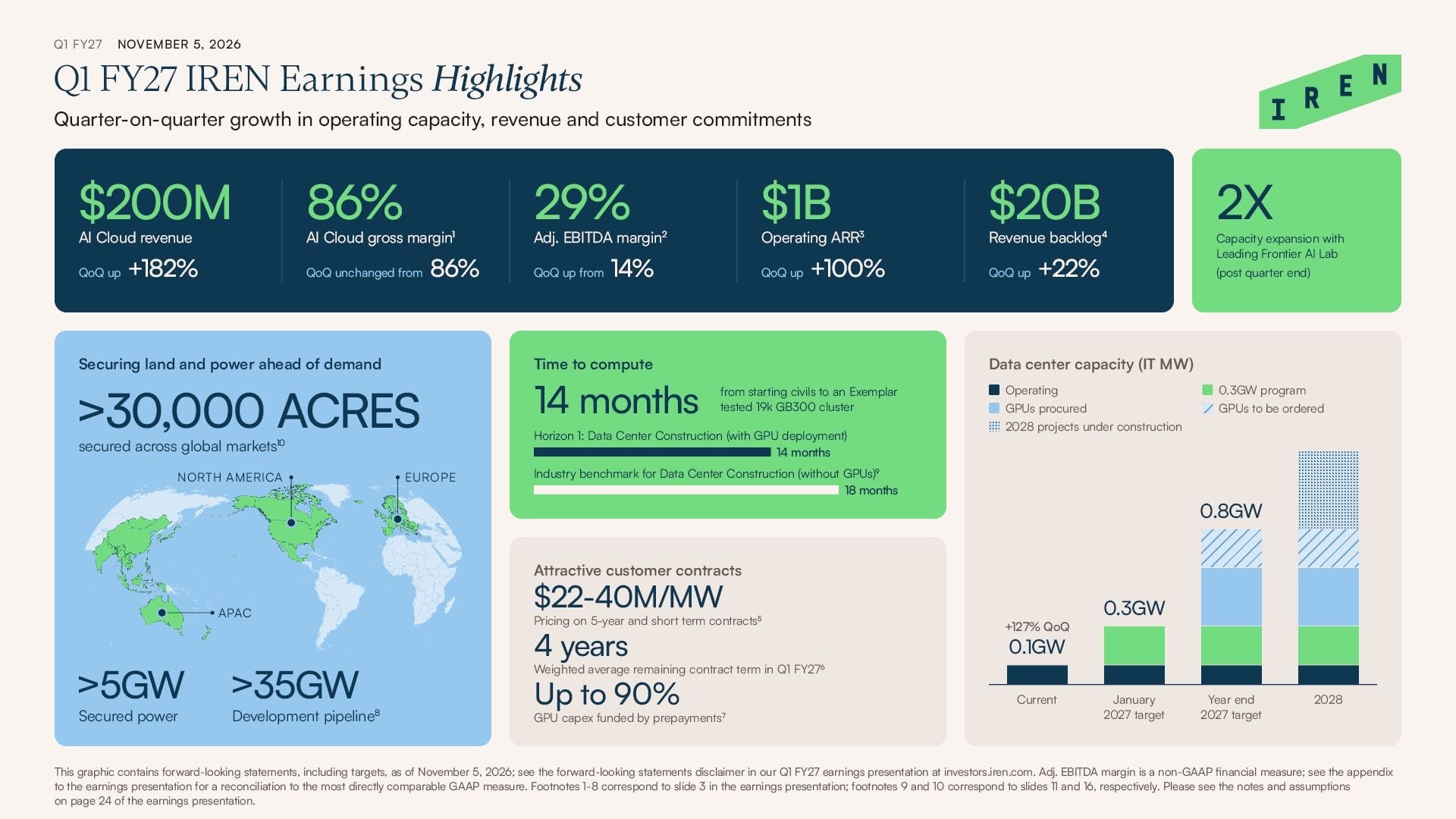
The market has voted with equities: CoreWeave, Nebius+11.41% — Nebius, up 11.41 percent today and IREN+1.22% — IREN, up 1.22 percent today are down at least 30 percent in October, and Nvidia is off 7.6 percent, on pace for its worst month since November 2025 1. Gartner+2.16% — Gartner, up 2.16 percent today, the research firm, puts a floor underneath: about 80 percent of neoclouds could shut down by 2030, with more than $3.5 trillion of AI spending facing impairment 3.
Watch the spread, and one trigger
CoreWeave chief executive Mike Intrator told employees in a memo seen by Reuters that the deal backlog "more than covers" its debt obligations 3. Perhaps. But record put option buying the same week says investors are hedging the case where it does not 3.
The credit spread is the first place Nvidia's insurance book gets marked, before any default ever lands on the balance sheet. The single event that would settle the dispute is a trigger, not a quote: OpenAI posting collateral or winning the rating that ends Nvidia's $105 billion guarantee, or the first GPU resale below a guaranteed residual value 1. Watch for which one lands first.
Get Data Center by email, free
Who is building AI's data centers, and who is paying for them. In our daily email, every weekday.