Nvidia backed its own AI customers with more than $170 billion; 81% run GPUs at half capacity
The Information counts more than $170 billion of Nvidia commitments behind its own customers, Huang says only working capital is missing, and 81% of production AI operators run their GPUs at half capacity. The market spent Thursday pricing who pays.
 Vincent Jiang · 2 min read

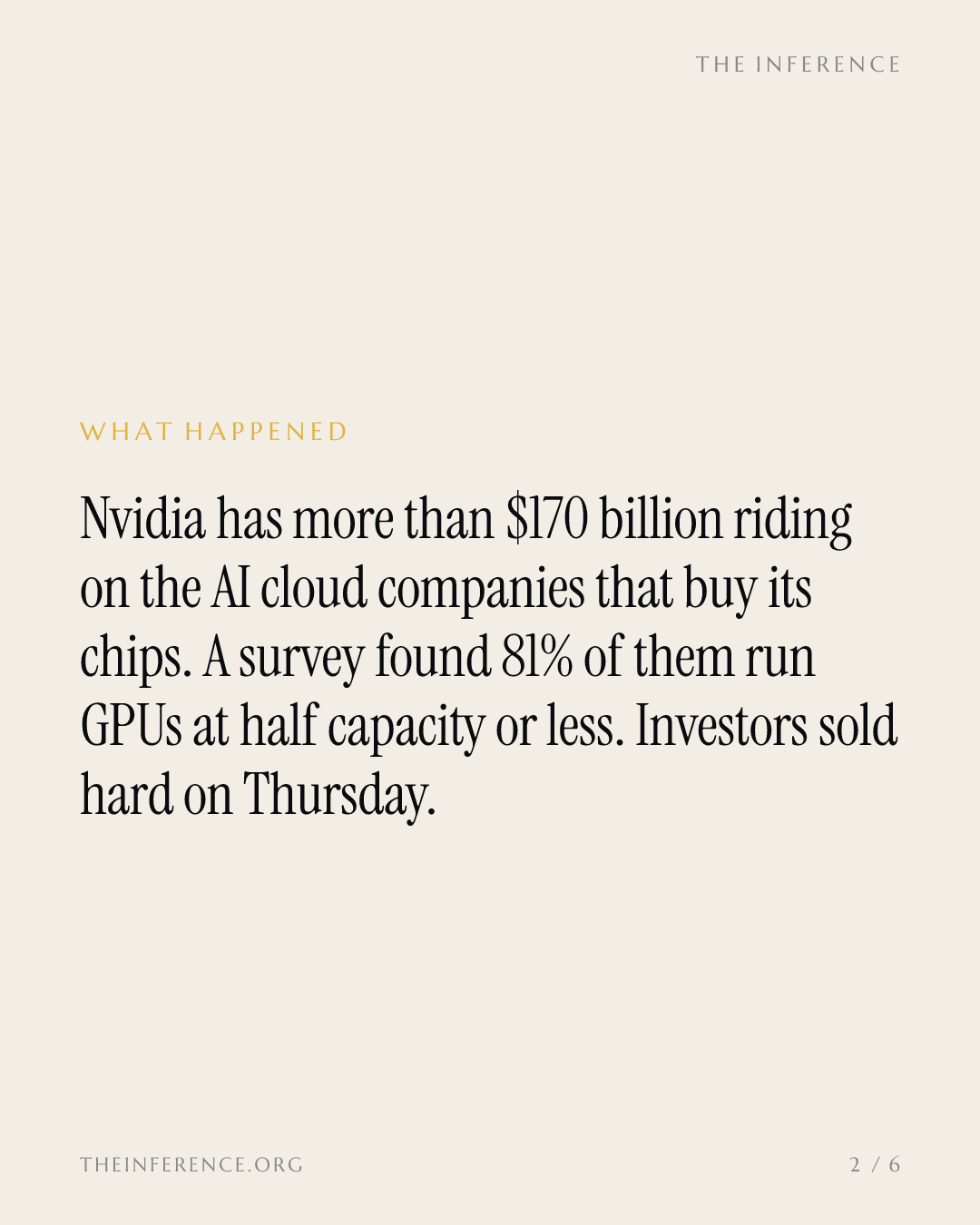
The chipmaker that sells the shovels has become the bank. The Information's read of Nvidia's filings puts more than $170 billion on the line for neoclouds and other large customers through the July quarter: up to $164.5 billion in guarantees, including promises to pay landlords if tenants default, plus more than $7 billion invested directly in AI cloud providers 1. Nvidia+0.01% — Nvidia, up 0.01 percent today also holds $99 billion of stock in companies that buy its chips 1.
The market voted on who pays
Investors answered the question this week. On Thursday October 22, Nvidia fell 4.40% to $212.21, erasing roughly $235 billion of value, and the Philadelphia Semiconductor Index dropped 6.72% 3. CoreWeave−1.47% — CoreWeave, down 1.47 percent today sank 10.1% to $55.60 and IREN+0.12% — IREN, up 0.12 percent today 8.4% to $25.51, both 2026 closing lows 4. Nebius+1.30% — Nebius, up 1.30 percent today fell 7.2% even after announcing a $3.5 billion financing facility from Citi−1.25% — Citi, down 1.25 percent today 4.
Jensen Huang's counter-argument, made on CNBC at GTC Berlin: demand for neoclouds is "off the charts," and "what is missing in the middle is the working capital to fuel that growth." The debt, he said, "is now becoming an asset class" 13.
The customers' GPUs are half idle
A VentureBeat Intelligence survey of 102 infrastructure buyers complicates that pitch 2. Of 68 companies running AI in production, 55, or 81%, reported average GPU utilization of 50% or less, and 91% of planned adopters have no finance-reviewed ROI figure for the infrastructure they already own 2.
Nebius still leads 2026 at plus 90% while CoreWeave and IREN sit at minus 22% and minus 33%
Data
| Value | |
|---|---|
| Nebius | 90.1% |
| Applied Digital | -22.1% |
| CoreWeave | -22.4% |
| IREN | -32.5% |
Nvidia's own books show the stakes. Supply and capacity commitments hit $279 billion as of July 26, up from $119 billion a quarter earlier 3. Its maximum guarantee exposure is $108.5 billion, but $105 billion of that sits in SB Energy Ohio campus leases for OpenAI$1.18T — OpenAI, private, latest valuation $1.18T; only $3.5 billion is AI leases 3. When the guarantees are called, the bill routes through one tenant more than any neocloud 3.
A float pension funds declined, Nvidia still funds
Firmus is the model in miniature: the Australian cloud pulled its ASX float after failing to sell a $30 billion valuation, having sought $5.5 billion 1. Nvidia, already an investor, is now in talks to put in hundreds of millions more 1. The supplier financing its own demand, at valuations pension funds declined, is the loop to watch. The November 18 earnings print shows how much of the "off the charts" demand Nvidia itself carries 1.
Deep dive below for the filings behind each figure.
What happens next
NVDAHow much of the neocloud demand Nvidia itself is carrying through guarantees, investments and commitments
The case for
Nebius is still up 90.1% in 2026 and just landed a $3.5 billion Citi financing facility
The case against
Nvidia's maximum guarantee exposure routes through a single tenant, OpenAI, whose $105 billion SB Energy Ohio leases dwarf the $3.5 billion of AI leases
- Wed Nov 18, 2026Nvidia's third-quarter earnings print.
Get our follow-up when these land
Free. We'll email you when we publish on Nvidia, and send our free weekday newsletter. Unfollow in one click.

More about NVIDIA
NVDA · Fiscal Q2 2027Revenue rose 106% to $96.2B, 92.5% of it from Data Center, “driven by the ramp of our Blackwell Ultra infrastructure”. Gains on equity stakes of $7.8B lifted net income to $59.7B.
Show as a table
| Line | Value |
|---|---|
| Revenue | $96.2B |
| Gross margin | 75.0% |
| Operating margin | 66.2% |
| Net income | $59.7B |
| Hyperscale | $48.7B |
| AI clouds & enterprise | $40.3B |
| Data Center | $89.0B |
| Edge Computing | $7.2B |
| Gross profit | $72.1B |
| Cost of revenue | $24.1B |
| Other income | $7.8B |
| Operating income | $63.7B |
| Operating expenses | $8.4B |
| Tax | $11.8B |
| R&D | $7.1B |
| SG&A | $1.4B |