Nvidia picked Schneider Electric to build 14-day AI data centers as Barclays warns peak pricing may end
Nvidia named Schneider a factory builder of its 14-day DSX POD data centers on October 21, the same day Schneider launched its RapidScale design for Vera Rubin, while Barclays warned the day before that peak pricing for power-gear makers is ending. Volume and price now point opposite ways on the same company.
 Richard Tangfour-minute read

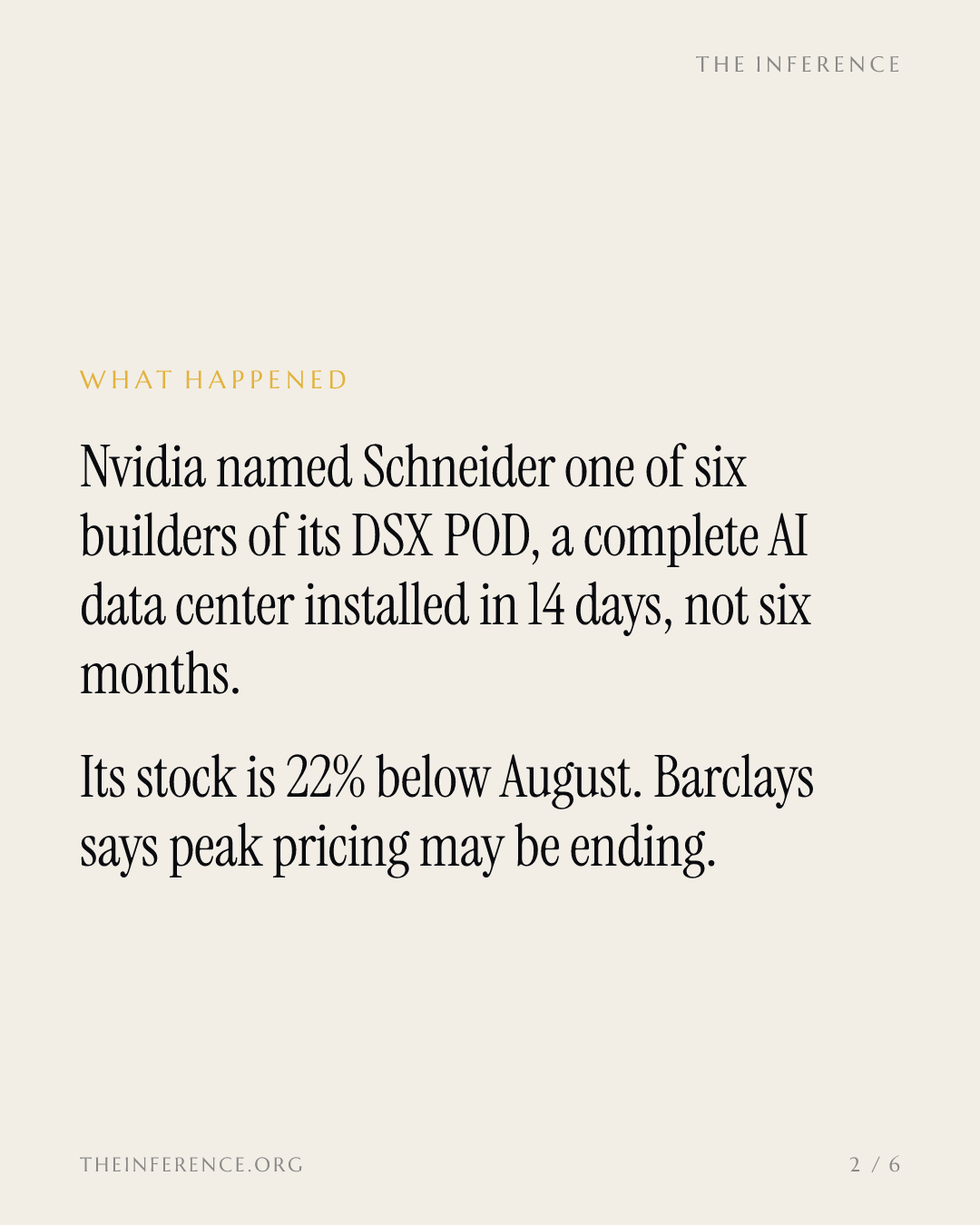
Nvidia−4.19% — Nvidia, down 4.19 percent today named Schneider Electric−0.78% — Schneider Electric, down 0.78 percent today on October 21 as one of six companies, alongside Dell Technologies−6.94% — Dell Technologies, down 6.94 percent today, HPE−4.02% — HPE, down 4.02 percent today, Lenovo, Bull and Vertiv−6.78% — Vertiv, down 6.78 percent today, that factory-build its new DSX POD, a complete AI data center assembled off-site and installed in as little as 14 days at a prepared site against about six months today, with first deliveries early 2027 35. The same day, Schneider launched RapidScale, its own prefabricated reference design built for Nvidia's Vera Rubin platform 6.
Three days earlier it had printed a record quarter: €11.5 billion of revenue, up 17% organically, data-center demand up triple-digit, and a second upgrade to its 2026 target in the year 1. That formalizes the volume story. The money argument ran the other way a day before the keynote.
Barclays says the peak price is ending
Barclays−2.06% — Barclays, down 2.06 percent today, led by analyst George Featherstone, warned on October 20 that "peak cycle economics could soon be normalized" for power-gear makers: AI buyers are pressing on price, and new capacity is arriving in exactly the two categories where lead times had spiked, power and medium-voltage equipment 2. Reported talks between Nscale, a compute-rental firm known as a neocloud, and Anthropic$350B — Anthropic, private, latest valuation $350B price capacity below CoreWeave's−6.61% — CoreWeave, down 6.61 percent today September benchmarks per gigawatt-year 2.
Paris had already voted. On October 20 Schneider fell 3.5%, the steepest drop in the CAC 40, as credit fear around neoclouds swept the equipment makers; CoreWeave, the largest of them, has seen its bond yields near 15% 7. The stock sits 22% below its August peak, Siemens Energy−1.75% — Siemens Energy, down 1.75 percent today is 31% off its April high, and ABB has given back about the same since June, figures Barclays itself reports 2.
The AI-gear drawdowns are deep: 22% to 31% from recent peaks
Data
| Value | |
|---|---|
| Siemens Energy | -31% |
| Schneider Electric | -22% |
| ABB | -22% |
Volume is not the open question
The demand side keeps confirming itself. Schneider's Systems business, the line prefabricated data centers are sold through, grew 22% organically in the quarter, faster than any other part of the company, and the group ended with a record backlog and what management calls increasing visibility into 2027 and 2028 1.
Nvidia sees the same build-out from above: its supply and capacity commitments, agreements to buy parts and book factory space, hit $279 billion at the end of July, $160 billion of it added in a single quarter, per its own 10-Q 3. "Demand is extraordinary. Capacity is the constraint," said Jensen Huang 3. When the buyer at the top of the chain commits like that, the volume link is locked.
Price and watts per token are the open links
Price is where the evidence is thinner and the risk sits. Nothing in this week's releases discloses what a DSX POD sells for or what Schneider's economics on the Nvidia arrangement are, so the question is whether factory standardization protects margin or turns power gear into a commodity box. The test arrives with POD pricing and the early 2027 deliveries 35.
Nvidia's own software adds a third force, and it pushes against volume of gear rather than with it. DSX trials squeezed 24% to 49% more token throughput from a fixed power budget, and in a grid-event trial a cluster cut its power draw by up to 40% while critical work kept running 34. More compute per megawatt means less power equipment per unit of AI, which is why efficiency, not only buyer pressure, can normalize what Schneider charges.
The stock is refusing to pick a side
So the volume story and the price story point opposite ways on the same company, and the 22% slide since August is the market declining to pick a side 2. The chain runs from standardized factory-built data centers to more AI installations to more Schneider Systems revenue; the price hop in between is unproven, and it is the one the next two quarters will settle.
Standardized volume growing faster than price falls makes the drawdown an entry; buyers paying commodity rates for factory-built boxes makes Barclays right that normalization has started.
Note: no disclosed figures exist for Schneider's POD economics or the terms of the Nvidia arrangement; the verdict above rests on reported volume, drawdowns and DSX efficiency results, not undisclosed pricing.
Get Data Center by email, free
Who is building AI's data centers, and who is paying for them. In our daily email, every weekday.




Reader comments
0 comments