Oracle's filing shows $288 billion off-balance-sheet leases as S&P sees no disconnect and CDS hits 295
The rating agency says it cannot see all the AI debt and sees no need to act. Oracle's quarterly filing puts a number on the unseen part, and the market's price for Oracle default keeps setting records.
 Richard Tang · 3 min read
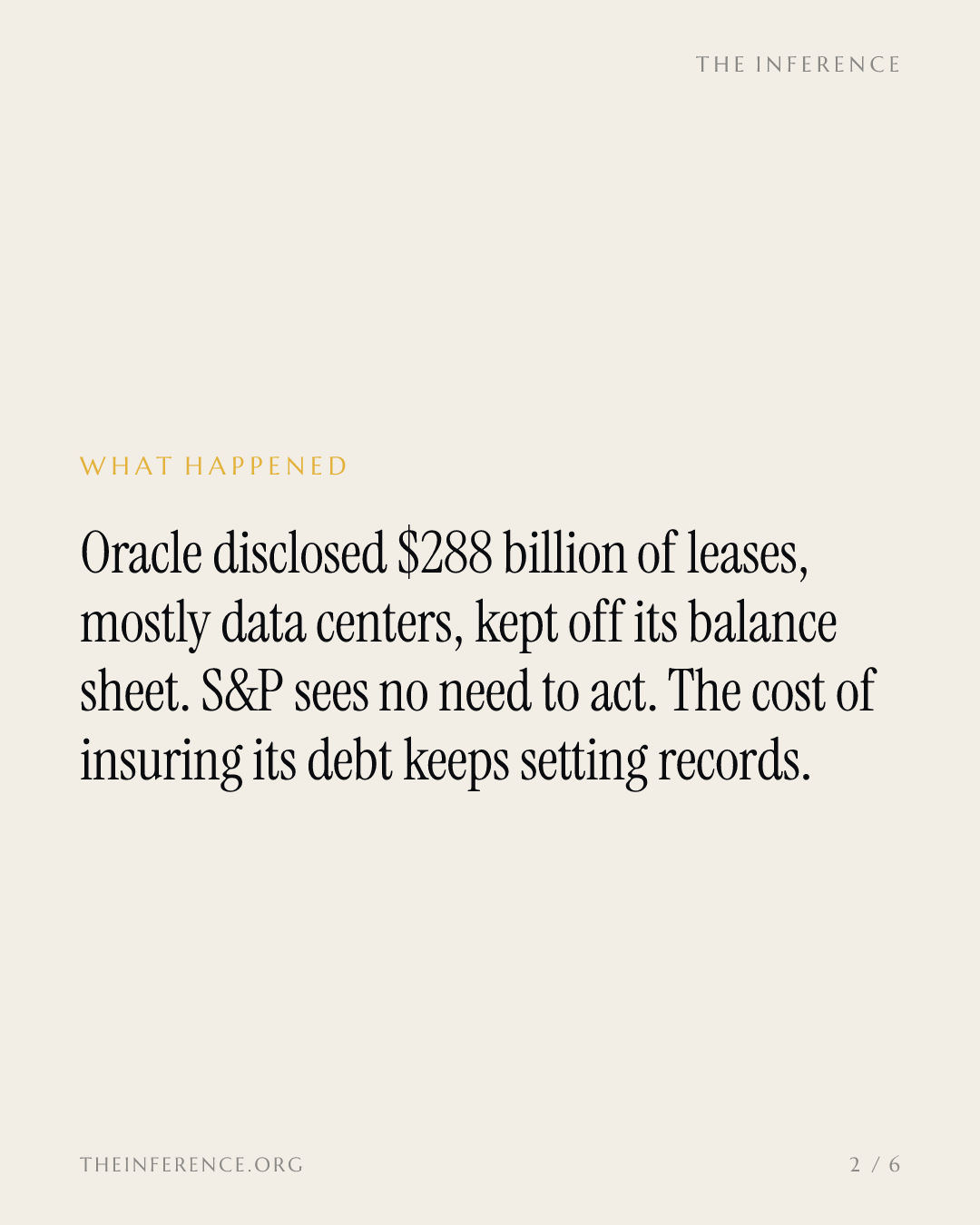
Oracle's−1.57% — Oracle, down 1.57 percent today quarterly filing just put a number on the AI debt S&P Global Ratings$123B — S&P Global Ratings, private, latest valuation $123B says it cannot see. The company disclosed $288 billion of additional lease commitments, substantially all data centers, sitting outside its balance sheet 1. Days earlier, S&P's global head of digital infrastructure said it is "safe to assume" the biggest tech firms carry more AI-linked debt than disclosed, while insisting no rating change is needed 2.
Meanwhile Oracle's default insurance keeps printing records: 295 basis points on October 19, the third this month 1. The agency's rating desk sees no disconnect; its own data terminal shows the market treating Oracle as high yield, and the parties exposed to the gap are Oracle's bondholders.
The notch is the product
S&P cut Oracle to BBB-, one notch above junk, on July 9, and holds it there 13. That notch is infrastructure, not commentary. Roughly $120 billion of Oracle bonds sit in investment-grade indexes, and one more cut to BB+ would force funds restricted to investment-grade paper to sell them 3. Deutsche Bank strategist Jim Reid warned of exactly that forced-selling dynamic; Oracle told CNBC that maintaining its investment-grade rating is its "first priority" 1. Moody's+1.20% — Moody's, up 1.20 percent as of its last quote, the rival rater, carries Oracle on negative outlook 3.
The market disagrees with the desk
Oracle's five-year credit default swap, the insurance against default, hit 261 basis points, then 288, then 295 this month 134. We reported the 261 basis point record on October 15 and the 288 print the same week; the 295 is new since then 4. S&P Global+1.05% — S&P Global, up 1.05 percent as of its last quote Market Intelligence's own fixed income desk prices the credit "in line with BB and B credit, which is high yield" 4.
Yet the ratings side of the same company told investors this week it sees no "major disconnect" requiring action, because its scores take a long-term view 2. One or the other description of Oracle's credit is wrong for someone's portfolio.
Oracle default insurance has set three records this month, reaching 295 basis points
Data
| Value | |
|---|---|
| Record, mid-Oct | 261 bp |
| Record, Oct 15 | 288 bp |
| Record, Oct 19 | 295 bp |
The filing answers the visibility question
S&P's Mark Habib said unseen liabilities may sit in unrated structures, where his agency might "not have the visibility" 2. Oracle's filing gives a partial answer: the $288 billion of off-balance-sheet lease commitments start paying out between fiscal Q2 2027 and fiscal 2029 1.
S&P models Oracle's fiscal 2027 free cash flow deficit at $42 billion, after a burn of nearly $24 billion in fiscal 2026, having raised its capex forecast almost 60% to $95 billion after talks with management 3. The backlog Oracle borrows against is $664 billion of contracted revenue, roughly 45 percent of it OpenAI$1.18T — OpenAI, private, latest valuation $1.18T, which lost $38.5 billion in 2025 and starts paying about $60 billion a year only in 2027 3.
Capex has outrun Oracle's operating cash flow every quarter since Q2 2025, in US$ billions
- Capital expenditure
- Operating cash flow
Data
| Capital expenditure | Operating cash flow | |
|---|---|---|
| Q2 '25 | 9.08 | 6.16 |
| Q3 '25 | 8.5 | 8.14 |
| Q4 '25 | 12.03 | 2.07 |
| Q1 '26 | 18.64 | 7.15 |
| Q2 '26 | 16.49 | 14.62 |
| Q3 '26 | 28.5 | 23.1 |
Who carries this
The arrangement moves risk to the party least able to exit: index-constrained bondholders must hold what the rating calls safe, and a sale is forced on them only after the notch moves 13. The stress is spreading beyond one issuer; SoftBank's five-year swap reached 432 basis points this week 1.
Oracle's December 14 quarter, the second of its fiscal 2027, is the test of whether the $664 billion backlog converts on schedule 13. If it does not, the question stops being what S&P can see and becomes which holders are forced sellers.
The daily newsletter