Perplexity CEO resets IPO plans to 2028 after crossing $1 billion of annualized revenue
Aravind Srinivas also put a 56% gross margin and a 60 to 70% Opus share of agent tokens on record, days after Perplexity widened a 16-agent mode whose cost it still does not publish. The audited numbers behind a $1 billion year and a reported $30 billion mark now wait on 2028.
 Vincent Jiangthree-minute read
Drafted with AI from the documents listed under Sources, then edited and fact-checked by Vincent Jiang. How we work
The clock moved back
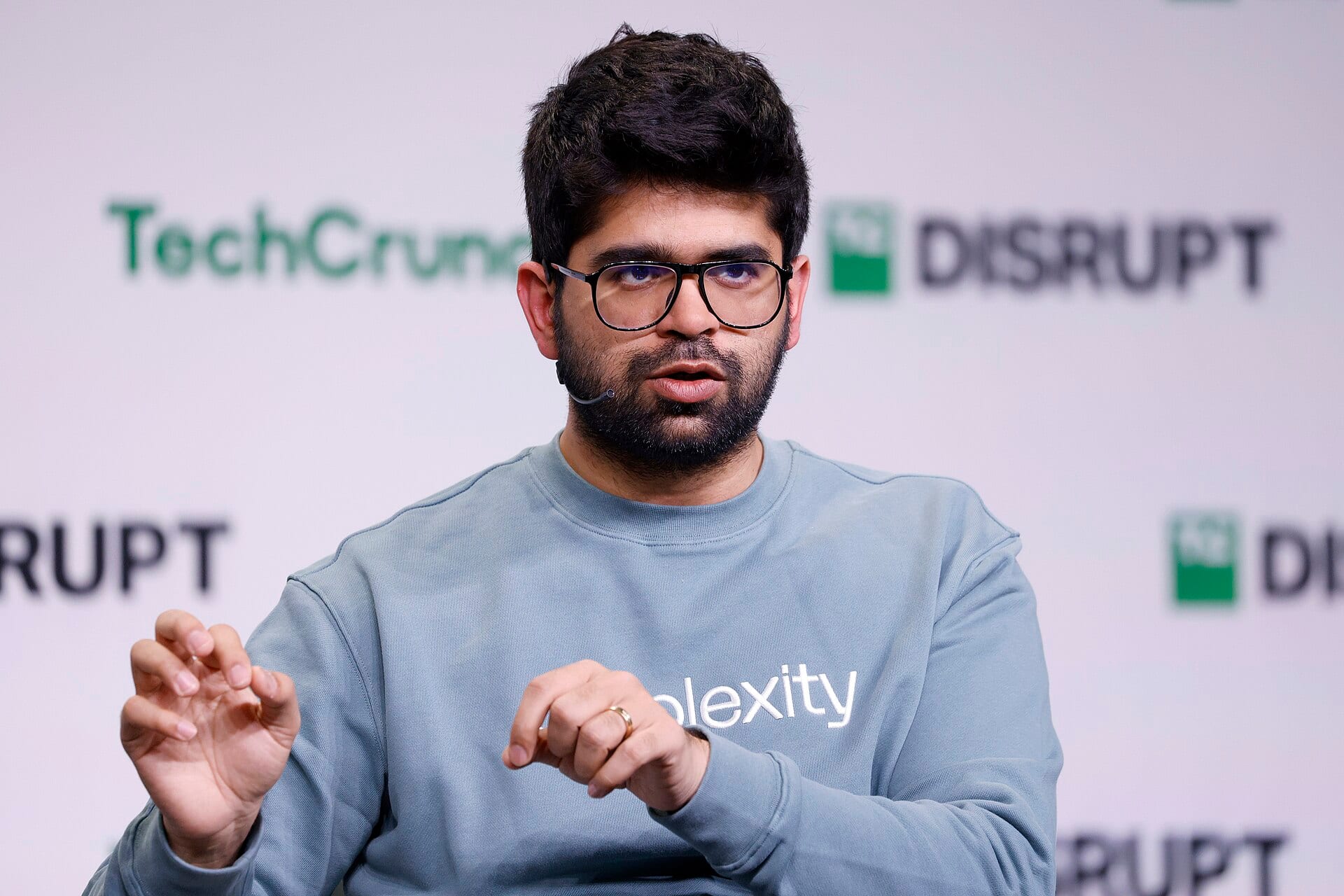
Asked by T. Rowe Price+0.45% — T. Rowe Price, up 0.45 percent today portfolio manager Stephanie Beebe at last week's TomorrowX Summit whether an IPO in the first half of 2027 was still fair game, Perplexity$30.00B — Perplexity, private, latest valuation $30.00B chief executive Aravind Srinivas said "2028 is our mental model", with a filing sooner "if the business progress sustains" 1. The company had "just crossed" $1 billion of annualized revenue against a year-end target he put at $650 million on stage; reports of his November 16 interviews said $750 million 2.
Perplexity cleared a $1 billion bar it had set at $650 million for the year
- Annualized revenue
- Estimate
Data
| Annualized revenue | |
|---|---|
| Year-end target he gave on stage (estimate) | $650M |
| Target reported from Nov 16 interviews (estimate) | $750M |
| Annualized revenue crossed by Nov 26 | $1,000M |
2028 again, days after he left 2027 open
On CNBC days earlier he would not rule out filing in the first quarter of 2027 3; in June he had called 2028 the plan 4. The Inference wrote on November 18 that an early filing would put audited numbers behind a $1 billion claim made without a cost breakdown 5. On his own base case the audited numbers now wait past the start of 2028, and with them the test of the mark Nvidia's−2.52% — Nvidia, down 2.52 percent today reported talks would set above $30 billion; cash generation he hopes for "towards the end of next year" 15.
The margin, and who sets its cost
The stage carried Perplexity's first public margin: 56% gross, on revenue he said grew 4.7 times year over year on Perplexity Computer alone 1. The pitch is model neutrality, "anytime any part of the AI ecosystem improves, Perplexity improves" 1. Yet on the agent side he put Opus 5.5, the Anthropic$350B — Anthropic, private, latest valuation $350B model he called the best, at 60 to 70% of tokens, the highest share any model has held there 1. Post-training its own models for quick answers saves $100 million a year in frontier-model fees 1.
Sixteen agents, no published cost per run
That neutrality now runs sixteen agents deep. Multiagent, launched November 17 as a lead plus up to 16 agents on Opus 5.5, GPT 6.1 Sol and Gemini 4 Carbon 6, widened on November 24 to mobile, Mac and Enterprise Max seats 7. It sits on the $167-a-month Max plan with 10,000 monthly credits, and no cost per run is published 67.
Who pays the meter
A paying Pro subscriber writing on MakeUseOf cites Perplexity's own documentation that there is no setting to turn Computer off, says Deep Research was folded in as a Computer skill, and counts metered use at $1 per hundred credits; a proposed class action filed in October alleges Deep Research quota cuts 8. Anthropic, which priced at $83 and closed its first Nasdaq day at $97.17 9, sits on the other side: 60 to 70% of Perplexity's agent tokens is a demand line for Opus now on the record 1.
The next reading is a published credit cost for a Multiagent run. Until it lands, the 56% figure 1 is a claim on stage, not a number in a filing.
Sources
- 1The Singju Post, Perplexity's Aravind Srinivas Interview at TomorrowX Summit (Transcript), 26 November 2026
- 2Inc42 via Newspoint, Perplexity may launch IPO as early as Q1 CY27: CEO Aravind Srinivas, 17 November 2026
- 3CNBC, Perplexity CEO says IPO could happen as soon as 2027, 16 November 2026
- 4The Next Web, Perplexity is sticking with a 2028 IPO while OpenAI and Anthropic race to list this year, 9 June 2026
- 5The Inference, Perplexity claims $1 billion of revenue on five times less spend than Anthropic's $1.4 trillion IPO, 18 November 2026
- 6MarkTechPost, Perplexity Computer Adds Multiagent: Up to 16 AI Agents That Cross-Check Work, 17 November 2026
- 7Data Studios, Perplexity Chrome extension and five new models, Multiagent on mobile and Mac for Max, 26 November 2026
- 8MakeUseOf, Perplexity is getting desperate about Computer, and I don't like it, 25 November 2026
- 9Invezz, Anthropic's ANT closes at $97.17, up 17% on its first day of trading, 19 November 2026
Get Model by email, free
The AI labs, their models, and the business behind them. In our daily email, every weekday.

Reader comments
0 comments