PG&E blacked out 85,000 customers as its $2 billion cut slows new homes, renewables and data centers
PG&E says the connection deferrals that followed wildfire reform's failure in Sacramento will slow new homes, renewables and data centers alike; consumer advocate Mark Toney says data centers are the one class PG&E is not slowing. The dispute lands with 85,511 customers dark in the widest planned shutoff in eight years.
 Vincent Jiang · 3 min read
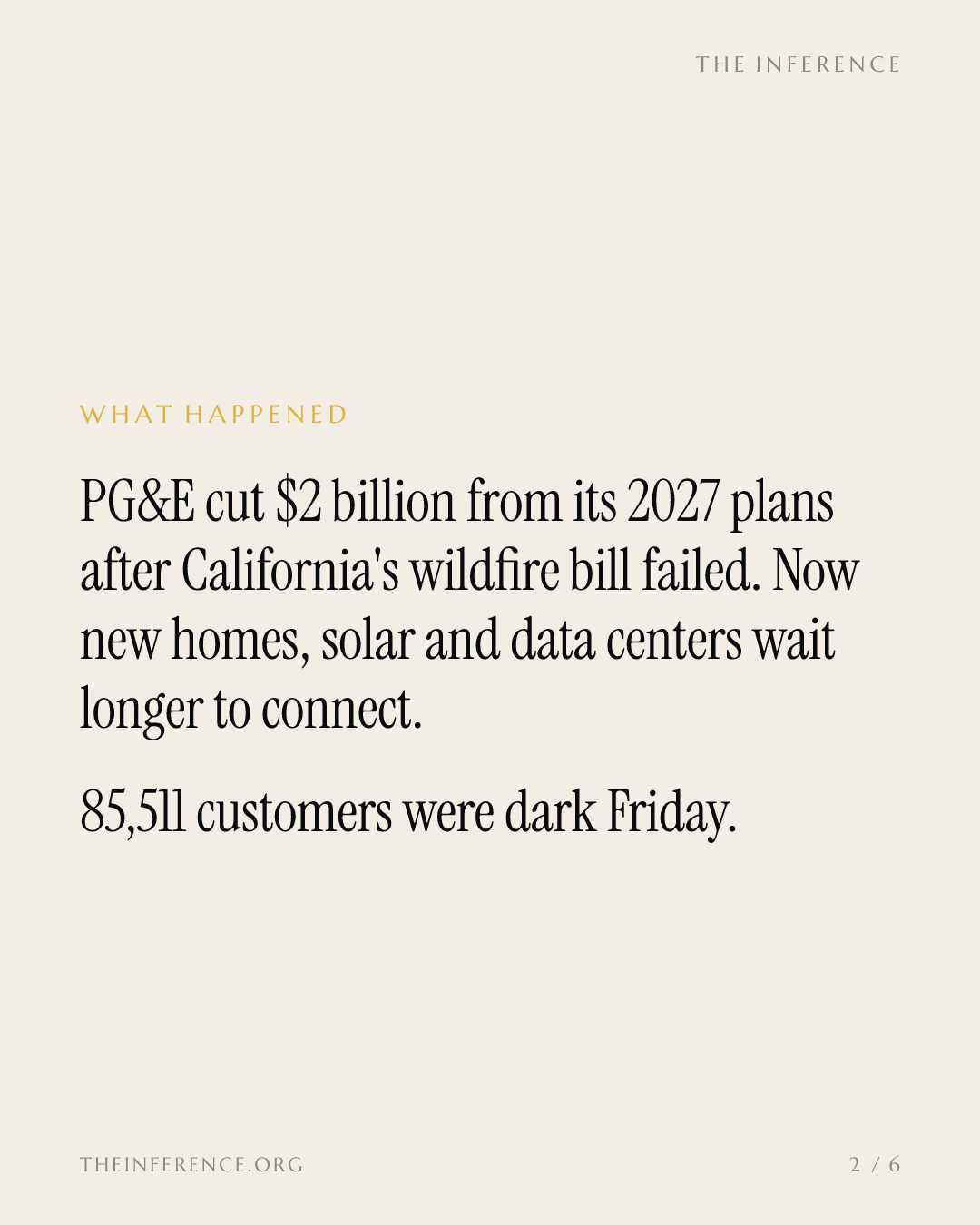
Pacific Gas and Electric counted 85,511 customers without power at 10 a.m. on Friday, October 16, up from 61,730 the morning before, after warnings placed about 88,000 customers across 29 counties in scope, roughly 5,500 of them people who rely on powered medical equipment 12. It was the largest effect from a planned shutoff in eight years, concentrated in the Sierra foothills, and crews must inspect lines on foot, by vehicle and from the air before power returns 1.
The cut came in September; the reach landed this week
The $2 billion cut is older than the blackout. Hours after the California Legislature rejected the wildfire liability bill in early September, chief executive Patti Poppe announced the company would defer about $2 billion of planned 2027 investment, trimming the year's capital spending to $11.4 billion from $13.4 billion 34. What is new this week is the cut's reach: PG&E has announced delays or deferrals of electrical connections for new homes, renewable-energy projects, data centers and other development, and renewable projects may slip by up to a year 56.
Homes and solar wait behind a 12.7 gigawatt queue
Mark Toney, executive director of the consumer group The Utility Reform Network since 2008, says schools, housing, hospitals and factories will carry the delay: "I don't hear PG&E+0.93% — PG&E, up 0.93 percent today slowing down data centers. PG&E wants data centers to jump the line" 6. The queue behind his complaint holds 12.7 gigawatts of proposed data centers, 3.9 gigawatts already in final engineering, and Poppe expects to serve 1.8 gigawatts of that load by 2030 7. PG&E itself names data centers among the deferred projects; the jump-the-line charge is Toney's reading of which deferrals actually bind.
Only 1.8 of 12.7 gigawatts in PG&E's data center pipeline is expected in service by 2030
Data
| Value | |
|---|---|
| Proposed pipeline | 12.7 GW |
| In final engineering | 3.9 GW |
| Expected in service by 2030 | 1.8 GW |
PG&E's answer: the $73 billion plan holds
The company's counter is that the five-year, $73 billion capital plan through 2030 is intact, needs no new equity, and that second-quarter core earnings of 40 cents a share beat the 36-cent consensus 3. Poppe's own warning still stands: "If the framework remains unresolved or insufficient, then we would need to reevaluate our capital allocation priorities" 3. The impasse is already priced into borrowing on a balance sheet carrying $64.7 billion of total debt, with customers paying an incremental $600 million of financing costs over two years and Fitch moving its outlook on PG&E to negative 811. Eight rate-increase proposals sit pending at the California Public Utilities Commission 6.
Debt has climbed $8.7 billion in three years, to $64.7 billion, just as PG&E trims 2027 spending
Data
| Total debt | |
|---|---|
| Q3 '23 | $55.96 |
| Q4 '23 | $57.73 |
| Q1 '24 | $58.57 |
| Q2 '24 | $60.61 |
| Q3 '24 | $60.03 |
| Q4 '24 | $58.34 |
| Q1 '25 | $59.97 |
| Q2 '25 | $59.68 |
| Q3 '25 | $59.79 |
| Q4 '25 | $61.34 |
| Q1 '26 | $62.94 |
| Q2 '26 | $64.7 |
October 20 and October 22 price the drag
PG&E owes state regulators its own valuation of San Francisco's grid on October 20, a figure Poppe puts north of $20 billion against the city's $3.4 billion offer 9. Third-quarter earnings follow on October 22, with consensus at 42 cents a share, down 16 percent year over year, on $6.59 billion of sales, and Zacks ranking the stock a Sell 10. At $13.08 against an $18.50 average analyst target, the market is already weighing the wildfire drag against AI load growth 9. The interconnection queue has become the committee that decides which AI projects break ground in California, and October's shutoffs are the argument both sides will use to remake it.
Deepdive
AI-generated from this story and its cited sources. Not investment advice.