PG&E may black out 70,000 customers after investigators tied a founder's death to a wire it failed to replace
A rusted tie wire killed ag-tech founder Steven Dodge in 2022, after PG&E's own inspectors had logged the same failure on poles nearby. That record is now part of the file regulators will read before deciding what ratepayers repay for PG&E's shrunken undergrounding plan, the grid California's data centers are queuing to join.
 Richard Tang · 4 min read
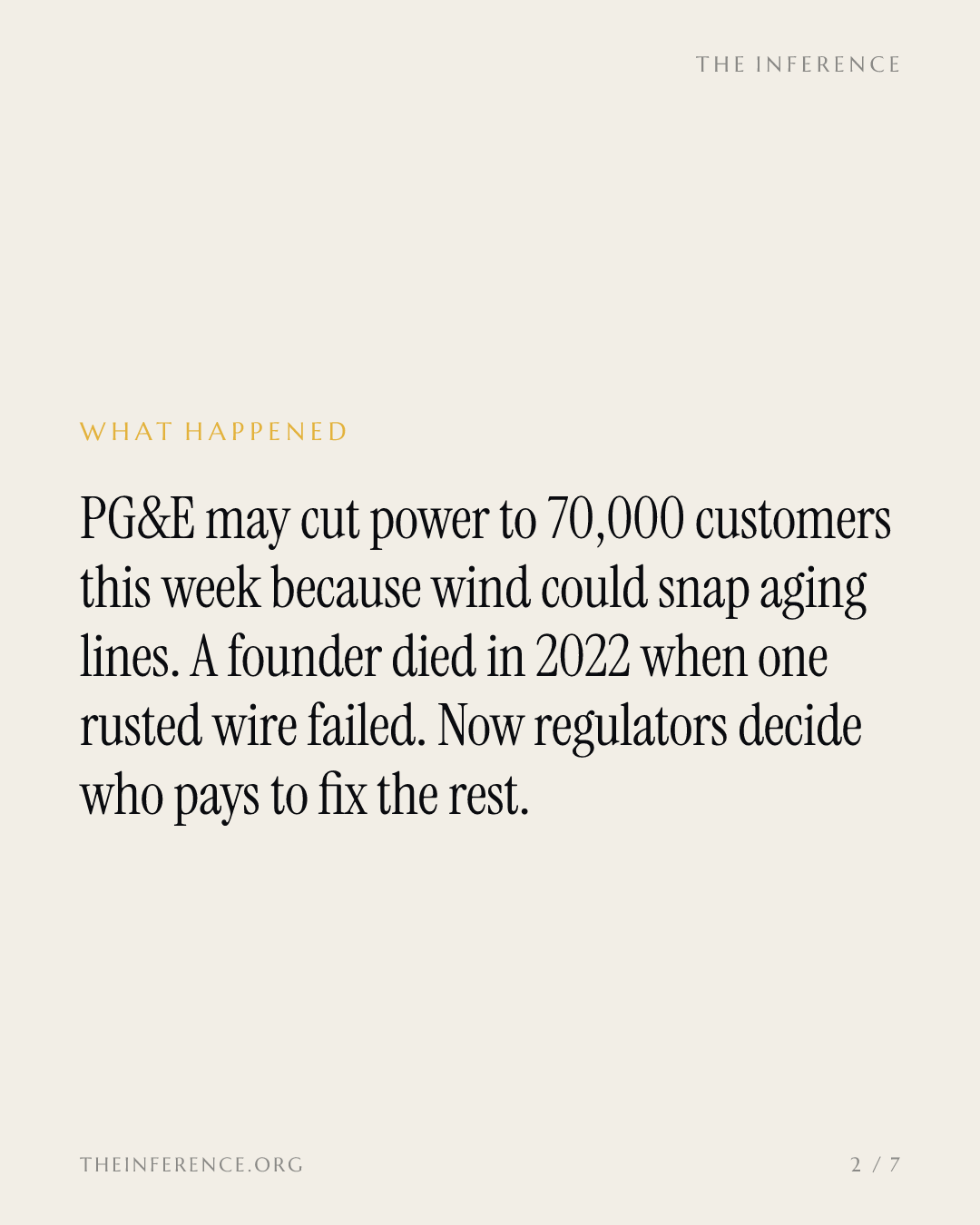
Pacific Gas and Electric−1.84% — Pacific Gas and Electric, down 1.84 percent today, California's largest utility, may have to switch off power to about 70,000 customers from this evening through Saturday, because forecast winds make its overhead lines dangerous to keep energized 1. The same week added two entries to the safety record that explains those shutoffs. State investigators tied a founder's 2022 death to maintenance PG&E's own inspectors had documented years earlier 2. The utility also filed a ten-year plan burying about 7,000 of the 10,000 miles it promised after the 2021 Dixie Fire 3.
The wire that killed him had a paper trail
Steven Dodge was 34, co-founder of Acuity Agriculture, an ag-tech startup building remote monitoring tools for farmers, when he was killed at a King City-area farm in Monterey County 2. The tie wire binding a 12,000-volt line to its insulator had rusted through, and the falling conductor struck him as he tested remote equipment on a raised irrigation platform 2. State investigators found PG&E responsible for failing to properly replace or reinforce that wire, years after its own inspectors logged the same rusting failure on two poles nearby 2. No fine followed, and his widow's wrongful-death suit settled privately 2.
The same failure kept burning the state
Tie-wire failures had already sparked at least two wildfires, one near King City and one in Kern County, before Dodge died 2. This year regulators also cited PG&E for loose tie wires, and the utility agreed a $22 million settlement with the California Public Utilities Commission 2. The commission approved that penalty in August over the 2022 Mosquito Fire, finding violations in design, construction and maintenance that PG&E denied 4. A former commission president, Loretta Lynch, calls the agency's handling of these failures "a clear dereliction of duty" 2.
Burial earns a return, a tightened wire does not
The money likely explains why burial got funded and tie-wire repair did not. Under California rate regulation, PG&E earns a return on the capital the state approves for what it buries, while a tightened wire is maintenance, an expense 5. The filed plan even books avoided maintenance as a benefit, about $6 billion of it 3.
The pledge shrank the same week the record landed
The plan, filed with the state's energy safety office on September 30, buries about 1,900 miles by the end of 2027 35. From 2028 through 2037 it buries 5,000 more, with the rest of the original promise met by stronger poles and covered lines 5. PG&E calls that "not a reduction" and values the plan's long-term benefits at $117 billion 3. Mark Toney of the ratepayer group TURN praised the cut, because it is "extremely expensive to underground lines" 6.
PG&E's filed plan buries about 7,000 of its promised 10,000 miles
Data
| Value | |
|---|---|
| Promised after Dixie Fire (2021) | 10,000 |
| Underground by end-2027 | 1,900 |
| Planned 2028–2037 | 5,000 |
The AI queue waits on the same poles
PG&E reports a 12.7-gigawatt pipeline of data-center power requests, growth its chief executive, Patti Poppe, says the grid has not seen in decades 7. Wildfire-liability reform that took the legislature two years fell short, the credit-rating agency Fitch reportedly cut PG&E's outlook to negative, and the utility trimmed its planned 2027 investment by about $2 billion 7.
The pressure behind that trim shows in the quarterly accounts: capital spending has outrun operating cash in ten of the last twelve quarters 8. The gap is closed with borrowing whose extra cost customers have already paid, about $600 million over two years 7. The shares are down about a quarter this year 7.
Grid capex has outrun operating cash in ten of the last twelve quarters
- Capital spending
- Operating cash flow
Data
| Capital spending | Operating cash flow | |
|---|---|---|
| Q3 '23 | $2.42B | $1.81B |
| Q4 '23 | $2.61B | $0.48B |
| Q1 '24 | $2.64B | $2.26B |
| Q2 '24 | $2.3B | $0.71B |
| Q3 '24 | $2.61B | $3.13B |
| Q4 '24 | $2.83B | $1.93B |
| Q1 '25 | $2.64B | $2.85B |
| Q2 '25 | $3.07B | $1.06B |
| Q3 '25 | $2.93B | $2.85B |
| Q4 '25 | $3.16B | $1.96B |
| Q1 '26 | $3.36B | $2.43B |
| Q2 '26 | $2.97B | $0.91B |
Even the blackout is aimed by software
This week's shutoff is scoped with machine learning: new modeling tools, PG&E says, "allow us to be more surgical when scoping," with wind-gust models run at the weather-station level filling gaps between coarser forecasts 1. The utility is applying AI to aim a blackout made necessary by hardware it failed to maintain. If the wires come slower, the hookups behind the 12.7-gigawatt queue come slower too.
The price gets set in two reviews
The sequence from here is fixed. The state energy office reviews the plan first, then the CPUC conditionally decides what ratepayers repay 5. State energy officials have already told utilities to assess tie-wire fire risk 2, and the Mosquito settlement shows the tool the commission has used once: an independent review of PG&E's inspection practices, paid for by the penalty 4. For anyone funding California compute, the CPUC's decision, and whether it ties repayment to maintenance evidence as well as to buried miles, is the schedule to watch.
Deepdive
AI-generated from this story and its cited sources. Not investment advice.