Robinhood has until October 16 to answer Ohio on the prediction markets that out-earned crypto
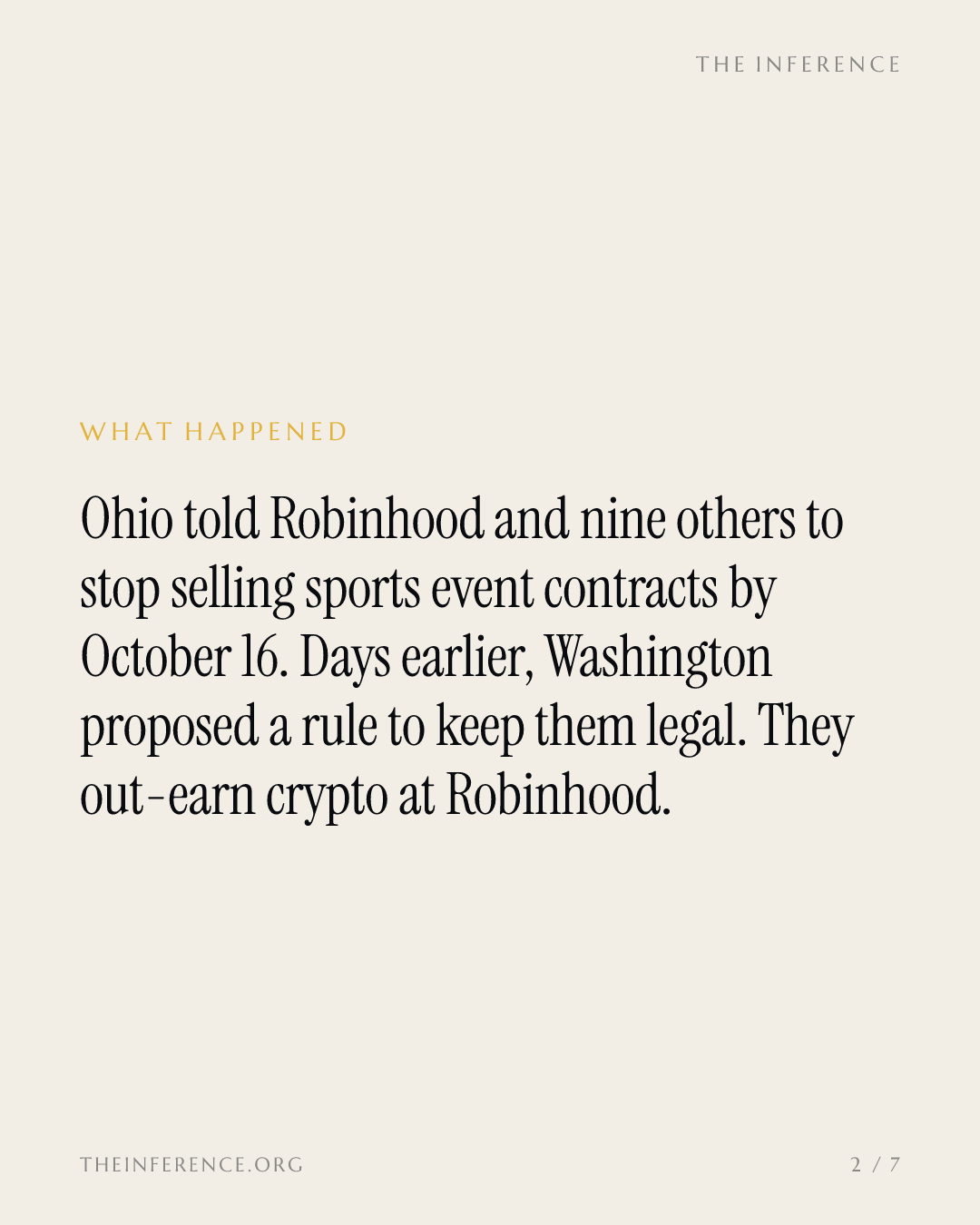
Ten operators, Robinhood among them, must confirm by October 16 that Ohioans can no longer trade sports event contracts. The CFTC's answer, proposed six days before the deadline: call event contracts swaps.
 Vincent Jiang · 3 min read
Friday, in writing, to Ohio
Ohio's governor and its casino regulator sent cease-and-desist letters dated October 2 to ten prediction-market operators, Robinhood+1.92% — Robinhood, up 1.92 percent today among them: stop offering sports event contracts to Ohioans, and confirm it in writing by October 16 1. The letters warn of civil penalties and fines equal to the money or value of property obtained, on products the state calls unlicensed bookmaking, a felony 1. Ohio has form here; it fined Kalshi $5 million in April 1. No public reply from Robinhood appears in the coverage of the letters.
Michigan already wrote the exit
Robinhood has used this door before. Under a court-approved September agreement with Michigan, it stopped listing new sports contracts and closed every remaining customer position by October 9 2. Coinbase+4.86% — Coinbase, up 4.86 percent today took the same terms, shutting its Michigan sports positions by October 10 3. Both deals preserve each side's legal arguments while the 6th US Circuit Court of Appeals hears the underlying appeals 3.
The CFTC rereads the definition the court used
On October 9 the CFTC proposed an interim final rule classifying event contracts on sports, politics, culture and weather as swaps, effective on Federal Register publication with 30 days of comment 4. That targets the exact definition the 6th Circuit applied on September 25, when it held that Kalshi's sports contracts are not swaps and that state gambling law survives the Commodity Exchange Act 13. The 3rd Circuit read the law the other way in April, a federal judge in Illinois sided with Kalshi this month, and New Jersey's petition sits at the Supreme Court 35. Robinhood is itself a named party in the 9th Circuit version of the fight, which ruled in August that state gambling law can reach Kalshi 36. Better Markets' Benjamin Schiffrin puts the other side plainly: "Calling it an event contract does not magically transform it into a financial derivative" 4.
The revenue is real, and the sports split is not disclosed
Prediction markets out-earned crypto inside Robinhood last quarter: $156 million of revenue on 13.6 billion contracts, against $100 million from crypto 6.
Robinhood's revenue hit a record $1.31B the quarter prediction markets out-earned crypto
Data
| Total net revenue | |
|---|---|
| Q3 '24 | $0.64B |
| Q4 '24 | $1.01B |
| Q1 '25 | $0.93B |
| Q2 '25 | $0.99B |
| Q3 '25 | $1.27B |
| Q4 '25 | $1.28B |
| Q1 '26 | $1.07B |
| Q2 '26 | $1.31B |
Sports is what users show up for. Seventy percent of US prediction-market traders bet on games, against 36 percent on economic or financial outcomes and 33 percent on politics 7. Only 10 percent of US internet adults have ever used a prediction market, and 44 percent have never heard of one 7.
Sports is the trade: 70% of prediction-market users bet on games
Data
| Value | |
|---|---|
| Sports | 70% |
| Economic or financial | 36% |
| Political | 33% |
| News and entertainment | 26% |
| Other | 11% |
Robinhood discloses no sports split for that $156 million, and chief executive Vlad Tenev says crypto contracts already outpace sports on his platform 8. If Ohio-style geofences spread, the cost lands on HOOD holders; if the swaps label survives the courts, it lands on state-licensed sportsbooks. Friday's paperwork is the next marker, and the verdicts arrive in Cincinnati and, most likely, Washington 35.
Deepdive
AI-generated from this story and its cited sources. Not investment advice.