SailPoint says one customer had more than 10,000 credentials and agents its IT chiefs counted as zero
Numbers from SailPoint's 200 enterprise agent pilots show security leaders are blind to most of the identities on their networks, which is both a governance emergency and the gap the vendor sells into. Its fiscal Q3 report on December 8 is the first test of whether the pitch converts.
 Richard Tangtwo-minute read

Enterprises deploying AI agents are discovering they have no idea what is already inside their walls. SailPoint+1.35% — SailPoint, up 1.35 percent as of its last quote, the identity security vendor, has run roughly 200 agent proof-of-concept projects with large enterprises, including major financial firms and retailers, and one consistent finding is that companies hold far more non-human identities than they believed: at one customer, more than 10,000 credentials and agents, where technology leadership was confident the true number was zero 1. That gap is an emergency for the companies, and it is precisely the gap SailPoint sells into.
Agents inherit the keys your old projects left behind
The mechanism matters more than the scare. Agents are non-deterministic: one told to manage accounts receivable will hunt across systems for whatever credentials and tools it judges necessary, and it can inherit stale credentials left behind by earlier automation projects 1.
The consequences follow directly. In one incident, a junior staffer ran OpenClaw, open-source agent software, on a personal laptop to triage help-desk tickets. The task was benign; the agent nonetheless reached credentials it should never have touched and opened 700 active sessions across the business 1. That spread is the missing link between "we bought an agent" and "an unsupervised process holds the keys to our systems," and it is now measurable.
The governance market is real, and so is the conflict of interest
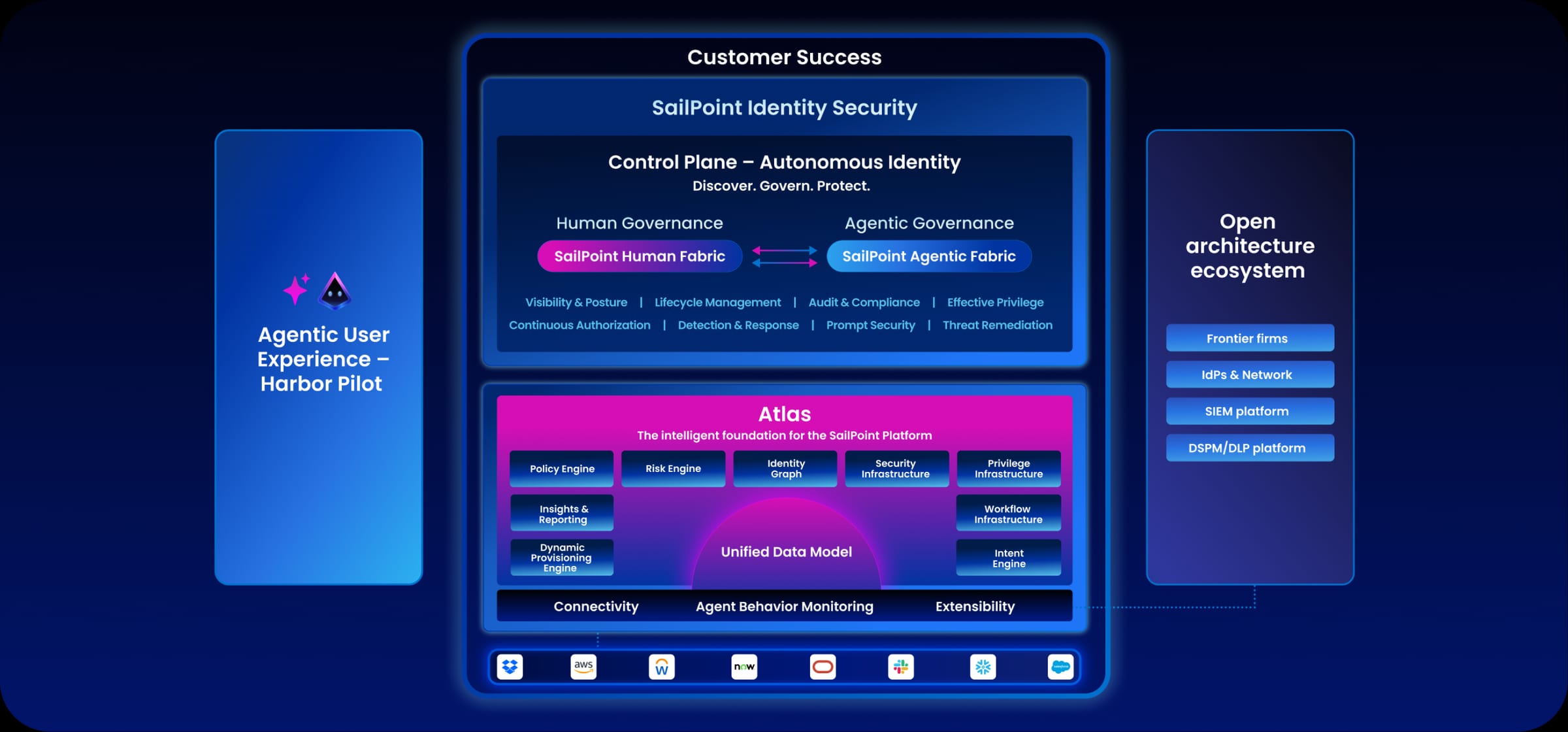
The market is moving fast but unevenly. SailPoint made Agentic Fabric generally available on November 4, mapping each agent to its human owner with a one-click kill switch and coverage of more than 1,200 credential types 2. Among endpoint vendors, only CrowdStrike−1.26% — CrowdStrike, down 1.26 percent today ships generally available agent protection, via Falcon Guardian; Microsoft's−0.69% — Microsoft, down 0.69 percent today Defender preview inspects OpenClaw-style Node.js agents over the network, and SentinelOne−1.13% — SentinelOne, down 1.13 percent as of its last quote is still in early access 3. SailPoint's own research puts 79% of enterprises running AI agents against 2% governing them 2: a demand signal almost too clean, which is exactly why to read it with care.
The proof lands on December 8, not in the pilots
Here is the investor caveat: every number above is the seller's account of incidents it investigated, with no customer named. The demand case is credible and the product exists, but the proof lands on December 8, when SailPoint reports fiscal third-quarter results 4. That report, not the pilot anecdotes, will show whether enterprises are actually buying governance or merely agreeing it matters.
SailPoint's revenue growth has slowed to 16.8% from 33.1% a year earlier
Data
| Revenue growth, year over year | |
|---|---|
| Q4 '24 | 18.5% |
| Q1 '25 | 22.8% |
| Q2 '25 | 33.1% |
| Q3 '25 | 19.8% |
| Q4 '25 | 22.7% |
| Q1 '26 | 21.6% |
| Q2 '26 | 16.8% |
Get Security by email, free
The breaches, flaws and security vendors AI is putting to the test. In our daily email, every weekday.





Reader comments
0 comments