Proofpoint agreed to pay $6.3 billion for Varonis, which reported 42% and 24% SaaS growth in one release
The data security firm published 42% and 24% SaaS growth in the same release, then canceled the only forum where analysts could ask which one Proofpoint's 8.4x revenue multiple is priced on.
 Vincent Jiangthree-minute read

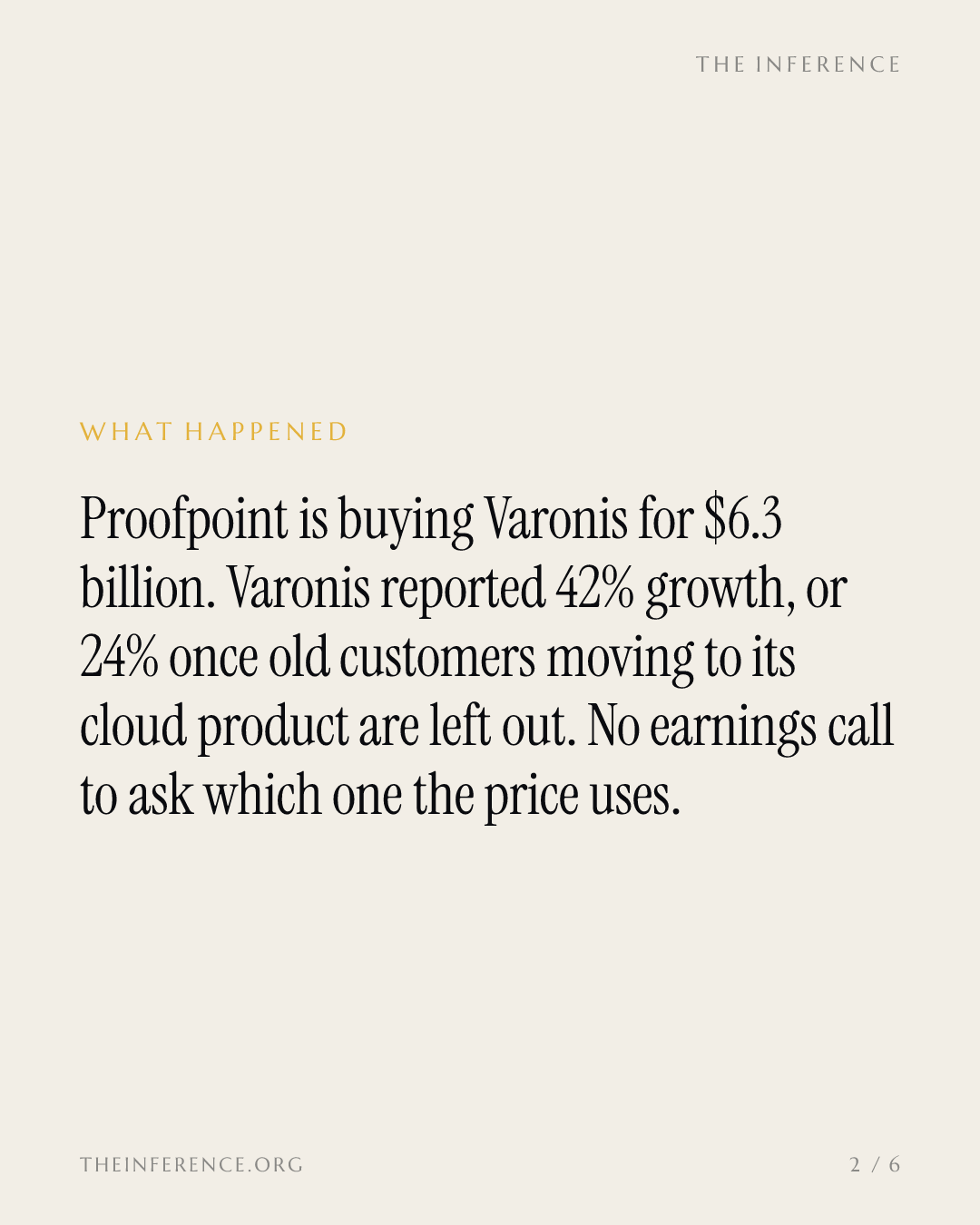
Varonis+0.31% — Varonis, up 0.31 percent as of its last quote closed its third quarter of 2026 with SaaS annual recurring revenue of $774.6 million, up 42% from a year earlier 13. That is the number that led the results published on November 4, 2026, eleven days after Proofpoint, the Thoma Bravo-owned security company, agreed to buy the data security firm for $49.75 a share in cash, roughly $6.3 billion, or 8.4 times trailing revenue 13.
The same release carries a second figure, one line down: growth excluding customers converting from term licenses onto the SaaS platform was 24% 12. Two growth rates, one quarter, one press release. Then something else that is standard for a pending deal and consequential anyway: no earnings call, no guidance 13.
Term licenses fell 95% as customers moved to SaaS
Term-license revenue fell from $24.8 million in Q3 2025 to $1.2 million in Q3 2026, a drop of more than 95%, which Varonis attributes to those customers migrating to SaaS 1. SaaS is now 95% of nine-month revenue, and the self-hosted products reach end of life on December 31, 2026 2. Part of the 42%, in other words, is revenue Varonis already had, wearing a new contractual label 2. Both figures are real. The open question is which one an 8.4x revenue multiple is priced on 2.
Varonis's 42% SaaS growth falls to 24% once license conversions are stripped out
Data
| Value | |
|---|---|
| SaaS ARR, reported | 42% |
| SaaS ARR, ex-conversions | 24% |
| Total revenue | 17.3% |
No call, no guidance, and a board that settled at $49.75
The timing is the story. The price was set on October 15; the results arrived November 4; and the call where an analyst could have pinned management on how much of the 42% is genuine net-new business did not happen 3. The proxy shows the negotiation ended early: the board sought $54 a share in August, Thoma Bravo answered with a best-and-final $49.75, no strategic buyer ever made an offer, and the only rival bid, $38 to $40, was rejected 4. Goldman's−2.63% — Goldman, down 2.63 percent today DCF range ran $36.40 to $54.12 4.
The signed $49.75 cleared every rival bid and sat near the top of Goldman's range
Data
| Value | |
|---|---|
| Goldman DCF low | $36.4 |
| Rival bid low | $38 |
| Rival bid high | $40 |
| Signed price | $49.75 |
| Board ask | $54 |
| Goldman DCF high | $54.12 |
The 24% was published, and nothing was hidden
Varonis published the 24% itself, in the same release; nothing was hidden 1. One independent estimate, from the analytics outlet Finsee, puts genuinely new cloud ARR at about $38.2 million for the quarter, above the company's internal plan of $28 million to $31 million, though that figure is a third-party reconstruction, not a reported number 1. Total revenue grew 17.3% to $189.46 million and the net loss widened to $41.65 million 25. The business is transitioning, not dying.
Three dates stand between the numbers and the close
Watch three dates instead of the headline: the US antitrust waiting period expires November 18, 2026, the shareholder vote is not yet scheduled, and closing is expected in the first half of 2027 4. After that, Varonis stops filing, and the 42%-versus-24% question becomes one nobody can ask on the record again 4. A number published without a question attached is not a number explained.
Get Security by email, free
The breaches, flaws and security vendors AI is putting to the test. In our daily email, every weekday.




Reader comments
0 comments