Sandisk's $93.9 billion floor is contracted, but Samsung and SK hynix add NAND layers in China
Ten multiyear deals across eight customers guarantee Sandisk at least $93.9 billion at floor pricing, with ceilings over the upside. Samsung, SK hynix and YMTC are adding NAND layers anyway, and the October 29 print shows who keeps the difference.
 Vincent Jiang · 3 min read

The floor is contracted, the level is not
Sandisk+1.95% — Sandisk, up 1.95 percent today reports fiscal first-quarter results on October 29, guided to $10.30–10.80 billion of revenue at 83–85% gross margin 1. The quarter underneath explains the stakes: fiscal Q4, ended July 3, booked $8.97 billion of revenue at an 84.6% adjusted gross margin, up from 26.2% a year earlier, with about two-thirds of the sequential gain from price rather than volume 2.
Revenue jumped from $1.9B to $9.0B in eight quarters
Data
| Revenue | |
|---|---|
| Q3 '24 | $1.88B |
| Q4 '24 | $1.88B |
| Q1 '25 | $1.7B |
| Q2 '25 | $1.9B |
| Q3 '25 | $2.31B |
| Q4 '25 | $3.03B |
| Q1 '26 | $5.95B |
| Q2 '26 | $8.97B |
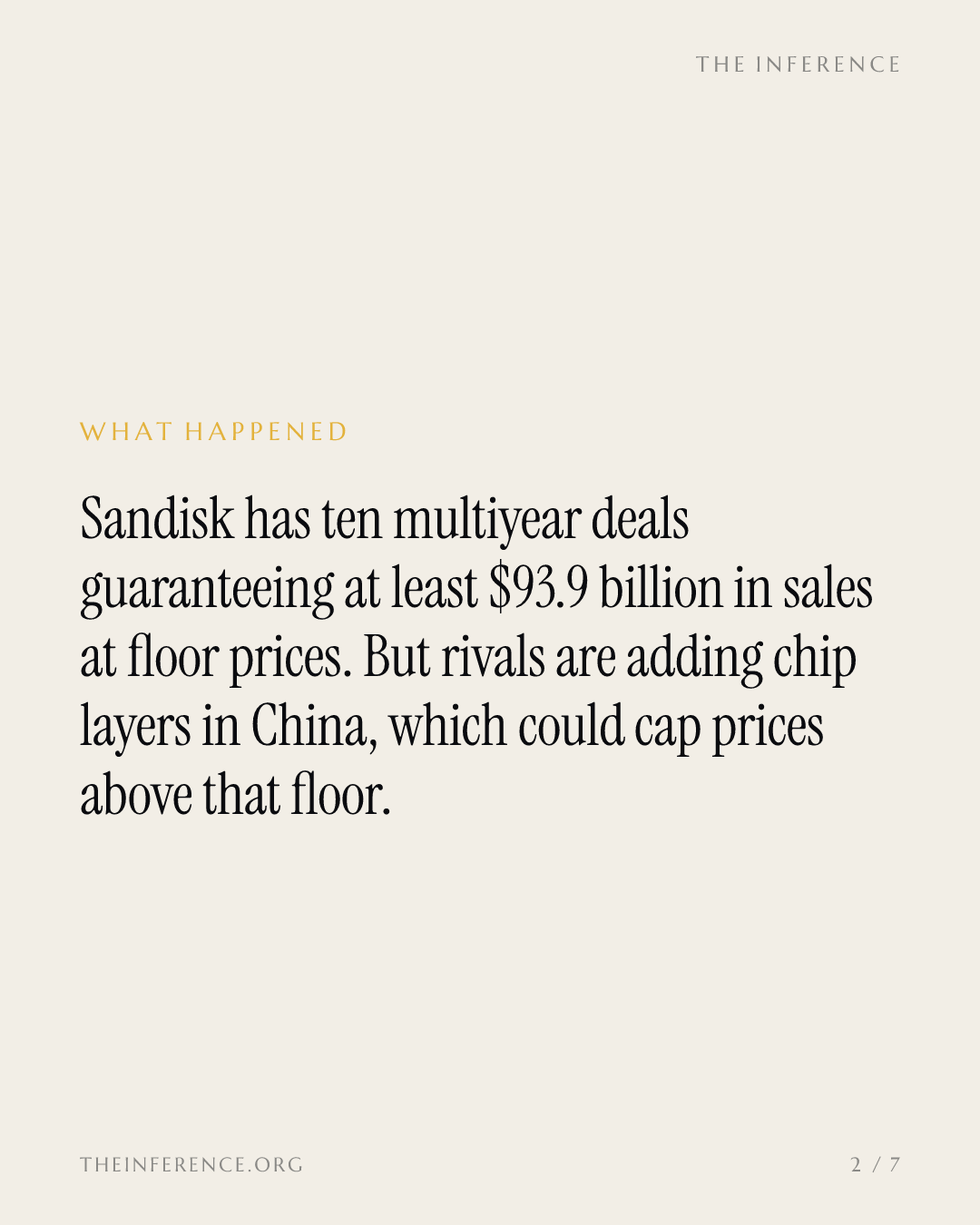
The New Business Model does not lock that margin. Its ten agreements across eight customers guarantee a minimum $93.9 billion at floor pricing, backed by $16.5 billion of customer deposits and financial instruments, and cover about half of fiscal 2027 bit shipments 2. Variable prices carry floors and ceilings 2. Only the floor is contracted; everything above it is priced in Xi'an and Dalian.
Gross margin climbed from 22.5% to 84.6% in six quarters; the new guide holds it flat
- Gross margin
- Estimate
Data
| Gross margin | |
|---|---|
| Q3 '24 | 38.6% |
| Q4 '24 | 32.3% |
| Q1 '25 | 22.5% |
| Q2 '25 | 26.2% |
| Q3 '25 | 29.8% |
| Q4 '25 | 50.9% |
| Q1 '26 | 78.4% |
| Q2 '26 | 84.6% |
| Q3 '26 guide (estimate) | 84% (83–85%) |
China is adding the layers that cap price
Reuters reported on October 21 that Samsung is converting Xi'an, about 40% of its global NAND output, from roughly 200-layer chips to 286-layer V9 under a project called Monami, aiming for 5,000 wafers a month in December 2026 and 40,000 by December 2027 3. SK hynix+2.31% — SK hynix, up 2.31 percent today is taking Dalian from 192 to 240-plus layers and may seek approval for 300-plus-layer research 3.
Washington said in 2025 it would license existing China fabs but not technology upgrades, and Reuters could not determine how many licenses have been granted 3. YMTC already ships small volumes of 294-layer chips and held 38.5% of China's NAND market in the second quarter, up from 28% for all of 2025 3. TrendForce estimates China at 30–35% of Samsung's NAND output and 40–45% of SK hynix's 5.
YMTC overtook Samsung in China's NAND market while Washington held the licenses
- 2025
- Q2 2026
Data
| 2025 | Q2 2026 | Change | |
|---|---|---|---|
| YMTC | 28.0% | 38.5% | +37.5% |
| Samsung | 36.0% | 33.5% | -6.9% |
| SK hynix | 20.0% | 17.0% | -15.0% |
The Inference argued on October 17 that a $57.8 billion, seven-session selloff was a DRAM scare in a market Sandisk does not sell into 24. Reuters has now moved that risk inside NAND, the one market it does. Shares closed October 20 at $1,365.38, about 42% below the June high of $2,354.39, on a $197 billion capitalization after a year up roughly 400% 24.
The buyer across the table renews from strength
The bull case has its own receipts: the ceilings cap upside as the floors cushion downside, Sandisk's own investor-day model calls for about 80% gross margin across fiscal 2028–30, below the level just posted, and at roughly seven times expected fiscal 2027 earnings a price decline is arguably already discounted 2.
What the contracts cannot transfer is the renewal. Meta+1.93% — Meta, up 1.93 percent today, Alphabet−1.59% — Alphabet, down 1.59 percent today and Oracle−0.87% — Oracle, down 0.87 percent today, the customers ramping now 1, would sit down in 2028 with 40,000 Xi'an wafers and a 300-plus-layer YMTC behind them. On October 29, watch gross margin against the 83–85% guide and any change in how the ten deals set floors and ceilings 3. December's first 5,000 V9 wafers are the supply-side checkpoint 3.
The daily newsletter