Schneider Electric's cooling chief says data centers carry three to five layers of unneeded cooling margin
Tuan Hoang says silicon allows coolant at 45°C but three to five stacked safety buffers push facilities colder, eroding free cooling. The same vendor just doubled European liquid-cooling capacity, so investors must judge how much of the AI cooling boom is heat and how much is specification.
 Vincent Jiangthree-minute read
Drafted with AI from the documents listed under Sources, then edited and fact-checked by Vincent Jiang. How we work
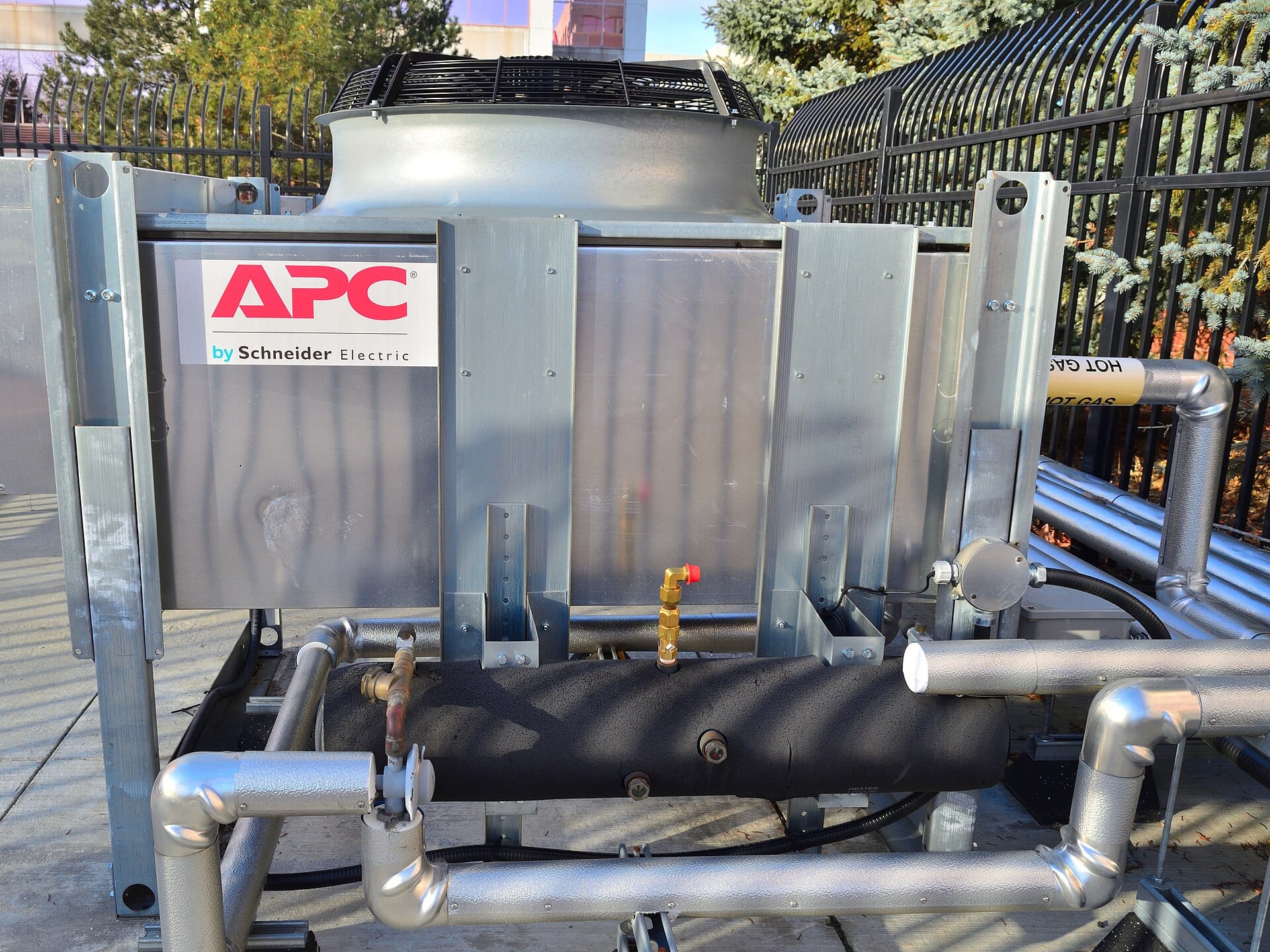
Schneider Electric's+1.11% — Schneider Electric, up 1.11 percent today head of cooling technology and product development, Tuan Hoang, said on November 26 that data centers are cooled harder than their chips need, because every layer of the value chain adds its own safety buffer 1. The same vendor announced the day before that it is doubling European liquid-cooling capacity at its Conselve plant in Italy 3. Both facts land in the same week, and they cut in opposite directions for anyone pricing the AI cooling boom.
Three to five layers of margin, each a little colder
Silicon makers specify that chips can be cooled with liquid supplied at up to 45°C 1. Server makers design a few degrees below that to guarantee performance. Customers add margin to protect warranties, and colocation operators add more to avoid penalty clauses in their service-level agreements. By the time a facility runs, Hoang said, there can be three to five layers of buffer, each lowering the design set point 1.
Every padded degree is a chiller hour lost
The cost is free cooling, the practice of dumping heat with outside air instead of machines. The warmer the coolant is allowed to run, the more climates let outdoor dry coolers do the job. Nvidia's−2.52% — Nvidia, down 2.52 percent today Rubin-generation racks accept coolant at up to 45°C, and projections put cooling energy and water savings at more than $4 million a year for a 50 MW site in favorable climates 5. Every unnecessary degree of padding between the chip spec and the operating set point shrinks the hours chillers can be switched off.
The same week, the factory doubles down
On November 25 Schneider said it will increase CDU (coolant distribution unit) manufacturing capacity at Conselve by 100% from January 2027 and big-chiller capacity by 50% by the end of 2026 23. A new test laboratory, due December 2027, will triple testing capacity for chillers up to 4 MW and Motivair CDUs up to 5 MW 23. The plant's workforce has nearly doubled in five years 3.
The Conselve lab will test CDUs of up to 5 MW and chillers of up to 4 MW
Data
| Value | |
|---|---|
| CDUs | 5 MW |
| Chillers | 4 MW |
| CRAH and fan walls | 0.8 MW |
Part of the growth forecast may be padding
The data center cooling market is forecast to grow from $19.5 billion in 2026 to $42 billion by 2031, a 16.5% annual rate 6. If operators raise their set points toward the 45°C silicon spec, they would size chillers smaller or skip them, and part of that forecast would be specification padding rather than heat 1. Hoang himself is betting on near-term optimization over new chip architectures 1.
Efficiency-led design also moves money toward Schneider's other lines. Its hybrid AC/DC modeling with Arup, Nexans, VINCI Energies and Tridonic reports modeled system efficiency rising from 87% to 92% and cable copper requirements falling 21% in a 46,000-square-metre building 4. Those are whitepaper figures, not booked orders.
Buyers pay today, shareholders pay later
Buyers overpaying for redundant cooling carry today's bill; Schneider collects it either way. The risk sits with shareholders who extrapolate liquid-cooling unit growth into a market the vendor's own cooling chief describes as padded. The test is whether European operators under energy-efficiency rules start commissioning facilities at warmer set points, and the first scheduled reading is Conselve's CDU capacity doubling from January 2027 23.
Sources
- 1ETDatacenters, Data centres overcooled due to safety margins, says Schneider Electric, 26 November 2026
- 2The Diplomat (Romania), Schneider Electric industrializes European liquid cooling manufacturing capacity to underpin AI & data center demand, 25 November 2026
- 3GlobeNewswire, Schneider Electric industrializes European liquid cooling manufacturing capacity to underpin AI and data center demand, 26 November 2026
- 4Sustainability Magazine, Schneider Electric: Reshaping Grids with Hybrid Systems, November 2026
- 5Crypto Briefing, Nvidia sets 45°C liquid inlet temperature, putting datacenter chillers on notice, 26 November 2026
- 6PR Newswire via Yahoo Finance, Data Center Cooling Market to Reach US$42 Bn by 2031, Wissen Research, 11 November 2026
Get Data Center by email, free
Who is building AI's data centers, and who is paying for them. In our daily email, every weekday.




Reader comments
0 comments