Sequans sold its last bitcoin for $24.6 million; its $37.5 million cap sits under NYSE's $50 million floor
The IoT chipmaker's crypto treasury chapter is closed, and the $39.7 million it freed now rides on Iris RF shipments to a drone customer this quarter, with the stock sitting under the NYSE listing floor and the cure clock running.
 Richard Tangthree-minute read

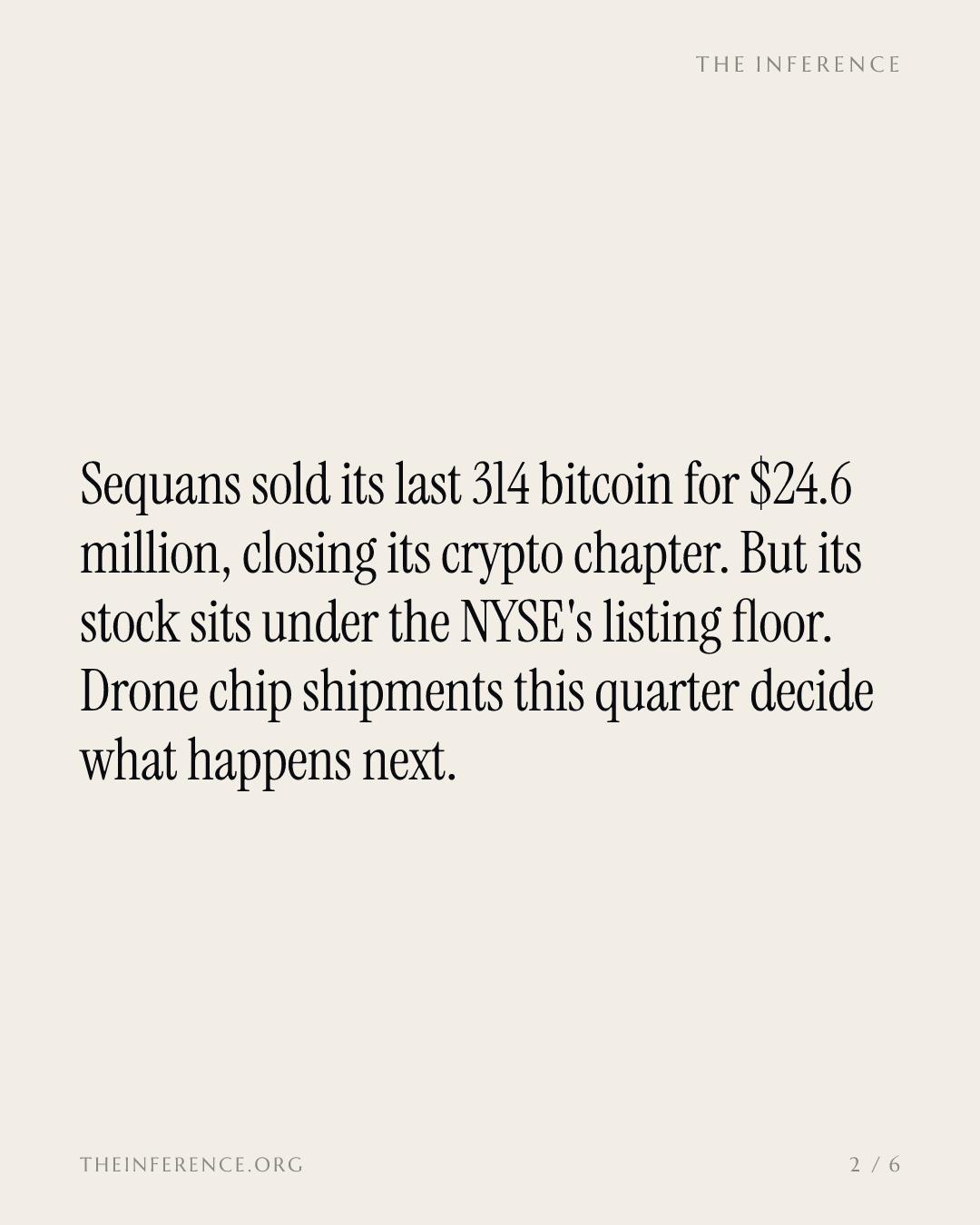
Sequans Communications−1.92% — Sequans Communications, down 1.92 percent as of its last quote has closed its bitcoin chapter. On the November 3 earnings call, the French IoT chipmaker confirmed its final 314 coins went for $24.6 million, completing a treasury exit that began when the coins were bought with a $384 million raise in June 2025 14. The freed capital now rides on one bet: Iris, the company's programmable radio chip, is being pushed from cellular IoT into defense, drone and space, with first production shipments to a drone customer due this quarter 1.
That shipment, not the coin sale, decides whose money moves. The stock ended last week at a $37.5 million market value 2, $12.5 million under the NYSE's $50 million listing floor, and the floor is what turns this quarter's shipments into a binary event for shareholders.
The exit is complete, and the company it keeps is miners
Lookonchain's tally, published today, puts Sequans on a list of 14 public companies that sold 108,247 bitcoin worth about $8.08 billion in 2026 5. The biggest sellers, MARA and Riot, are miners liquidating coins to repay bitcoin-backed loans and fund data centers; Sequans sits in the tail of the same list, having used its unwind to retire $94.5 million of convertible debt 35.
Cash and short-term deposits reached $39.7 million from $21 million in June, and the coins are off the income statement for good 3. The 2026 corporate bitcoin story is companies converting coins into something else, and Sequans converted into a clean balance sheet 3.
What the freed capital rides on
The mechanism is concrete. Iris is a software-defined radio, so a customer with an existing drone platform can swap the radio in and gain anti-jamming frequency agility without redesigning the whole system.
The first drone customer, a design win logged in the second quarter 6, did exactly that: it moved from design win to production in about six months, and orders ship this quarter 4. That is the whole chain in miniature. The chip becomes customer hardware, the hardware becomes a product that resists jamming, and the product becomes revenue in a single quarter.
Leads are not orders yet
Management counts more than 20 defense, drone and space leads worth over $30 million in potential three-year revenue, but says most are still in the engagement phase, with the first design win itself the smaller part of that number 14. The backlog runs into the second half of 2027, the book-to-bill ratio has held above one for three quarters, and fourth-quarter revenue is guided to $9.5 to $11 million 14. The growth is real; what is unproven is whether the RF pipeline converts at the pace the listing clock demands.
Revenue has rebuilt off the 2025 trough, and Q4 guidance keeps the climb going
Revenue has more than tripled off the Q3 2025 trough
- Quarterly revenue
- Estimate
Data
| Quarterly revenue | |
|---|---|
| Q3 '24 | $10.08M |
| Q4 '24 | $11.05M |
| Q1 '25 | $8.05M |
| Q2 '25 | $8.14M |
| Q3 '25 | $3.21M |
| Q4 '25 | $5.84M |
| Q1 '26 | $6.05M |
| Q2 '26 | $7.46M |
| Q3 '26 | $9.09M |
| Q4 '26 guided (estimate) | $10.25M ($9.5–11.0M) |
Ninety days to plan, nine months to cure, and a tape too thin to lift itself
The NYSE notified Sequans on September 14 that it had failed the $50 million market capitalization standard, giving it 90 days to file a compliance plan and nine months to cure 7. On a tape where barely $68,500 traded in a day 2, the market cap will not drift back over the line on its own, and with quarterly cash burn around $5 million the cash cushion buys roughly a year 4. Revenue is the only durable cure short of dilution.
The decision facing holders is close to binary: if Q4 shipments land and the leads start converting, growth is the case that lifts the market cap back over the floor; if they slip, the cure period ends in dilution or delisting. A team that turned a radio capability into shipped, jamming-resistant customer hardware in six months is doing exactly the builder's work that deserves the reward, and it should get the chance to keep its listing. Watch two things this quarter: whether the drone shipments actually go out, and whether the first customer's 2027 orders arrive behind them.
Get Chips by email, free
How AI demand is reshaping chipmakers, memory and the fabs behind them. In our daily email, every weekday.