SK hynix Is Spending Billions to Break Its Own Bottleneck
Kwak Noh-jung is building a $4 billion Indiana plant to relieve the memory shortage that has made SK hynix extraordinarily profitable. The math on that profit changes once the shortage it is funded to fix arrives.
 Vincent JiangSeptember 14, 2026 · 6 min read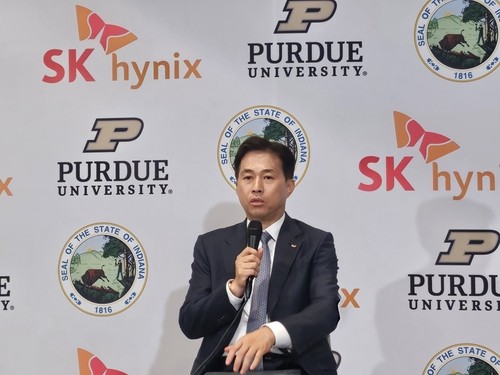
Kwak Noh-jung went to an Indiana gymnasium on August 27 to mark the construction of a memory-packaging plant. His company, SK hynix, plans to spend more than $4 billion there and begin mass production in the second half of 2029. The business is investing to relieve the shortage that has helped make it extraordinarily profitable.1
That is the tension in SKHY. Engineering leadership can last. Scarcity pricing invites the investment that eventually competes it away. Shareholders need to determine how much of today's earnings belongs to each.
SKHY is the Nasdaq-listed American depositary share of SK hynix, whose US trading began in July.2 Each represents one-tenth of a Korean common share, according to Citi's current program record.3 The new listing makes the business more accessible. It does not change the underlying manufacturing economics or remove currency exposure.
The customer pays to keep the processor working
High-bandwidth memory, or HBM, stacks memory beside an AI processor so data can reach it quickly. Its value comes from keeping expensive computing equipment productive. More arithmetic capacity accomplishes little when the processor waits for the information it needs.
Nvidia's July 21 description of Rubin specifies up to 288 gigabytes of HBM4 and 22 terabytes per second of peak memory bandwidth per GPU.4 Those are vendor specifications, not independently measured application results. The commercial point is that model weights and stored context must move quickly enough to sustain useful output. Memory is part of the machine's earning capacity.
This gives a capable supplier bargaining power. The customer needs qualified parts, predictable delivery and power consumption that fits the system. A cheaper chip that delays an accelerator launch can become an expensive purchasing decision. SK hynix's defensible advantage lies in consistently delivering a working memory subsystem at scale, not simply in owning capacity during a shortage.
The boom reaches beyond HBM
The latest industry data complicates the familiar AI-memory story. On September 7, TrendForce estimated that second-quarter DRAM industry revenue rose 59.5% sequentially, primarily because conventional memory prices increased sharply. Bit shipments grew only modestly.5 Revenue was accelerating much faster than the physical quantity sold.
Its June research explains an unusual consequence. HBM prices were generally negotiated annually, while conventional memory repriced more quickly. TrendForce estimated that a common high-capacity server-memory product overtook HBM in revenue and profitability per wafer during the first quarter.6 These are modeled industry economics, not disclosed SK hynix product margins.
An advanced product can therefore have stronger strategic importance while a less specialized product captures more of the immediate shortage. Investors who attribute every additional won of profit to HBM's technical moat risk valuing a temporary pricing benefit as permanent differentiation. The right question is how much profit remains when conventional memory prices stop rising so quickly.
The lead has to be won again
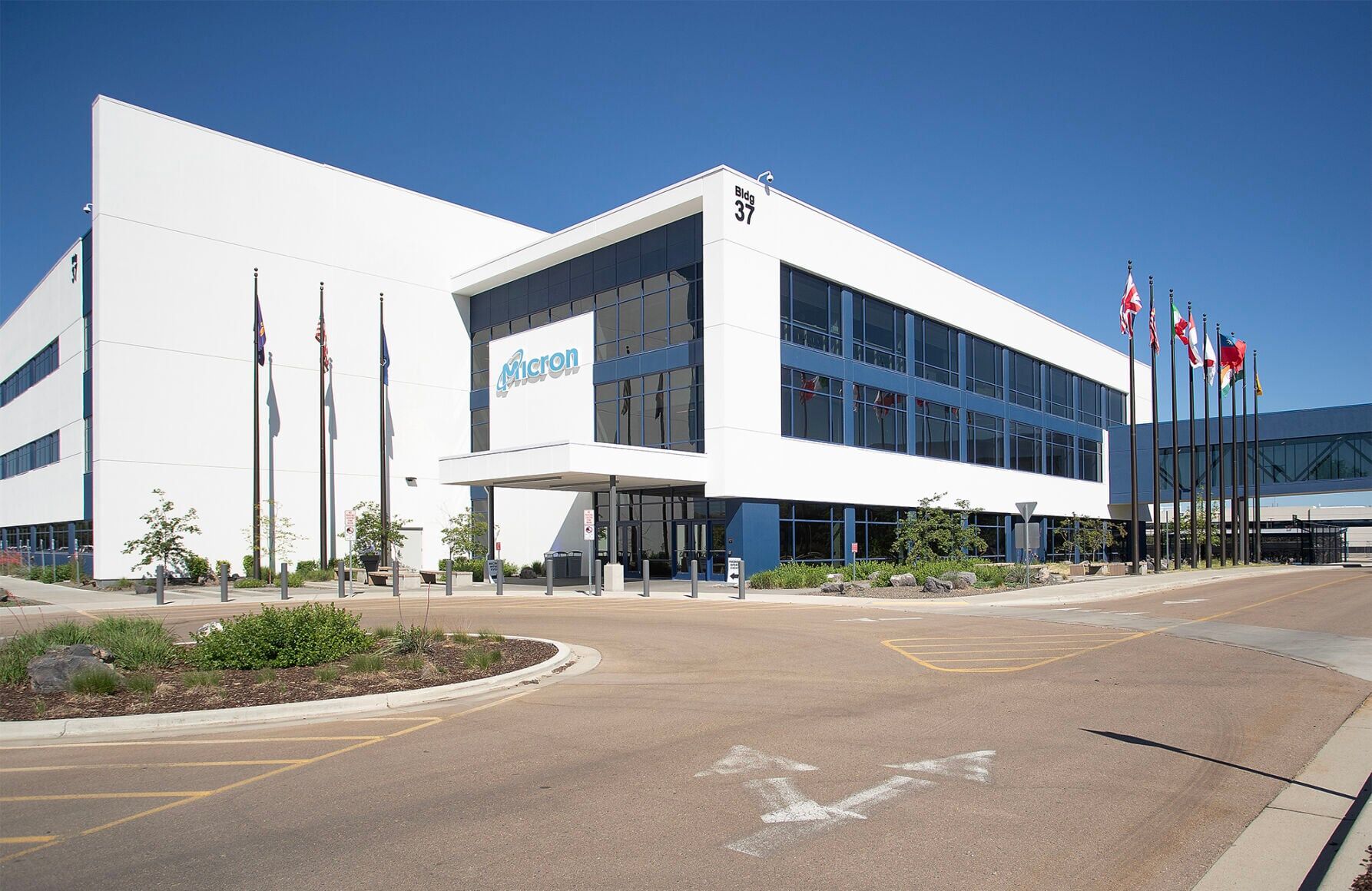
SK hynix reported that HBM4 mass shipments began in the second quarter.7 Competitors have commercial evidence too: Samsung Electronics' July 30 results described expanding HBM4 sales,8 while Micron said on June 24 that it had already shipped more than $1 billion of HBM4 revenue.9 These are company reports, but they establish that the competitive discussion has moved beyond laboratory samples.
Customer relationships are also being contested. A March agreement published by AMD aligns Samsung Electronics as the primary HBM4 supplier for AMD's MI455X accelerator.10 It is a memorandum of understanding, without disclosed binding volumes or exclusivity. Nevertheless, a larger AI market does not automatically become a larger SK hynix order book.
The implication is not that SK hynix has lost its advantage. Each product generation creates another test of manufacturing yields, power efficiency and customer qualification. Leadership deserves a premium when it repeatedly produces better economics. A historical lead alone cannot establish the size or duration of that premium.
Today's shortage is financing tomorrow's supply
Indiana illustrates both the opportunity and the delay. Wafers manufactured in Korea will undergo packaging and testing in the new US facility. Washington's December 2024 award provided for up to $458 million in direct CHIPS funding, disbursed against milestones.11 Government support can improve project economics; it cannot guarantee profitable customer demand when the plant opens.1
The larger commitment is in Korea. On August 7, SK hynix approved 35.2 trillion won for Yongin Y2 and 19.1 trillion for Cheongju M17.12 Those are multiyear projects, not this year's spending. The company says it will install equipment in stages according to demand. That flexibility matters because a building's capacity and commercially usable output arrive at different times.
Nor does additional HBM solve every constraint. TSMC chief C.C. Wei said in July that tight packaging capacity was limiting customers' growth.13 Memory suppliers depend on the rest of the accelerator supply chain converting their output into deployed systems. More memory and more AI revenue are connected, but the connection has other factories in it.
Normalize the earnings before calling the shares cheap
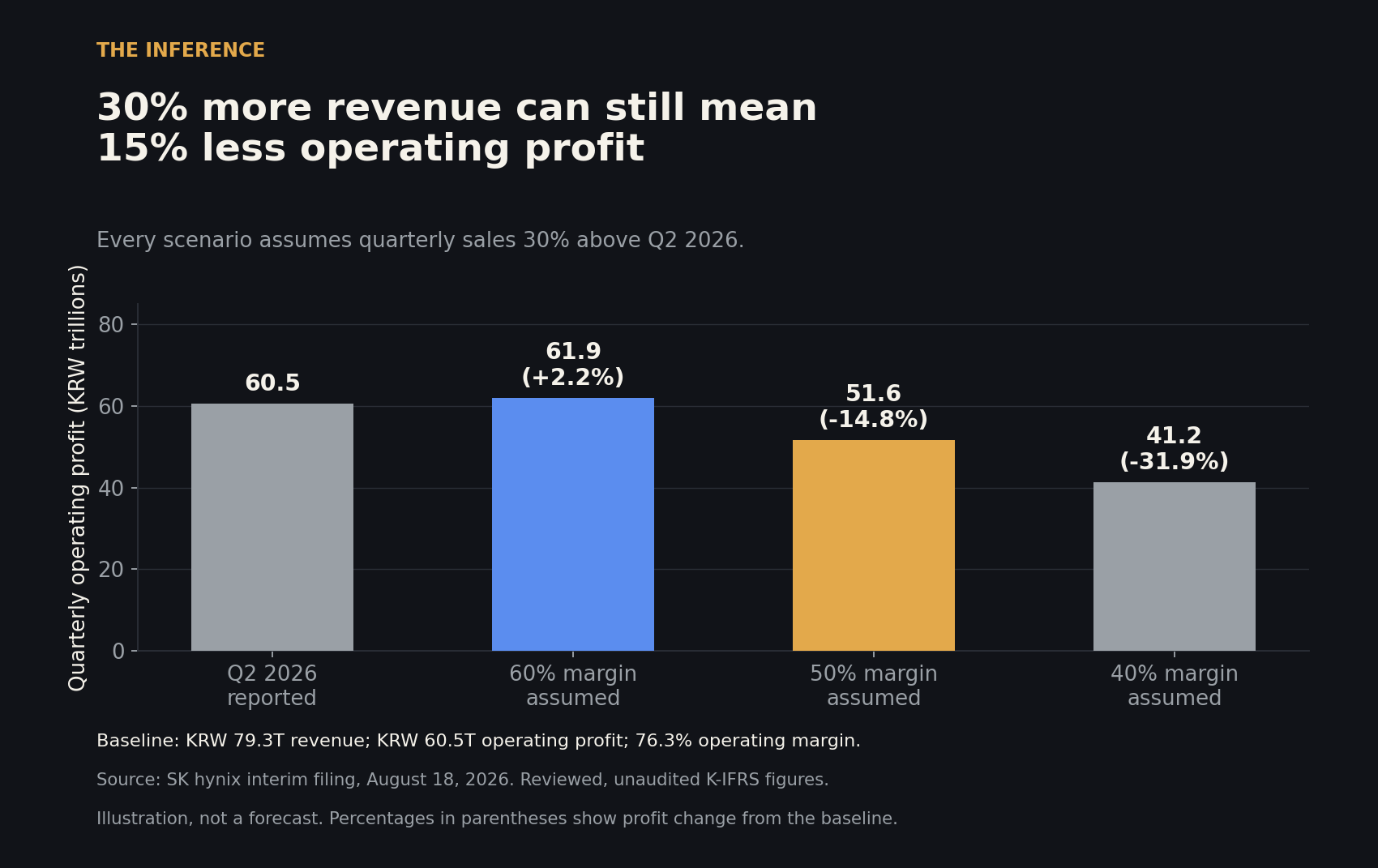
SK hynix's second-quarter revenue was 79.3 trillion won, with 60.5 trillion of operating profit, approximately a 76% margin. Its reported 93.9 trillion won of net income needs separate treatment: the interim filing records 53.2 trillion in financial-instrument valuation gains and 10.0 trillion in dividend income for the quarter.14 Those amounts are not evidence of recurring profit from selling memory. The statements were reviewed by independent accountants but remain unaudited.
Even operating profit requires a cycle adjustment. Suppose quarterly revenue eventually grows 30% above the second-quarter level, while the operating margin settles at 50%. Operating profit would be about 51.6 trillion won, approximately 15% below the starting point. At a 60% margin it would be only about 2% higher. These are illustrative assumptions, not forecasts of a particular quarter.
A memory company's moat is the profit it can keep after supply catches up.
This arithmetic does not establish that SKHY is overpriced. It establishes what a valuation must survive. A low multiple of unusually high earnings can become an ordinary multiple without the share price moving. A credible investment case needs a sustainable earnings denominator before it needs a target price.
Cash generation is substantial too. First-half operating cash flow less cash purchases of property, equipment and intangible assets was 72.7 trillion won, calculated from the filing, before other investing and financing flows. Operating cash flow included 14.0 trillion won of dividends received.14 The sources matter when deciding how much can recur to fund factories and buybacks.
The strongest bull case is in the contracts
The serious counterargument is that customers may help absorb the investment risk. SK hynix says it has long-term agreements with around ten customers. Its July earnings call described pricing mechanisms designed to address volatility and deposits supporting contract fulfillment, with terms varying by customer.7,15 These are practical protections against the risk of building for demand that disappears.
Micron offers a more detailed example: its strategic agreements include binding volume commitments, and major contracts generally have price floors and ceilings.9 Identical protections cannot be assumed at SK hynix. They do show how customers' need for reliable supply could make future memory earnings more resilient.
There is also a difference between approving capacity and flooding the market. Complex plants take years, equipment can be installed incrementally, and demand can keep growing while factories are built. If SK hynix maintains its technical edge and obtains meaningful customer commitments, today's profits can finance a more durable business. That possibility weakens a simple boom-and-bust prediction; it does not make today's margin permanent.
Watch where the cash goes next
On August 19, SK hynix approved a 40 trillion won share repurchase and cancellation program and proposed returning more than half of cumulative 2025-2027 free cash flow.16 The announced buyback was roughly 3.3% of issued shares at the reference price. Execution and purchase price will determine the benefit to each remaining share.
The next results should clarify additional shareholder returns, which management said it would detail with third-quarter earnings. Put those decisions beside actual capital spending, cash generation and contract protections. The Indiana plant will take years to prove its economics. Capital allocation starts showing management's judgment sooner.
Watch how much of the shortage's profit reaches each remaining share.
How this brief was made
01Gathered & sourced322 channels · 1,394 articles▾
Agents swept 322 channels and ingested 1,394 articles, then de-duplicated and ranked them for signal.
02Verified & cross-validated16 claims · 21 data feeds▾
Every one of 16 load-bearing claims was checked against primary sources, with 21 live data feeds reconciling the figures and charts.
- 1SK hynix, Indiana groundbreaking announcement and production plan, Aug 28, 2026 (company plan: spending and production dates are company-stated, not independently verified; Korea supplies wafers for US packaging and testing).
- 2Nasdaq, SK hynix Nasdaq listing report, Jul 10, 2026 (primary exchange record of the US listing; does not establish ADR/Korean-share price parity).
- 3Citi, SK hynix depositary receipt program directory, checked Sep 14, 2026 (primary depositary record of the ADR's ratio and identity).
- 4NVIDIA, Rubin GPU architecture blog post, Jul 21, 2026 (vendor specification, not independently measured application results).
- 5TrendForce, Q2 2026 DRAM industry research, Sep 7, 2026 (original industry estimates of pricing, revenue and shipment growth; total DRAM share is not HBM share).
- 6TrendForce, HBM per-wafer economics research, Jun 2, 2026 (modeled industry estimates, not disclosed SK hynix product margins).
- 7SK hynix, Q2 2026 business results, Jul 29, 2026 (company-reported preliminary K-IFRS results, HBM4 shipment statement and contract-mechanism description).
- 8Samsung Electronics, Q2 2026 results, Jul 30, 2026 (competitor's company report of HBM4 sales progress).
- 9Micron, fiscal Q3 2026 prepared remarks, Jun 24, 2026 (competitor's company evidence of HBM4 revenue and contract price-floor/ceiling terms; fiscal periods differ from SK hynix's calendar quarter).
- 10AMD, Samsung supply agreement announcement, Mar 18, 2026 (joint announcement with Samsung; a memorandum of understanding, not a disclosed binding volume or exclusivity commitment).
- 11US Department of Commerce, CHIPS incentive award to SK hynix, Dec 19, 2024 (historical award with milestone-based disbursement; does not establish that the full amount has been received).
- 12SK hynix, Yongin Y2 and Cheongju M17 investment announcement, Aug 7, 2026 (company-approved multiyear capital authorization, staged installation).
- 13TSMC, Q2 2026 earnings call transcript, Jul 16, 2026 (management identifying packaging capacity as a constraint on customers, not evidence of falling memory demand).
- 14SK hynix, interim filing with the SEC, income statement, cash-flow statement and note 24, filed Aug 18, 2026 (primary financial statements; independently reviewed but unaudited).
- 15SK hynix, Q2 2026 earnings-call transcript, Jul 29, 2026, reproduced by Stock Analysis (management's description of contractual pricing mechanisms and deposits; individual terms not disclosed).
- 16SK hynix, share repurchase and retirement announcement, Aug 19, 2026 (company-approved buyback program and proposed return policy; completion not yet verified).
03Reviewed & edited2 human editors▾
2 editors read the draft against the evidence, tuned the framing, and signed off before it shipped.
Confidential tips
Know something about this story? We protect our sources. Reach the editor directly, or read our guide to sharing securely.
Deepdive
AI-generated from this story and its cited sources. Not investment advice.