Smartphone shipments fell 20%, the weakest since 2012, while Micron's mobile memory margin hit 88%
Counterpoint Research's first third-quarter count shows shipments down 20 percent, the weakest since 2012, as AI data centers cornered the memory supply. Micron's phone unit earned its highest margin in the same quarter, and its take-or-pay contracts keep the bill on the handset side through 2030.
 Richard Tang · 3 min read
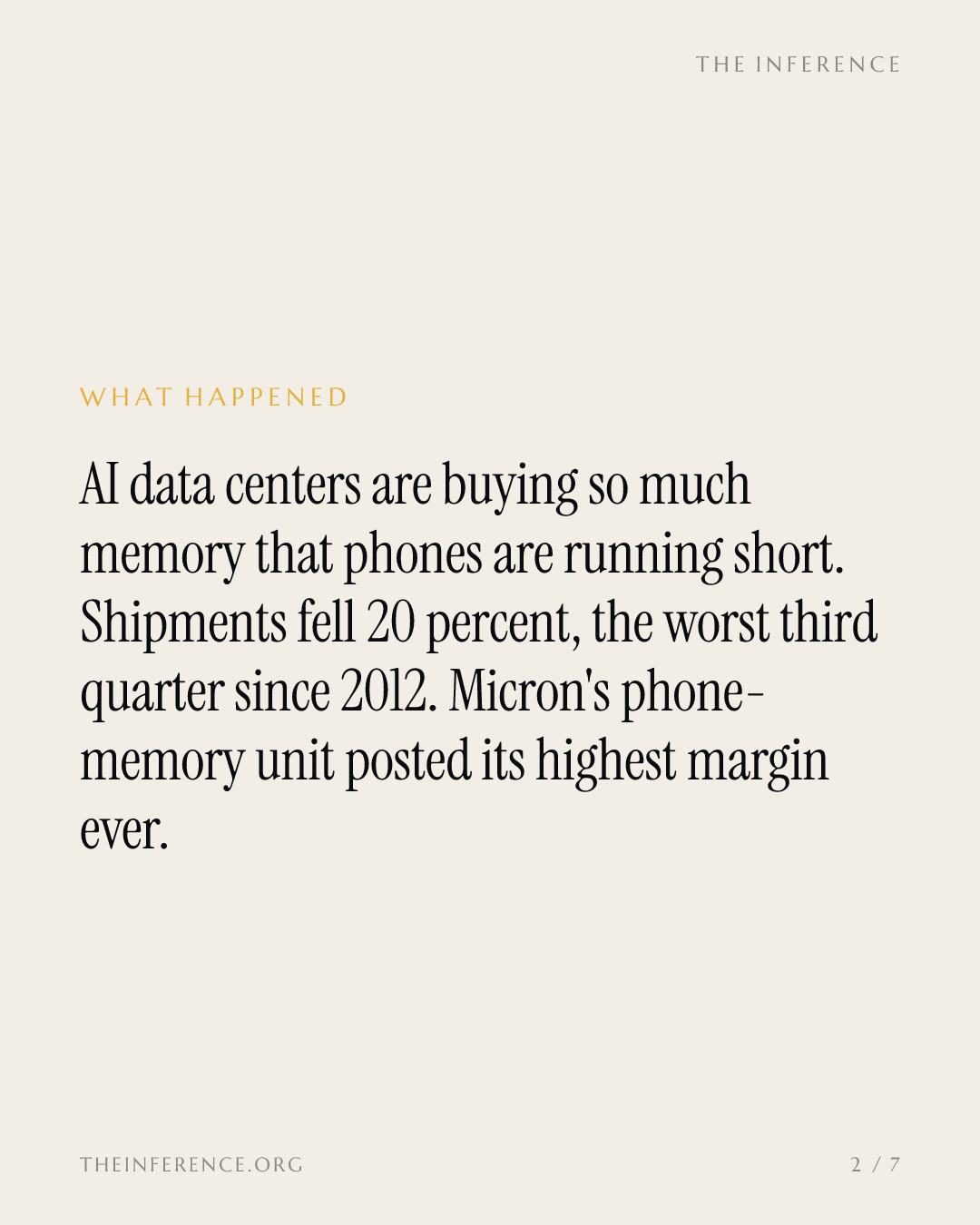
The first hard count of what AI's memory bill is doing to phones arrived this week. Preliminary estimates from Counterpoint Research, the market-research firm, put global smartphone shipments down 20 percent year over year in the third quarter, the weakest third quarter since 2012 1. Its price tally, relayed through a market commentary, has retail prices up 20 percent this year 2. The AI data center boom has started eating its own customer base, and the damage is now measured rather than forecast.
The handset side took the hit in its own numbers
Qualcomm+3.32% — Qualcomm, up 3.32 percent today, whose chips run most premium Android phones, said fiscal third-quarter handset revenue fell 20 percent to $5.09 billion on a "challenging memory and supply environment" 2. Arm+2.59% — Arm, up 2.59 percent today, whose designs sit inside most smartphones, pulled royalty growth back toward the high teens on handset softness 2. Apple−0.31% — Apple, down 0.31 percent today told suppliers to cut October iPhone 18 Pro component orders by at least 15 percent and pushed the base iPhone 18 into early 2027 partly on memory costs 3. A spokesperson said the company had "never seen a component price increase this much, this quickly" 3.
Micron wins twice
Micron+1.66% — Micron, up 1.66 percent today, the largest US memory maker, printed the other side of the same ledger. Its Mobile and Client unit, which sells memory into phones and PCs, earned an 88 percent operating margin in the September quarter, the highest of its four businesses 4, while the phones it feeds shipped a fifth fewer units 1. Price rose faster than volume fell, and the difference is profit.
Micron's most profitable unit sells into the phones that stopped selling
Data
| Value | |
|---|---|
| Mobile and Client | 88% |
| Core Data Center | 85% |
| Automotive and Embedded | 79% |
| Cloud Memory | 76% |
The boom is also contractually locked. Micron has signed 26 take-or-pay agreements, which bind customers to pay for contracted volumes whether or not they take them, covering more than a third of expected revenue through 2030 and about $150 billion of minimum backlog at floor prices 5. Most of that revenue is priced inside bands with floors and ceilings, so the contracts also cap how far memory prices can rise 5. Chief executive Sanjay Mehrotra says supply stays "much tighter" through fiscal 2028 6.
Micron's quarterly revenue went vertical as phone shipments went the other way
Data
| Quarterly revenue | |
|---|---|
| Q4 '24 | $8.71B |
| Q1 '25 | $8.05B |
| Q2 '25 | $9.3B |
| Q3 '25 | $11.32B |
| Q4 '25 | $13.64B |
| Q1 '26 | $23.86B |
| Q2 '26 | $41.46B |
| Q3 '26 | $54.23B |
The bottleneck has moved to memory allocation
Qualcomm's answer is a phone that thinks. Chief executive Cristiano Amon says phones are entering an agentic era, with AI agents running in the background all day and up to a million tokens processed on the device daily 7. A Qualcomm remark relayed on social media puts the newest Snapdragon, Qualcomm's flagship chip line, at running a 30-billion-parameter model 9. By 2028, Amon says, companies at the forefront of AI want a 100-billion-parameter model running in a phone "kind of all the time" 8.
The phone's memory budget now decides how much AI it can run
A model that size is, before anything else, a memory bill, and that memory has flowed to data centers. IDC's February forecast had AI data center buildouts absorbing memory supply as chipmakers prioritized higher-margin parts 2. What a phone's memory budget caps is how large a model can sit resident. Qualcomm's answer couples memory and accelerators the way data centers do 7. Micron's moves the cache a model rereads into flash, and its newest data-center SSDs already ship for that job 4.
Apple reports on November 2 and Qualcomm's fiscal fourth quarter follows, on guidance of $9.7–10.5 billion 23. Those two prints will price how much of the handset annuity the memory bill consumes. Micron's guidance offers no relief in between: Mehrotra expects fiscal 2027 to be even stronger than fiscal 2026 4.
Deepdive
AI-generated from this story and its cited sources. Not investment advice.