SMIC paid $5.58B for the rest of its northern fab just as Beijing reopened the door to Nvidia
SMIC paid $5.58B for the 49% of SMIC North it did not own, at full utilization and at the end of the worst quarter Chinese AI hardware has had. The same week, Beijing started counting how many Nvidia chips its biggest buyers want, and that meter can reverse the demand the deal is priced on.
 Richard Tang · 3 min read
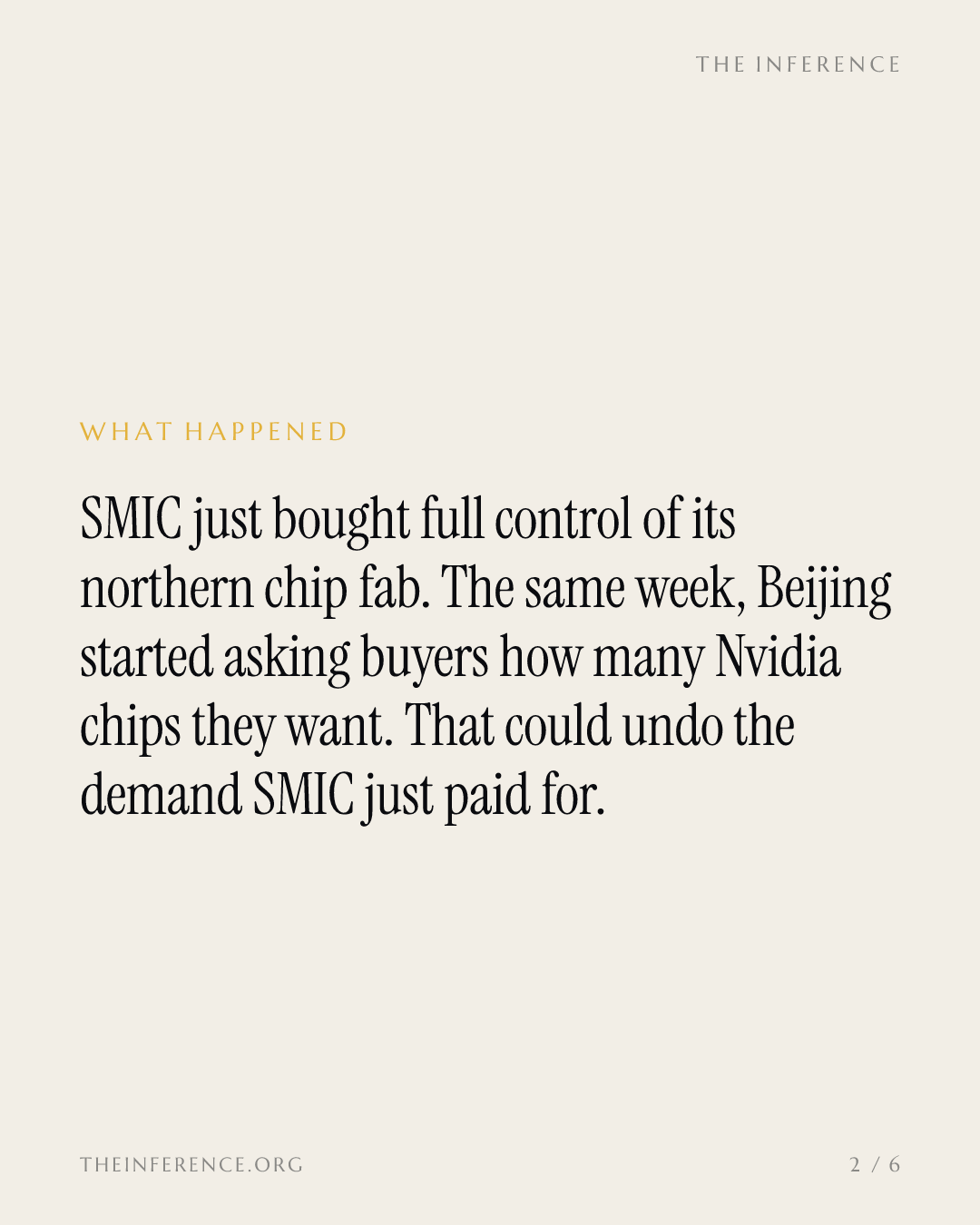
SMIC has completed the purchase of the 49% of SMIC North it did not own, paying US$5.58B in one of the largest A-share deals of the year and taking full control of the northern manufacturing unit 1. The buyout closed into a quarter that punished exactly this trade: the Star 50 and ChiNext indexes, the benchmarks most loaded with Chinese chip and AI hardware names, have fallen around 30% since the end of June, giving back most of a 75% three-month rally 4. The exiting minority got a fixed price at the top of that cycle. SMIC's remaining shareholders now carry the integration risk and the timing.
The operating case for the deal is real
SMIC's numbers justify consolidation on the merits. Q2 2026 revenue crossed $3B for the first time at $3.006B, up 20.0% from Q1, with gross margin at 25.3% and capacity utilization at 93.7% 2. Utilization near full is the argument for buying capacity rather than building it: a buyer inherits licences, clients and ramped fabs instead of waiting out construction, which is why Chinese industrial buyers are favoring horizontal mergers this year under loosened review rules 1. Q3 guidance calls for revenue up 2 to 4% sequentially and gross margin of 26 to 28% 2. Meeting that band at 93.7% utilization most plausibly runs through price, since little spare capacity remains to sell more volume, though SMIC has not said how it gets there.
The demand meter is the risk the wires missed
The same week the buyout completed, China's Ministry of Industry and Information Technology asked Alibaba, ByteDance and others how many of Nvidia's RTX Pro 5500 workstation chips they planned to buy and for what, which The Information read as groundwork for approval; ByteDance alone is reportedly considering about a million units, with Nvidia planning shipments of roughly 500,000 per quarter from late December 5. The chip runs trained models for inference but is not suited to training, so it competes directly with the domestic inference silicon SMIC's fabs are being consolidated to supply, including Huawei's Ascend, which SMIC manufactures 5. The market repriced that risk on 28 September: SMIC fell 3.7%, Hua Hong nearly 5%, Moore Threads 6.3% 3.
One MIIT report knocked the whole Chinese chip sector on 28 September
Data
| Value | |
|---|---|
| SMIC | -3.7% |
| Hua Hong | ≈ -5% |
| Moore Threads | -6.3% |
| Cambricon | -5.7% |
| NAURA | -3.4% |
| CXMT | -4% |
Who pays, who benefits
The beneficiaries are clear: the cashed-out minority, and SMIC's margins if any price increases stick. The risk sits with shareholders who paid roughly $6.1B for a fab business whose demand can be re-metered by one ministry memo, at the end of the worst quarter Chinese AI hardware has recorded 1234. If Beijing approves the Nvidia sales at the scale the questionnaire implies, the near-full utilization behind the margin guide meets a buyer with alternatives, and the arithmetic that supports the guide weakens 25. The next SMIC margin print, due with Q3 results around early November on the company's quarterly reporting cadence, is where this resolves.

More about NVIDIA
NVDA · Fiscal Q2 2027Revenue rose 106% to $96.2B, 92.5% of it from Data Center, “driven by the ramp of our Blackwell Ultra infrastructure”. Gains on equity stakes of $7.8B lifted net income to $59.7B.
Show as a table
| Line | Value |
|---|---|
| Revenue | $96.2B |
| Gross margin | 75.0% |
| Operating margin | 66.2% |
| Net income | $59.7B |
| Hyperscale | $48.7B |
| AI clouds & enterprise | $40.3B |
| Data Center | $89.0B |
| Edge Computing | $7.2B |
| Gross profit | $72.1B |
| Cost of revenue | $24.1B |
| Other income | $7.8B |
| Operating income | $63.7B |
| Operating expenses | $8.4B |
| Tax | $11.8B |
| R&D | $7.1B |
| SG&A | $1.4B |
Deepdive
AI-generated from this story and its cited sources. Not investment advice.